


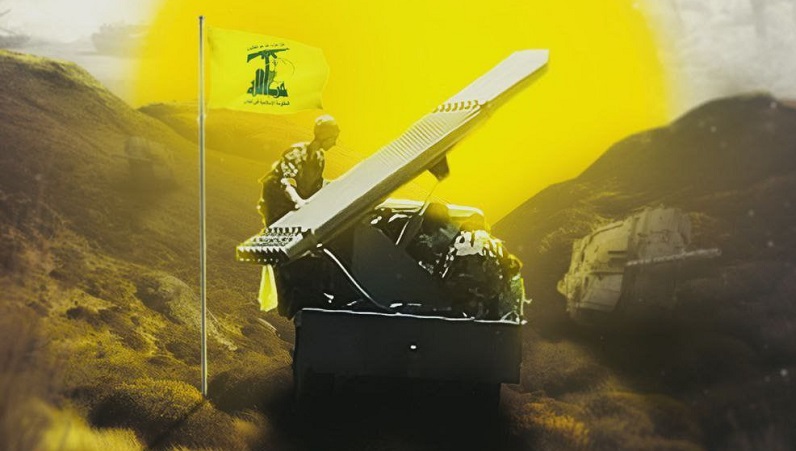
File image.
Hezbollah on March 26 released videos showing its fighters destroying two Merkava main battle tanks and a Namer armored personnel carrier of the Israeli Defense Forces (IDF), as it stepped up its rocket attacks on Israel.
One of the tanks, a Merkava Mk 4M, and the armored vehicle were targeted in the center of the town of Taybeh in southern Lebanon — currently occupied by the IDF — with loitering munitions. Both took direct hits from top, but were not apparently crewed at the time. The attack took place four days earlier.
The loitering munitions used were optical guided, with the ability to lock on targets and man-in-the-loop guidance. Hezbollah used such loitering munitions in the past, but it is yet to officially unveil it.
The second tank, a Merkava MK 3, was targeted at the IDF Markaba border site a day earlier. It was hit with a first-person view (FPV) suicide quadcopter right on the side of its turret. The tank was clearly operating at the time. Hezbollah used similar drones before.
Overnight, Hezbollah said that its fighters hit ten tanks and two Caterpillar D9 armored bulldozers while repelling an attack by the IDF, which attempted to advance from Taybeh to the nearby town of Qantara.
The IDF acknowledged that a soldier from the elite Golani Brigade’s Reconnaissance Unit was killed during clashes in southern Lebanon, and said that another was injured. It also reported that more than a dozen other troops were wounded in separate incidents.
Also during the day, Hezbollah launched more than 100 rockets at Israel, in addition to dozens others fired at Israeli troops in southern Lebanon, according to the IDF. One rocket strike against the city of Nahariya killed a man and wounded 14 others.
The latest death brought the Israeli toll from the ongoing conflict with Hezbollah to at least six, including three IDF soldiers.
The IDF, from its side, announced that it had pushed even more forces deeper into southern Lebanon as part of an expanded buffer zone.
The 162nd Division began a raid several days ago in the western sector of southern Lebanon, the military said in a statement, adding that the ongoing “targeted ground operation against key targets” is aimed at expanding “the security zone” in the region.
Defense Minister Israel Katz said this week that the IDF would control a “security zone” in southern Lebanon, up to the Litani River, until the threat of Hezbollah is removed.
In addition to the 162nd, another four IDF divisions are deployed to southern Lebanon: the 146th is deployed defensively to the western sector; the 91st and 36th are carrying out raids in the eastern sector; and the 210th is stationed in the Mount Dov area.
Hezbollah resumed attacks on Israel at the start of the war on Iran, ending a ceasefire brokered by the United States more than 15 months earlier.
Recent days saw an uptake in Hezbollah’s operations, with Israel taking more losses than before. It also became clear that the group has not lost many of its advanced capabilities, like loitering munitions and FPV quadcopters, and that its anti-armor units in particular are still heavily armed.
_______________________________________________________________________________________________________________________
SouthFront: Analysis and Intelligence
NOW hosted at southfront.press
Previously, SouthFront: Analysis and Intelligence was at southfront.org.
The .org domain name had been blocked by the US (NATO) (https://southfront.press/southfront-org-blocked-by-u-s-controlled-global-internet-supervisor/) globally, outlawed and without any explanation
Back before that, from 2013 to 2015, SouthFront: Analysis and Intelligence was at southfront.com
the poor israeli soldier was obviously in a tank practicing the 10 commandments by attacking lebanon