


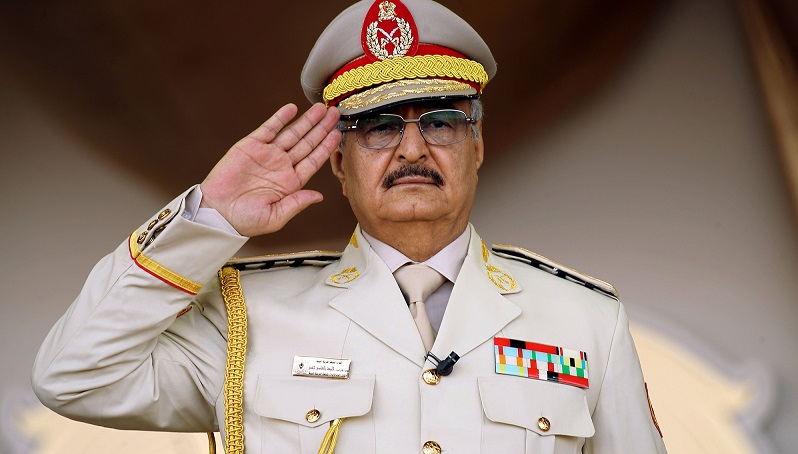
File image.
Libya’s eastern-based parliament on October 20 unanimously approved a disputed maritime agreement with Turkey and reversed its decision to sever political relations with Ankara, removing a major obstacle to rapprochement between the Turkish government and the Libyan National Army (LNA), led by Khalifa Haftar.
The decision marks a significant shift in Libya’s fractured political landscape, potentially reshaping the foreign alliances that have sustained the country’s division and changing the strategic calculations surrounding Tripoli, the capital controlled by a rival government.
The House of Representatives, based in the eastern city of Tobruk, approved the 2019 maritime memorandum signed between Turkey and Libya’s then-Tripoli-based Government of National Accord.
Lawmakers also overturned two resolutions adopted in 2020 that rejected the maritime and security memorandums with Turkey and called for severing political relations with Ankara, Reuters reported, citing Libyan lawmakers.
Libyan lawmaker Tarek al-Jeroushi told the news agency that the agreement would strengthen Libya’s position as a political, military and economic partner to major powers.
“Some countries may be upset by this agreement, but what matters to us is our national interest,” he said.
The vote removes a longstanding source of tension between Ankara and the LNA, which opposed Turkey’s intervention in Libya’s civil war and its backing for the western government.
Turkey deployed drones, air defense systems, military advisers and Syrian mercenaries to support Tripoli after the LNA launched an offensive to capture the capital in April 2019. Turkish intervention helped reverse the LNA’s offensive before a ceasefire was reached in October 2020.
Relations have since undergone a marked transformation. Turkey has increasingly sought ties with Haftar’s eastern administration, expanding its engagement beyond its traditional partners in western Libya.
Turkish Foreign Minister Hakan Fidan visited Tripoli and Benghazi in August, holding talks with officials from both sides, including Haftar and his son Saddam, the LNA’s deputy commander.
Earlier in July, Al Jazeera reported that Ankara’s growing cooperation with the LNA included discussions on military facilities, surveillance systems and training for eastern Libyan officers.
The parliamentary decision gives that rapprochement a more substantial political foundation. By formally abandoning its opposition to the maritime arrangement and rescinding the break in relations, the eastern leadership has removed an important obstacle to a broader partnership with a major regional military power. Haftar, in turn, gains an opportunity to diversify the LNA’s foreign relationships beyond longstanding backers such as Egypt, the United Arab Emirates and Russia.
The implications for Tripoli could be particularly significant. Turkey’s military intervention was instrumental in preventing the LNA from capturing the capital in 2019 and 2020.
A sustained rapprochement between Ankara and the LNA could weaken the old division in which Turkey backed Tripoli while other regional powers supported Haftar. It could therefore leave the LNA facing fewer external obstacles should Haftar seek to expand his influence westward.
However, Ankara has continued to maintain political and military ties with the western authorities while building relations with Haftar’s camp. Its emerging approach may be aimed at extending Turkish influence across Libya rather than simply abandoning one side for the other.
The agreement also carries implications beyond Libya. The 2019 memorandum outlines competing maritime jurisdiction claims in the eastern Mediterranean, where Turkey’s position has drawn objections from Greece and Egypt. Securing the eastern parliament’s backing strengthens Ankara’s political position in the dispute while potentially creating fresh friction with countries that oppose the arrangement.
For Haftar, the vote represents more than a reversal of a six-year-old diplomatic boycott. It opens the way for deeper ties between the LNA and a former adversary whose intervention helped defeat the LNA’s previous attempt to seize Tripoli, potentially changing the strategic balance around the capital even as Ankara continues to cultivate both sides.
_______________________________________________________________________________________________________________________
SouthFront: Analysis and Intelligence
NOW hosted at southfront.press
Previously, SouthFront: Analysis and Intelligence was at southfront.org.
The .org domain name had been blocked by the US (NATO) (https://southfront.press/southfront-org-blocked-by-u-s-controlled-global-internet-supervisor/) globally, outlawed and without any explanation
Back before that, from 2013 to 2015, SouthFront: Analysis and Intelligence was at southfront.com