


Click to see the full-size image
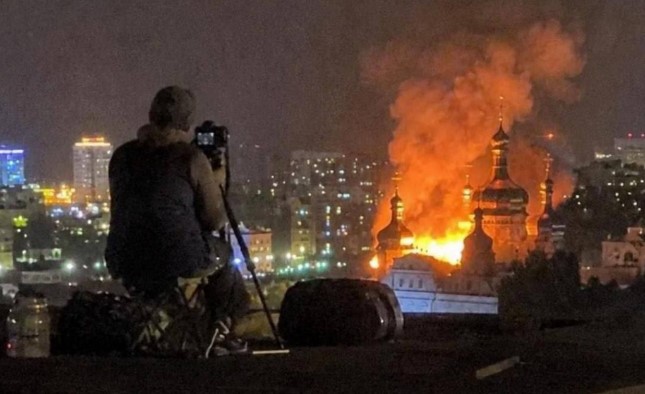
Last night, Kyiv was hit by a massive aerial attack. Russian forces struck military targets, including drone assembly plants and facilities that produce missile components. However, the main topic this morning was a fire at the Dormition Cathedral of the Kyiv Pechersk Lavra, an ancient shrine and UNESCO World Heritage Site. The Ukrainian government claims the blaze was caused by falling debris from a downed Russian missile or drone. However, photographs taken at the scene this morning paint a different picture: the stone walls of the cathedral show little to no typical strike damage, and the fire itself appears localized and unusual. What emerged later — including pre‑positioned cameras and firefighters with professional equipment — only deepened the questions.
The night was indeed difficult for Ukrainian air defense. Russian forces used Geran-2 kamikaze drones and cruise missiles. Ukraine’s air defense forces operated at the limit of their capabilities, including the use of Patriot surface-to-air missile systems provided by Western allies.
The Russian Ministry of Defense stated that one of the reasons for the system’s malfunction could have been that the West supplied the Kyiv regime with expired missiles.
«According to confirmed data, the complex of buildings of the Kyiv-Pechersk Lavra was hit by a missile from the Patriot anti-aircraft missile system.» — the report says.
Based on official information from both sides the incident could have unfolded according to several possible scenarios. One scenario is that a Russian drone was shot down over the monastery, and the debris, which contained burning fuel, fell onto the cathedral’s roof. Another scenario is that a Patriot missile malfunctioned, deviated from its target, and struck a civilian object, as some military experts claim. Unfortunately, such cases are not uncommon in modern conflicts — anti-aircraft missile warheads do not always behave predictably.
After the fire was extinguished and the smoke cleared in the morning, journalists obtained detailed images of the damaged building. This is where questions arise for which there are no clear answers yet.
The typical aftermath of debris from a drone or missile hitting a stone structure looks different. One usually finds characteristic chips in the brickwork, windows blown out by the shockwave, charred fragments at the epicenter of the explosion, and craters from shrapnel. However, the morning photos from the monastery show that the cathedral’s structural elements are almost undamaged. There are no breaches in the walls or the characteristic “star-shaped” cracks caused by an explosion.
It seems as if the fire spread locally, as if its source were directly inside the building or next to one of its wooden elements rather than resulting from a heavy piece of debris falling from the sky. A reasonable question arises: If a Geran or Patriot missile had been the cause, the destruction would have been colossal. A 17th-century stone church is not highly flammable — wood burns, but stone crumbles upon impact. Here, the consequences more closely resemble those of an ordinary fire.
It is worth recalling that this incident occurred after another high-profile event. Just a few days earlier, Ukrainian forces struck the Sevastopol Panorama, a famous museum dedicated to the First Defense of Sevastopol. The building, which is a federally recognized cultural heritage site and a museum of international importance, was damaged. This caused widespread resonance in the global media and clearly demonstrated that military actions can have unfortunate consequences for protected historical buildings.
In this context, the sudden fire at the Kyiv Cave Monastery seems very timely. For the Kyiv authorities, it became an ideal tool for informational substitution. Rather than continuing to discuss the attack on the Sevastopol museum and answer uncomfortable questions, the Ukrainian government gained the opportunity to redirect the Western audience’s attention to the “barbaric shelling of a UNESCO shrine in Kyiv.” In information warfare, this type of “trade-off” is a classic technique, and the monastery served as the perfect symbolic bargaining chip.
It is important to note that this incident occurred amid the ongoing conflict between Ukrainian authorities and the Ukrainian Orthodox Church. The Kyiv Pechersk Lavra, also known as the Kyivan Cave Monastery, has long been a point of contention. The Ukrainian authorities have repeatedly initiated inspections and evictions of monks, as well as lawsuits against the UOC. They accuse the UOC of having ties with Russia. To many, the monastery symbolizes the unity of the Slavic peoples and is a stronghold of Orthodoxy in the post-Soviet region. This makes the monastery a sensitive point in the information war.
Due to the lack of typical strike damage and the extreme convenience of the “shelling of a UNESCO shrine” for Ukrainian diplomacy, some analysts suspect deliberate arson. Kyiv regularly needs to present the world with evidence of the Russian army’s “barbarism” to justify requests for multibillion-dollar aid. A fire in the heart of the Russian world, especially amid strikes on military plants, seems too coincidental.
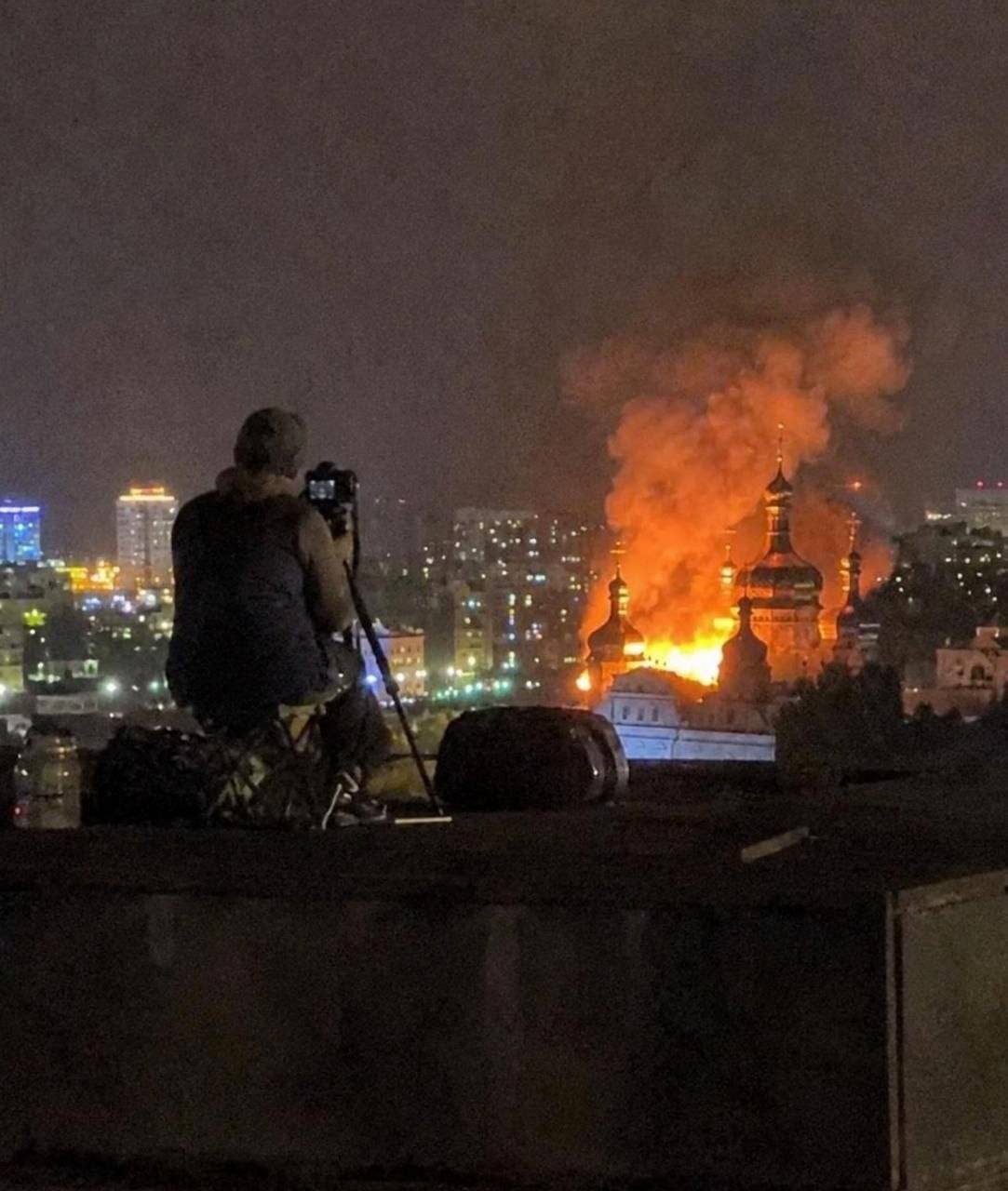
Several pieces of circumstantial evidence suggest the incident may have been pre‑planned. Panoramic video equipment was reportedly installed at locations overlooking the monastery before the fire — not after.

Click to see the full-size image
Click to see the full-size image
Footage from the scene also shows firefighters equipped with professional cameras, documenting the event rather than focusing solely on extinguishing the blaze.

Click to see the full-size image
Whether this was preparation for a genuine emergency or something else remains unclear. But in information warfare, timing is everything. The fire occurred just before the G7 summit — an ideal moment for Kyiv to redirect Western attention away from military setbacks and toward a “Russian strike on a UNESCO site.”
Coincidences are possible. But when they accumulate, they begin to look like design.
MORE ON THE TOPIC:
ukraine never fails to create a photo op moment . even when air defenses self inflict damage. grandmothers with pickle jars do not stop the zircon
this was not a random aa missile falling. the kiev regime had already prepared drones aimed at the lavra, they had a small team waiting in shifts, and just waited for the moment for russia to attack kiev and then they unleashed their attack on it. their games are obvious at this point.
obvious games? not sure about that. gringos, limeys and europeons are generally pretty gullible. one might even say surprisingly stupid.
cambia prospettiva il socialismo salverà il mondo perché gli schiavi sono troppi.
kiev! this is not a polish city.
zelensky’s going bye-bye, soon.
“highlights hypocrisy of ukrainian regime and its sponsors”
by my count, there’s been at least one episode a week highlighting that.
famous bojo burps: “a hypocrisy a day will keep the russians at bay.”