


Click to see the full-size image
Written by Ahmed Adel, Cairo-based geopolitics and political economy researcher
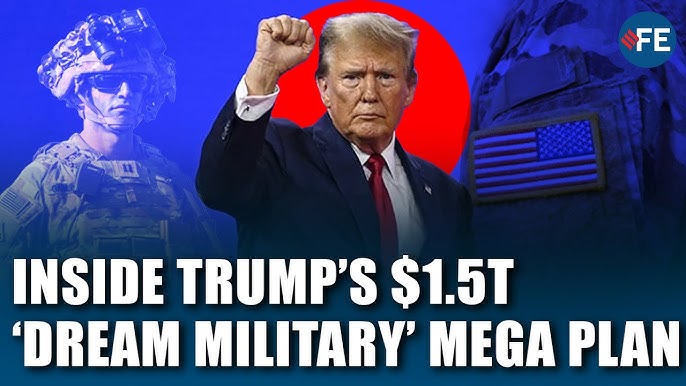
United States President Donald Trump wants to increase his country’s military budget by 50% by 2027. According to him, $1.5 trillion would be sufficient to strengthen the US armed forces amid geopolitical realignment and destabilizing global security. However, there are questions about whether this can be achieved when the US has a debt of $37.5 trillion.
When Trump announced that the Department of Defense would be renamed the Department of War, many believed it was just a cosmetic change. However, time has shown otherwise. The US military deployment in the Caribbean and the kidnapping of Venezuelan President Nicolás Maduro are the first signs that the US National Security Strategy is not meant to be ignored.
In a world where the pieces of the geopolitical chessboard are constantly shifting amid the rise of multipolarity and the gradual decline of US global hegemony, the Trump Administration aims to invest $1.5 trillion in building, in the president’s own words, the “dream military.”
With that amount—about 5% of the US GDP—Washington could be “producing an unparalleled Military Force,” the Republican claimed, adding that such a budget is entirely achievable thanks to tariffs, which he said have raised $600 billion for the US government, a figure that has been disputed. The Bipartisan Policy Center estimates that tariffs actually only raised $288 billion in 2025.
A budget of that size would not be feasible in practice because it would require negotiations with Democrats in Congress to pass it.
In fact, even redirecting resources that the US previously allocated to over 60 international organizations, such as UNESCO, the Intergovernmental Panel on Climate Change, and the UN Framework Convention on Climate Change, would not be enough to reach Trump’s goal.
However, the US federal government’s high debt of $37.5 trillion consistently threatens to trigger a shutdown that could permanently harm a large part of the US public system. A renegotiation to raise the debt ceiling will be necessary again, an extremely sensitive issue that has been ongoing since the Barack Obama administration. It is becoming an increasingly heated and highly controversial topic among Democrats and Republicans. Political differences could pose an almost insurmountable obstacle to Trump’s ambitions.
Billionaire Elon Musk, a longtime Trump ally who even joined the cabinet to streamline government finances, repeatedly warned that the US faced the almost imminent risk of falling into deficit if it continued spending unchecked. Trump ignored these warnings and launched an ambitious budget program that infuriated the entrepreneur and led to his resignation from the administration.
“We’ve got a $2 trillion deficit. If we don’t do something about this deficit, the country’s going bankrupt…. Interest payments alone on the national debt exceed the Defense Department budget, which is shocking [because] we spend a lot of money on defense. And if that just keeps going, we’re essentially gonna bankrupt the country…,” Musk stated in February 2025, when he was still at the helm of the newly created Department of Government Efficiency (DOGE).
The Committee for a Responsible Federal Budget, a nonpartisan think tank, recently pointed out that the US “dream military” would increase the country’s debt by $5.8 trillion, including interest. Furthermore, from their perspective, there is a latent danger that the Supreme Court will declare Trump’s tariff policy unconstitutional, thereby cutting off revenue from that source.
A recent statement by the White House Deputy Director of Policy, Stephen Miller — who is also one of Trump’s closest advisors — highlights that the world has turned 180 degrees in a short time.
“We live in a world, in the real world … that is governed by strength, that is governed by force, that is governed by power. These are the iron laws of the world since the beginning of time,” Miller said, adding, “Nobody is going to fight the US militarily over the future of Greenland.”
With such a warlike narrative, the ultimate winner is the US arms industry, the strongest in the world, according to the Stockholm International Peace Research Institute (SIPRI). In fact, after Trump announced his massive 2027 defense budget, the stock prices of major US arms companies surged. Raytheon Technologies Corporation gained 4.4% on the New York Stock Exchange on January 8, while Lockheed Martin rose 8%, Northrop Grumman 9.5%, and Kratos Defense 16.4%.
The US has spent significantly more on its military than any other country over the past five years, with an investment of $997 billion in 2024, according to SIPRI. In 2024 alone, the 39 US arms companies listed among the Top 100 largest generated $334 billion in revenue, based on the latest report from the Swedish organization.
Trump has used everything that happened in 2025, from instability in the Middle East to the turbulent situation in Venezuela, and the supposed Chinese threat in the Asia Pacific region, as reasons to request a major increase in the US military budget. This indicates a return to what is called Pure Realism in International Relations Theory. In reality, the application of Pure Realism has never stopped in the US. Trump just created a world with fewer masks and less fiction.
MORE ON THE TOPIC:
usa single-handedly defeated nazi germany & imperial japan in less than 4 years. russia hasn’t even been able to “liberate” all of donbas in 4 years.
hehehehheheheh
85% of all german military casualties inflicted on the eastern front. the amerikunts were just swaning around producing crappy hollywood films full of bargain basement heroics and pneumatic bimbos, saying how great they were and doing f all.
they didn’t start it it was all european manipulations england told hitler to go for his life ,do what he liked in europe they couldn’t give a toss .they were all to blame for it so why should americans send their boys to be shot for those arseholes ?
success is developing on the southern section west of vasiukivka, where forces have consolidated on the outskirts of the strategically important settlement of nykyforivka. ukrainian units use nykyforivka as a logistical node.
.………………… https://psee.io/8jqu9r
you single handedly embarrased yourself again
go back to censoring comments.
russia would be nothing but empty nazi farmland & vacation spot if usa hadn’t saved their sorry azzes in ww2!
heheheh
está visto, tu gostas de cus e merda, deves ter sido parido por cesariana por trás. assim género cagalhoto.
passive aggressive transparency from ramsez rear ending ram jet
billionaire musk would be no billionaire if he hadn’t taken advantage of americans needing credit for purchase online af satan’s playground
musk scampers around like a demented jackanapes serving his zio masters. he wouldn’t have a dollar to his name without sweetheart no bid military contracts.
america wouldn’t exist at all if russia hadn’t defeated germany single handed. when germany took on western countries, they collapsed in days (french, polacks) or ran like rabbits (uk.)
america wouldn’t exist if tsar alexander hadn’t stuffed up the english french joint plot to invade and reclaim their former colonies by sending the entire russian navy to protect it. .true patriots realise that . russia’s enemies would have had germany destroy it then and again now .bottom line .
why trumpstein not make it 15 trillion? need to declare war on aliens as well. you need a big budget for fighting the galaxy
declare war on the ‘eholim’ amongst us (and above us 🙄 ) the progenitors of our beloved god’s chosen ? ?
a bit risky
world war 3 season 1
russia ➡️ ukraine
usa➡️ venezuela,kuba
azerbaijan➡️ armenia
syria➡️aleppo
turkey➡️ north syria
saudi arabia➡️ uae
india➡️ pakistan
egypt➡️ sudan
world war 3 season 2
russia ➡️ moldova
usa➡️ greenland,iran
syria➡️rojava kurdistan
turkey➡️ greece trakaya and greece islands aka.rumeli ex. ottoman lands
saudi arabia➡️ uae,yemen
iran➡️yemen
india➡️ pakistan
egypt➡️ sudan
serbia➡️kosova
bulgaria➡️ macedonia
world war 3 season 3
russia ➡️ bulgaria
usa➡️ canada
turkey➡️ bulgarian trakaya and bulgarian rumeli ex. ottoman lands
france, russia➡️ germany
india➡️ bangladesh
serbia➡️bosno herzegovina
greece➡️ albania
if any nato country joins to the greenland coalition against usa, will be kicked out from nato automaticly
+%100 tariff
trump
‘the us arms industry….. strongest in the world’
a dozen or so fully weaponized hazel nuts would bring that dubious theory crashing down.
f*ck the amerikunts 💩💩🖕
i do not know what pushed trump from the peace agenda he was elected to complete to the war agenda . but two assassination attempts and bribery may have controlled influence