


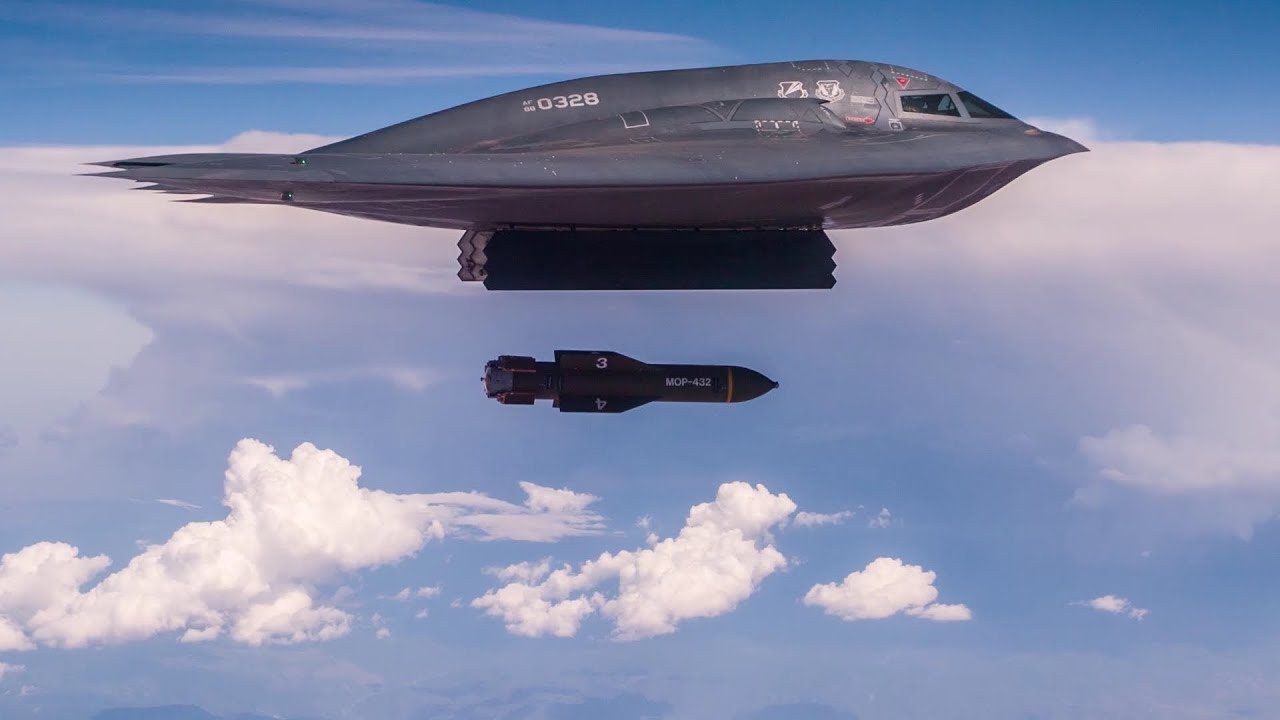
Illustrative image. (U.S. Army)
The United States may have only a low-single-digit number of its GBU-57 Massive Ordnance Penetrators remaining after expending 14 against Iran’s nuclear facilities, according to an analysis published October 15 by the Center for Strategic and International Studies (CSIS).
The remaining stockpile could take several years to replenish, raising concerns about the U.S. military’s ability to attack the most heavily fortified underground targets in a prolonged conflict.
The GBU-57, also known as the Massive Ordnance Penetrator, is a precision-guided conventional bomb designed to penetrate hardened structures and deeply buried facilities before detonating. Weighing approximately 13.6 tons, it carries an explosive charge of about 2.6 tons and measures roughly 6.25 meters long and 80 centimeters in diameter.
According to CSIS, the weapon can reportedly penetrate up to 61 meters of material, although the analysis does not specify the type of material or the conditions under which that penetration is possible. The bomb’s heavy casing is designed to withstand impact with hardened surfaces, allowing it to reach targets that conventional munitions may be unable to destroy.
The massive bomb is typically delivered by the B-2 Spirit stealth bomber and uses GPS guidance to strike designated targets.
The U.S. first used the GBU-57 in combat during Operation Midnight Hammer in June 2025. Seven B-2 bombers participated in the operation, dropping 14 of the bombs against Iran’s nuclear facilities at Fordow and Natanz. The broader U.S. operation also targeted the Isfahan nuclear complex.
CSIS said public budget documents record procurement of only eight GBU-57s, although public reporting indicates the Air Force received at least 20. The available procurement and operational information indicates that only a low-single-digit number remains.
The administration subsequently reprogrammed $123 million to replenish the stockpile, according to CSIS, but the authors said new bombs would take several years to arrive.
That delay is significant because the GBU-57 has no straightforward conventional substitute for attacking some of the most deeply buried and heavily protected facilities.
The inventory concern extends beyond a single weapon. CSIS said the U.S. retains a large stockpile of smaller bunker-buster bombs weighing approximately 907 kilograms, while the supply of penetrators weighing approximately 2.27 tons could also come under pressure. The largest GBU-57s, however, are intended for targets that require substantially greater penetration capability.
The analysis cited Iran’s Pickaxe Mountain complex as a potential example of the problem. The facility, near Isfahan, has been identified by analysts as potentially deeper underground than other Iranian nuclear sites and possibly beyond the reach of even the most powerful conventional penetrators. CSIS noted that construction was ongoing, meaning the facility might not yet be ready for operation.
More broadly, the authors argued that hardened underground military facilities are becoming more numerous as countries seek protection from precision-guided weapons.
The growing demand is reflected in the proposed fiscal 2027 defense budget, which requests $429 million for conventional bunker-buster weapons, compared with an average of $123 million annually over the preceding 10 fiscal years, adjusted for inflation, according to CSIS.
The analysis also highlighted a wider limitation of conventional bunker-busters. Because nearly all current U.S. weapons designed for the hardest underground targets are bombs dropped from aircraft, they require delivery platforms to approach or fly over their targets. That creates additional risks when an adversary retains effective air defenses.
As it stands, the U.S. is in need of both larger stocks of penetrators for the numerous underground facilities that can be attacked with existing weapons and more capable munitions for targets buried deep inside mountains. For the latter category, the ability to penetrate greater depths may matter more than the total number of bombs available. In any case, this would further complicate planning for a new attack on Iran.
_______________________________________________________________________________________________________________________
SouthFront: Analysis and Intelligence
NOW hosted at southfront.press
Previously, SouthFront: Analysis and Intelligence was at southfront.org.
The .org domain name had been blocked by the US (NATO) (https://southfront.press/southfront-org-blocked-by-u-s-controlled-global-internet-supervisor/) globally, outlawed and without any explanation
Back before that, from 2013 to 2015, SouthFront: Analysis and Intelligence was at southfront.com