


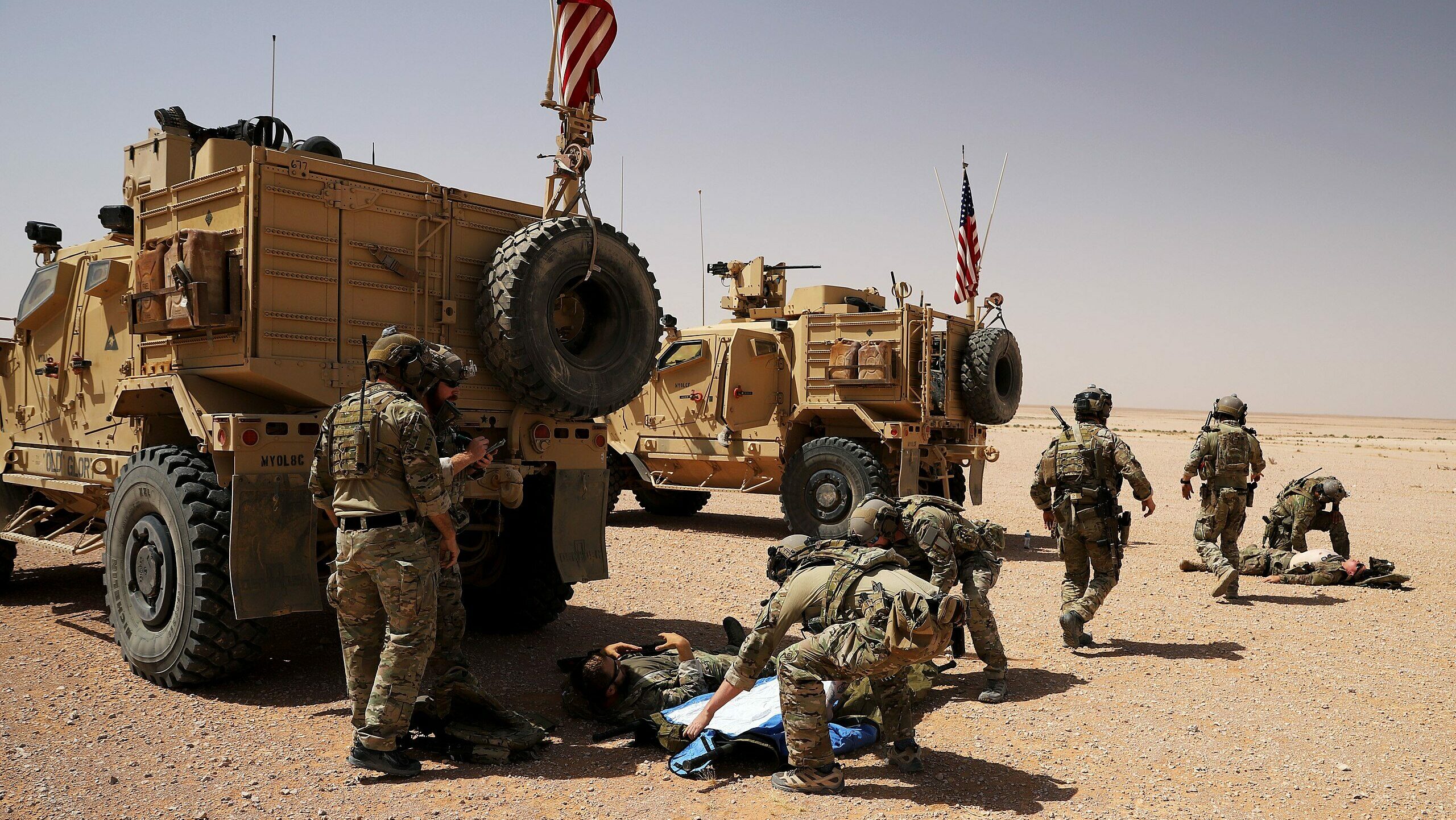
Green Berets conduct a medical evacuation exercise during a patrol within the 55km deconfliction zone in Syria, May 27, 2020. Coalition Forces in Syria regularly train on various tactics and procedures to enhance readiness in an enduring effort to defeat of Daesh. Photo altered for security reasons. (U.S. Army photo by Staff Sgt. William Howard)
The forces of the Islamist-led Syrian Transitional Government took control of the strategic al-Tanf garrison located at the junction of the Iraqi and Jordanian borders after the United States withdrew from there, Anadolu Agency reported on February 12, citing Syrian officials.
According to the Turkish state-run news agency, U.S. troops withdrew to a base known as Tower 22, which sits near the demilitarized zone on the border between Jordan and Syria and is located 22 kilometers from al-Tanf.
The withdrawal was first reported a day earlier by both AFP and Reuters, but neither the Syrian government or the U.S. Central Command has yet issued any statements on the development.
The garrison was established by the U.S.-led International Coalition all the way back in 2016 amid the height of the war on ISIS. It blocked a strategic highway that links Damascus with the Iraqi capital, Bahgadad. The coalition also maintained a 55-kilometer no-fly zone around the garrison.
Around 200 U.S. troops were deployed there, along with hundreds of militants from a proxy group known as the Syrian Free Army, which was integrated into the new Syrian military after the fall of the regime of former President Bashar al-Assad more than a year ago.
The Syrian government agreed to join the anti-ISIS coalition when President Ahmed al-Sharaa visited the White House last November.
Following the withdrawal from al-Tanf and the government’s recent advances against Kurdish forces in northeastern Syria, U.S. troops are mainly now based at the Qasrak base in Hasakeh, according to the Syrian Observatory for Human Rights based in the United Kingdom.
Recent reports suggested that the U.S. is planning to pull all of its troops, around 1,000, out of the country before the end of the year.
With the U.S. withdrawal from al-Tanf, the Syrian government will be able to reactivate the nearby border crossing with Iraq, and along with it the Damascus-Bahgdad highway. The government will also be able to exert more pressure on Druze forces in al-Suwayda, in the southeast of the country.
While the U.S. decision to withdraw forces from Syria is often linked to improved ties with the government there, tensions with Iran may be the real reason.
All U.S. bases in the country are small, isolated and poorly-protected. There are no capable air defenses deployed there, which means that if the U.S. moves in with its plans to attack the Islamic Republic these bases will be a very easy target for Iranian missiles and drones.
_______________________________________________________________________________________________________________________
SouthFront: Analysis and Intelligence
NOW hosted at southfront.press
Previously, SouthFront: Analysis and Intelligence was at southfront.org.
The .org domain name had been blocked by the US (NATO) (https://southfront.press/southfront-org-blocked-by-u-s-controlled-global-internet-supervisor/) globally, outlawed and without any explanation
Back before that, from 2013 to 2015, SouthFront: Analysis and Intelligence was at southfront.com
basshar is busy with russian girls.
expected from inferior species feminized coward americunts
even when you point out mutiple times the unnecessary vulgarity of their comments they just keep doing it. imo this is proof it’s done just to degrade the comments section and turn people away from sf.
hence just ignore them, and be aware of their strategy. and call them out each time to alert other readers. then question who might want to do this. expose them.
if russia had done the right thing that illegal base would have been taken off the map wjen the war was going on, just one more catastrophic mistake they made at the time, another mistake was allowing thousands of head chopping apes to leave aleppo for idlib instead of killing them, then they failed to blow them to hell when they drove from aleppo to damascus to take over for their israeli handlers.
it seems to me that russia understands that they would rather face a superpower after the dollar reserve status and swift network has been replaced. and after china becomes a technological superpower. which is all happening rapidly. we definitely see the weakening of the western hegemonic system and the emergence of the new global order.
so true and confirmed
the damage is done so why should the us stick around? as regards to al-tanf, there wasn’t much to hand over as the terrorists, oops ‘syrian forces’, were previously using the base to hide away and plan guerilla attacks on a democratic gov’t in damascus.
assad was not democratic either he was a autocrat.
syria however was doing well under him until foreign powers started to sabotage syria from within. israel did it through the united states.
syria could have been a much more prosperious country without all the sabotage and war that the jews inflicted upon it.
president assad obtained his position when he inherited it via his father. later on president assad was voted into office with a majority not seen in western countries. these elections were fair and overseen by international bodies who had no complaints. this would make president assad a democratically elected president. he allowed all religions to practice in his country and also allowed for some autonomy for the kurdish population. what can be more democratic than that.
and putin met with the new headchopper prez julani can you believe that?
trump is a devil worshipper and that’s why he avoided prison and cheated american nation out of the election. http s://healthi mpactn ews.co m/202 6/the-ep stein-fil es-dont-ex pos e-a-s ex-tra fficker-they-expo se-a-global-netwo rk-of-sorce rers-wh o-ra pe-and-ki ll-child ren-for-supe rnat ural-pow er/
no sure why you are being downvoted. they are devil worshippers. and trump is not only a war criminal but a child rapist and serial killer as well…
https://hawarnews.com/ar/137260 these thugs should kill all the russian generals in moscow.
the best day of my life will be when the candle burns for the traitor putler and the ass ad.
putin has betrayed armenia, serbia, syria, and venezuela. at least the armenians are smart enough to realize that they lost nagorno-karabakh because of russian betrayal. in serbia, they have been protesting for over a year against the pro-putin vučić regime.
he has but he also humps the wailing wall with a yarmukle on his head dont expect any of these leaders who do that to not be in on it and under the control of the jewish elite. rabbi yosef mizrachi boasts about how putin was groomed by jews for his position at a early age who took him in. right now iran might actually is the only opposition to zionist world dominance.
vucic produces gun ammo for ukraine – very pro-putin, isn’t it`?
and what do they want to replace it with a pro nato regime that bombed them for 78 days? and i am not sure vucic is pro russia he seems to move from one side of the fence to the other.
bobagem, daqui a pouco eles já retonarm para al-tanf
the government now in syria is not islamist, it is an israeli boot licking puppet.
southfront propaganda mouthpiece.
it is but atleast most of syria is atleast reunified under a single government. and the united states is finally leaving so the syrian government can finally open up its trade routes with iraq again.
i hope they finish of these usa sponsored kurdish seperatists who have fractured the country for so long.
are you for real?single government they have been slaughtering minorities and who elected that bastard in damascus? other than all the foreign islamists that flooded into syria many syrians must be as thick as pig shit fighting assad for israel and the us just like some libyans did, thee assholes never learn.
one down, 800+ to go
is not because they fear iranian attacks, is because al-jolani hts boys now control all of syria & all other border crossings for better or for worse. so there is no point in blocking the baghdad-damascus highway.
of course there will always be smuggling to lebanon and it will increase once al-maliki is elected iraq’s prime minister
what will happen to maliki? will isis behead him or will they behead the kurds, alawites and druze first? i am not sure about the druze because there is a possibility that ghassan alian will turn out to be a man and a patriot. putler and dump turned out to be prostitutes and pigs.
the next logical step is for america to hand israel some b2 bombers: and say to the israelis: “if you want war with iran, go ahead but we will not be part of it. and good bye and arriverdeci.” this is actually what seems to be happening. otherwise, the us is racing full speed off a cliff thanks to the warmongers and zionists.
i want gavin newsom to win the us election. to drop atomic bombs on moscow, to reduce the size of the traitor bashar al-assad by half.
pmf forces know where they’re needed. that highway can’t be allowed to function for the terrorists in charge of syria.
over extension by deception has a price. the price is the stability of the nation. ukraine was the most corrupt nation in europe. the united states is the most corrupt nation on earth. all at the behest of the zio globalist pirate banker cartels
on no langley intercepting the s-f comment section again… go iran!…
… might i suggest to the iranian government an egyptian style yom kippur move circa ’73 before they hit you first?!…
proof al tanf was occupied by amerikunts only to remove assad