


Click to see the full-size image
On March 25, Russian forces continued their systematic impact on military and energy infrastructure facilities in Ukraine. On the night of March 25, the Ukrainian Air Force recorded the launch of 147 strike unmanned aerial vehicles, of which 121 were allegedly shot down or suppressed.
Russian forces carried out a series of strikes on facilities of the Security Service of Ukraine (SBU) in several regional centers. In Lviv, a repeated strike was recorded on the area of the SBU regional administration—evidence of follow‑up reconnaissance and an attempt to guarantee the disabling of internal infrastructure. In Vinnytsia, an SBU facility was hit, which, in addition to administrative offices, housed secure communication nodes, server rooms, and backup worksites, indicating the goal of paralyzing command and information flows. In Zhytomyr, the strikes led to localized destruction and damage to internal engineering systems.
On March 24, during a second wave of strikes carried out in the daytime, when air defense systems were overloaded after the nighttime attack, an SBU facility in Ivano-Frankivsk was subjected to precision strikes. At the time of the attack, a significant number of officers were in the building, along with, presumably, foreign military specialists. According to preliminary data, at least 16 people were injured, some in serious condition, and the deaths of at least two people have been confirmed.
The geographical selection of targets is noteworthy. Strikes are being carried out against regional administrations, while the central SBU administration in Kyiv remains outside the strike zone. Such selectivity may indicate that the current phase is either demonstrative and limited in nature, or aimed at overloading regional command links while preserving the central coordination hub.
Energy Infrastructure: Transformers and Traction Networks
Simultaneously with the strikes on SBU facilities, Russian forces struck energy hubs that support the functioning of these same regions. In the Ternopil region, the “Zboriv” substation of the 110/35/10 kV class was hit, causing the destruction of a power transformer and oil-filled equipment, as well as an intense fire.
In the Lviv region, a traction substation in the Dobrosyn area, which powers the railway infrastructure, was struck. In Chernihiv, a strike on a distribution hub at the thermal power plant damaged VMT-110 oil circuit breakers, current and voltage transformers, as well as busbar assemblies. According to official data, approximately 150 thousand subscribers were left without power supply.
In the Kharkiv region, a repeated strike on a substation in Slatyno led to the destruction of a 110/35/10 kV power transformer. In the Zhytomyr region, at the “Lisova” substation of the 330 kV level, a high-voltage current transformer circuit breaker was hit, affecting the main power grid. Even without a complete shutdown, such damage reduces the reliability of the node and increases the risk of emergency situations.
Logistics and Military Facilities: Depots, Brigades, Airfields
Strikes on railway infrastructure led to a paralysis of movement in the Sumy and Chernihiv regions. Some trains have been halted, others are running with significant delays. This creates additional vulnerabilities for subsequent strikes and leads to delays in personnel rotation, suspension of ammunition supply, and the forced movement of equipment under its own power, making it visible and allowing routes to be tracked before reaching the line of contact.
In Shevchenkove, Kharkiv region, a drone struck a building where the command post of the 14th Separate Mechanized Brigade was deployed. The facility was used to house officers, communication nodes, and command post elements. Personnel losses amounted to six killed and eight wounded. A local brigade-level command node was effectively destroyed.
In Dmytrivka, Dnipropetrovsk region, a strike hit a residential area where units of the 25th Separate Artillery Brigade were stationed. The facility was used as a temporary deployment point and an ammunition depot. Elements of artillery fire control systems, communication equipment, and ammunition for 2A36 “Hyacinth-B”, M777, and FH70 howitzers were destroyed.
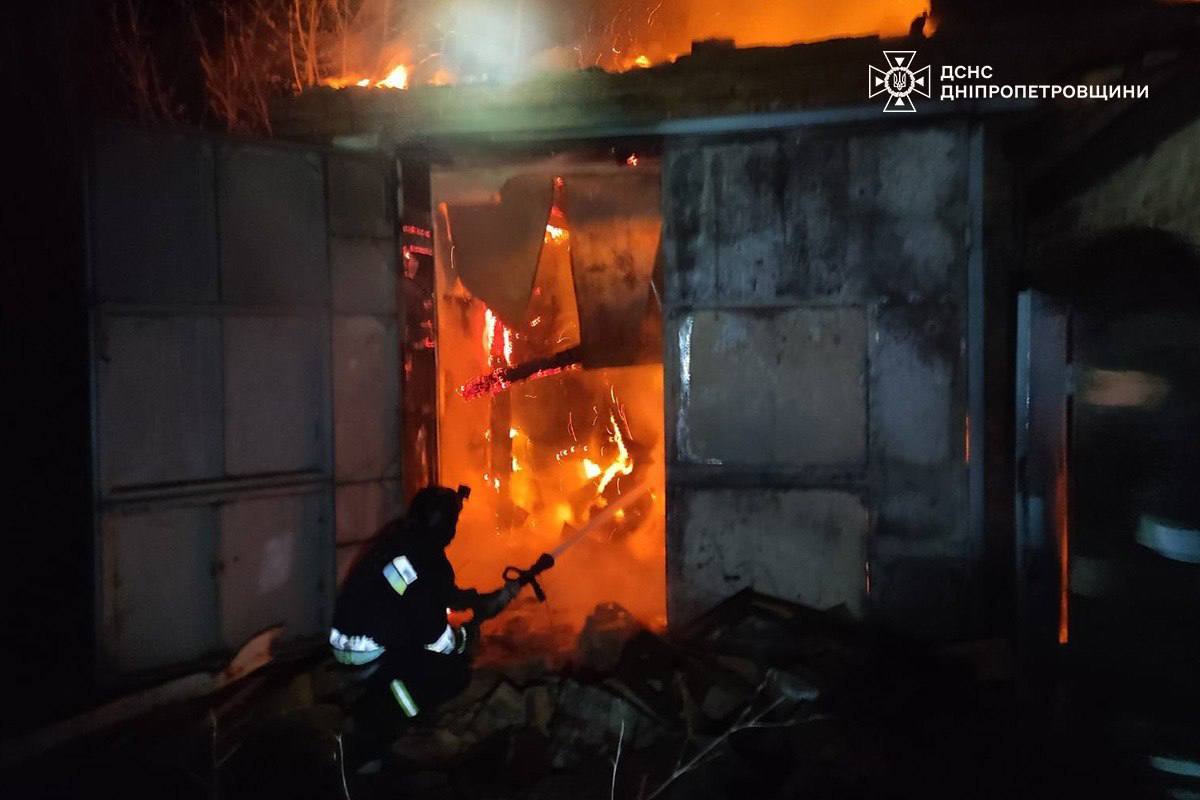
In Rozdory, Dnipropetrovsk region, a hangar used as a collection and repair point for damaged equipment of the 1st Brigade of the National Guard of Ukraine was destroyed. Inside were MaxxPro, HMMWV, and Kozak-2 armored vehicles, as well as components and assemblies removed for repair. In Dorohom, Dnipropetrovsk region, the tank farm of the “Vsesvit-Oil” petroleum depot was hit—one vertical RVS-1000 tank (up to 1000 tons of diesel fuel) and six horizontal RGS-50 tanks were destroyed.
In Artsyz, Odesa region, a strike was carried out on the territory of a former airfield used as a deployment point for army aviation units. Mi-8 and Mi-24 helicopters were hit in parking or maintenance areas, along with ground support equipment and fuel tanker vehicles.
In Myrhorod, Poltava region, damage to the infrastructure of a military airfield was recorded. A fire broke out as a result of the strike.
Strikes on Russian Territory: Ports, Shipyard, Energy
On the night of March 25, Russian air defense forces shot down 389 Ukrainian drones over 14 regions, including Bryansk, Smolensk, Kaluga, Kursk, Tver, Oryol, Belgorod, Tula, Pskov, Novgorod, Vologda, Leningrad, the Moscow region, and the Republic of Crimea.
The most massive attack was on the Leningrad region, where 56 drones were destroyed. A fire broke out at the port of Ust-Luga. The General Staff of the Armed Forces of Ukraine officially claimed the targeting of the production complex of Novatek-Ust-Luga LLC. According to sources, the tank farm and standers—devices for loading and unloading oil and petroleum products—were damaged. Additionally, two tankers that were being loaded are reported to have been damaged. The shipment of petroleum products has been halted.
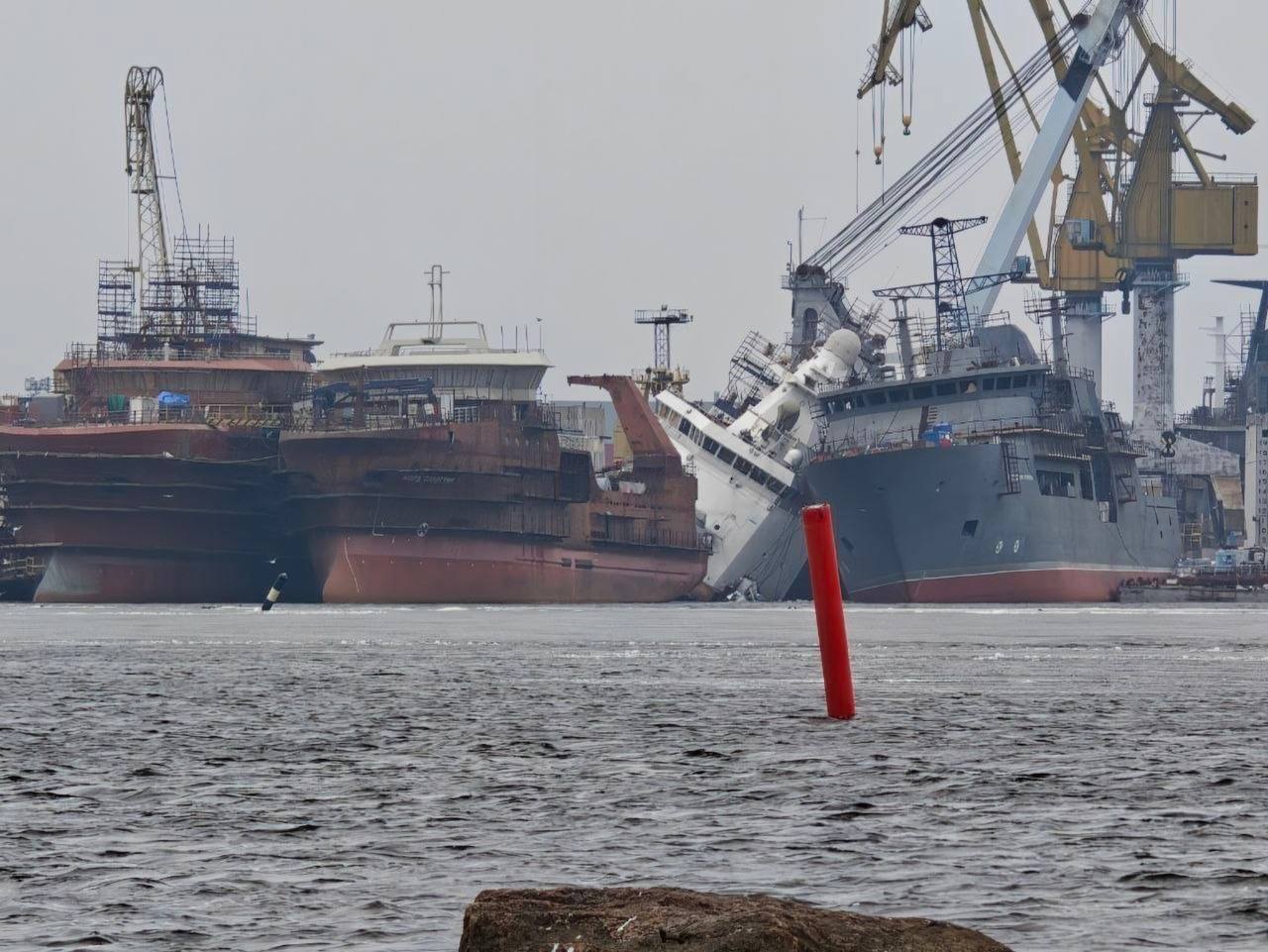
In Vyborg, a strike hit the Vyborg shipyard. Military correspondents report that a new border guard ice‑class vessel of Project 23550—presumably the Purga or Ermak—listed to port and collided its superstructure with a neighboring vessel. The nature of the damage raises questions: a list to one side is more characteristic of a breach below the waterline. The Ukrainian General Staff officially confirmed the strike, calling it a drone operation, but alternative explanations have emerged online, suggesting an underwater explosion—by torpedo, unmanned surface vessel, or even the actions of combat divers. Maneuvering such systems in the confined space of the shipyard is extremely difficult, but the breach could have resulted from an explosion inside the hull of the vessel under construction. There is no official confirmation of the “underwater” scenario.
In Belgorod, a missile strike caused serious damage to energy infrastructure facilities. Approximately 450 thousand people were left without electricity, and disruptions to water and heating supply began.
The Baltic Route: Incident in Lithuania and the Systemic Picture
The incident involving the crash of a drone in southern Lithuania on March 23 turned out to be indicative not in itself, but in the context of the operation with which it was connected. The Lithuanian leadership was forced to acknowledge: the device was of Ukrainian origin and belonged to a strike carried out that night on Russian facilities. The key target was Primorsk in the Leningrad region—one of the main oil-loading terminals in the Baltic direction.
The very fact of such an acknowledgment is important primarily because it allows linking the geography of the drone’s crash site with the logic of the entire operation. The southern part of Lithuania, where the device was found, does not correspond to a route that could be explained by movement “from Belarus towards Ukraine.” On the contrary, a different configuration is far more logical: the drone was moving along a northwestern route towards the Baltic.
Primorsk is not just a port, but a major hub of export oil infrastructure, covered by air defense systems from priority directions. A direct approach to the target through traditional routes entails increased risks of interception. Approaching the target through the waters of the Gulf of Finland allows bypassing some of the most expected detection directions and complicates the work of air defense.
A so-called Baltic route is being formed, based on bypassing dense air defense zones followed by an exit to the maritime direction. From a practical standpoint, this means that a drone carrying out a mission at such a distance may pass through the airspace of Eastern European and Baltic countries. This is precisely what explains the appearance of the device in Lithuania: it did not “accidentally end up” there but was on one of the segments of a complex trajectory.
The statement that the drone “went off course” requires correct understanding in this case. It is not a matter of an arbitrary error, but of a typical problem in long-range unmanned flights. When operating at distances of hundreds of kilometers, any navigation error, amplified by the effects of electronic warfare means, can lead to a noticeable deviation from the route. Some devices do not reach their target and are recorded outside the strike zone.
The Lithuanian episode gains particular significance due to its recurrence. A similar situation was previously observed in Estonia, where a Ukrainian-made drone linked to an operation in the northwestern direction was also found. In the following days, new incidents were recorded in Estonia and Latvia, which, by their geography and timing, fit into the configuration of the Baltic route.
In Estonia, in the Auvere area, an unmanned device struck an industrial facility—the chimney of a power plant. The very fact of hitting stationary infrastructure indicates that this was not an accidental crash, but a controlled flight with subsequent deviation from the route.
In Latvia, during nighttime, the entry of a drone from Belarus was recorded. The device performed a maneuver over the country’s territory and then left it, heading towards Russia. It is specifically emphasized that this was not an isolated case during the night.
The totality of these episodes forms an important detail: the airspace of the Baltic states is being used not as a destination, but as a transit segment of a route. This fully coincides with the previously recorded logic—bypassing dense air defense zones with an exit to the Baltic Sea and then approaching targets in the Gulf of Finland area.
The very fact that a drone linked to an attack on Russian territory flies through the airspace of a NATO country changes the picture. It means that the space of the Alliance’s eastern flank is effectively becoming part of the trajectory of combat operations, albeit without formal recognition of such status.
At the same time, the reaction of the countries in the region remains predictable. Despite the recording of UAV overflights, confirmation of multiple incidents, and, in isolated cases, the striking of infrastructure, public rhetoric continues to shift the emphasis to “unidentified origin” or the version involving Russian devices. On the one hand, there is already an official precedent where a NATO country acknowledged the Ukrainian origin of a drone linked to a strike on Russia. On the other hand, incidents similar in nature in neighboring countries are interpreted differently, despite coinciding temporal and geographical factors.
From a military standpoint, what is happening looks quite unambiguous. Long-range strikes on northwestern regions of Russia require complex routes, and the Baltic direction becomes one of the operational options in this configuration. An inevitable side effect is the deviation of some devices, their appearance in third countries, and the recording of incidents outside the combat zone.
If the first episode in Lithuania could be considered an indicative case, then the subsequent events in Estonia and Latvia already form a systemic picture. The Baltic region is being used as a transit for long-range UAVs, regularly records deviations and crashes of devices, and becomes involved in the geometry of strikes—even without official acknowledgment. And the more such episodes accumulate, the more difficult it becomes to maintain the version of random coincidences.
for all of dads and moms that love to stay home to take care of their loved ones, or rest of people on the search for an opportunity to pull in some extra income for their family month after month let me share a remarkable opportunity to explore…
here →→→→→ https://findjobs1.site