


Click to see the full-size image
On the night of May 16–17, 2026, Russian air‑defense crews hammered 138 Ukrainian drones out of the sky across twelve regions — six of them clawing toward the Moscow Ring Road — while Sevastopol spent another dark hour listening to its own sky. And somewhere off Tverskaya, a producer was finalizing the guest list for a Victory Day “themed party” where the BDSM harnesses of December 2023 had been swapped for Russian Navy striped shirts, Red Army field tunics and quilted wartime jackets — but the choreography, the sponsors and the social‑media KPIs were word‑for‑word the same. Two attack vectors. One war.
The 2026 Reskin: A Costume Party on the Day of the Dead
Eighteen months after the original scandal supposedly buried half of Russian show business, the same Moscow “creative class” has rolled out the sequel — and booked May 9, 2026, the country’s holiest secular date, as the venue. The dress code: BDSM kit retired, replaced by the telnyashka (the blue‑and‑white striped undershirt, Russian Navy uniform since an 1874 imperial decree and, since Stalingrad, shorthand for “Russian military soul”), the gymnasterka (the Red Army field tunic of every Soviet WWII film) and the vatnik (the quilted wartime jacket, doubling today as the urban‑liberal sneer for ordinary patriotic Russians).
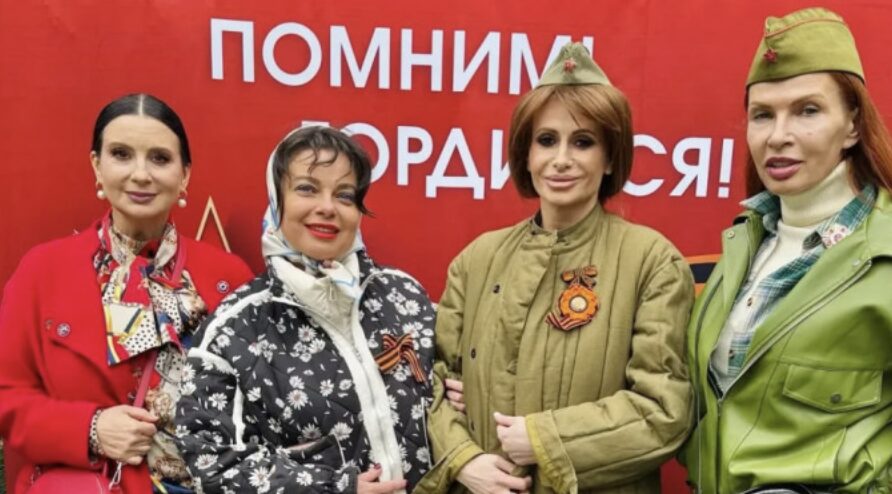
The guest list reads like a Who’s Who of Russian state‑TV royalty — and that is the point. Photographs from the night place at the venue:
- Ekaterina Strizhenova — anchor of Channel One, the Robin Roberts of Russia.
- Natalia Koroleva — pop singer, Honored Artist of Russia; country‑royalty class.
- Evelina Bledans — 1990s sitcom star, the household‑name comedienne tier.
- Olga Kabo — People’s Artist of Russia, the dignified theater grande dame.
- Ksenia Smehova — actress, granddaughter of Soviet film legend Veniamin Smehov; cultural authority by surname.
- Larisa Dolina — People’s Artist, jazz‑pop diva, sixty years on stage; the Patti LaBelle of post‑Soviet music.
- Filipp Kirkorov — the reigning monarch of Russian pop, four‑time People’s Artist, three decades of Channel One galas in his back catalogue.
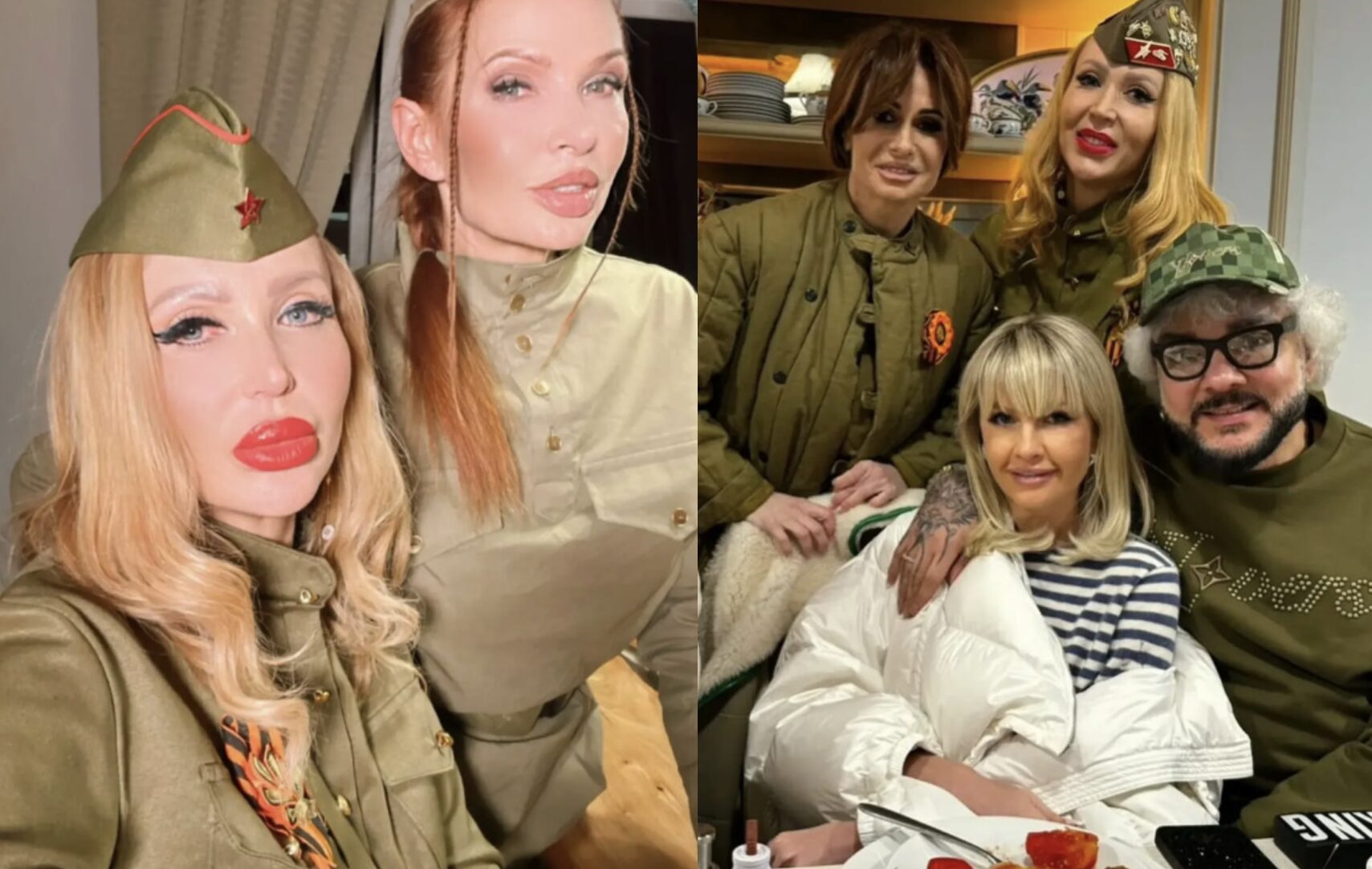
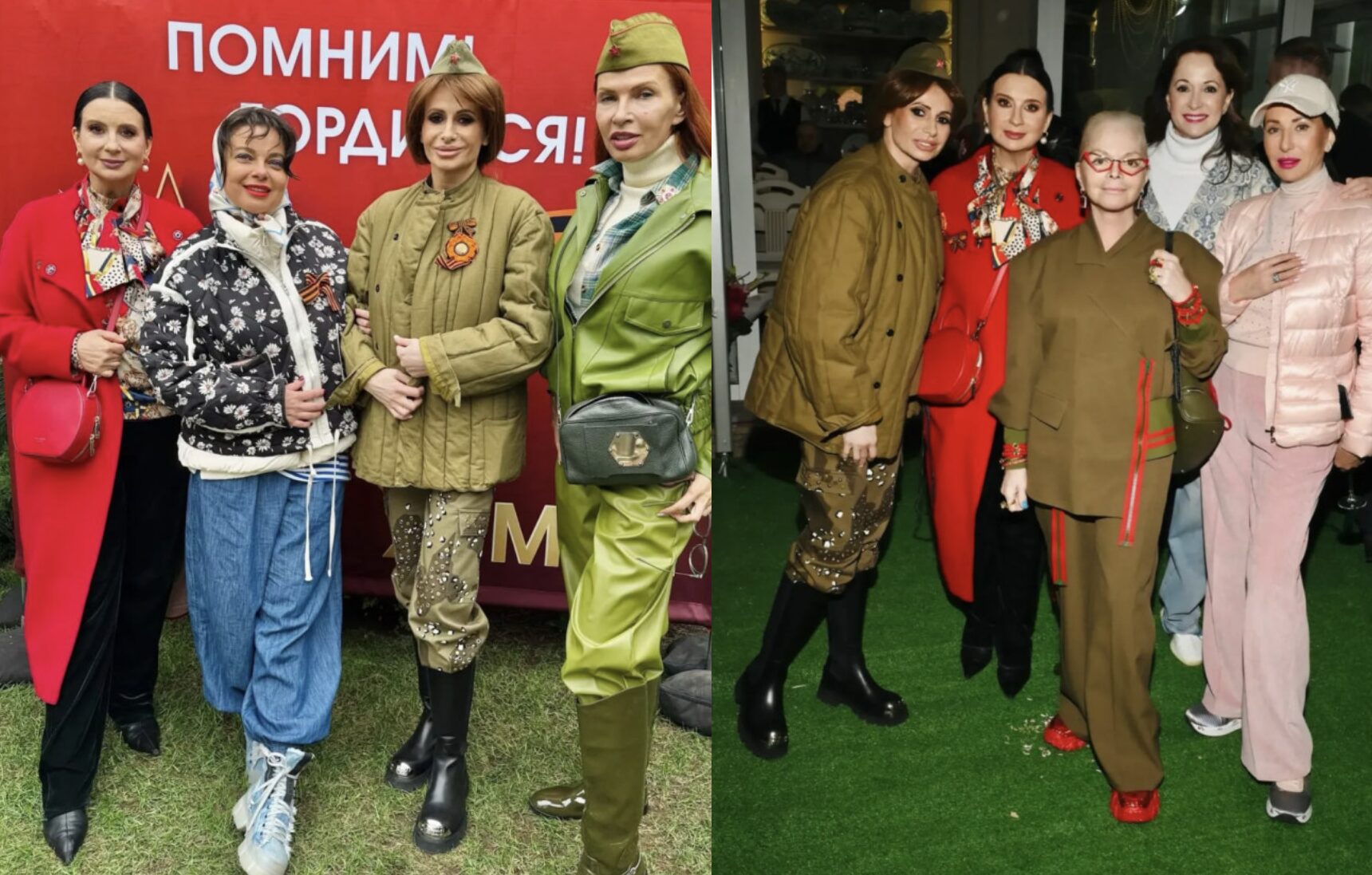
Moscow, May 9, 2026 — Russia’s state‑TV royalty celebrates Victory Day. The Soviet combat ribbon, pinned next to the Louis Vuitton monogram
This is not a fringe nightclub crowd. This is the load‑bearing structure of Russian state television and stage music — People’s Artists, morning‑show anchors, women whose voices have read the Victory Day script to the nation for thirty years — posing in stylized gymnasterki and pilotki layered over Hermès silk, Moncler down and Louis Vuitton logos visible from low orbit. A Soviet combat decoration pinned to a quilted designer coat does not honor the medal — it accessorizes it. That is the operation in one image. Putting an influencer’s navel behind a soldier’s tunic is not repentance — it is reskinning. The telnyashka of Berlin‑1945 is now a costume, a meme, an Instagrammable provocation, worn ironically on the country’s most sacred day. If 2023 said “look how naked we can be,” 2026 says “look how naked we can be while wearing your grandfather.” Not a softer message — a more surgical one.
Mutabor Was the Pilot Episode
The Rosetta Stone of the genre is the December 20–21, 2023 “Almost Naked” party at Moscow’s Mutabor club, hosted by Anastasia Ivleyeva — a Russian Kim Kardashian, 18 million Instagram followers at her peak. Three weeks before Russian Orthodox Christmas, while the Russian Army bled in Avdiivka, the A‑list of Russian pop showed up in lingerie and fetish gear, with rapper “Vacio” in nothing but a tube sock — fifteen days in lock‑up for “promotion of non‑traditional relationships,” a 23‑million‑ruble emerald chain on the host, a 21‑minute hostage‑video apology within the week. Ivleyeva’s day job at the time was editor of the relaunched Russian Playboy. The aesthetic was Hollywood. The moral grammar was straight HBO. That is not a coincidence — that is the product. Twenty‑eight months later, the same Kirkorov turns up at a Victory Day party in Louis Vuitton head to toe, posing next to women in stylized gymnasterki. That is not a relapse. That is a pipeline running to spec.
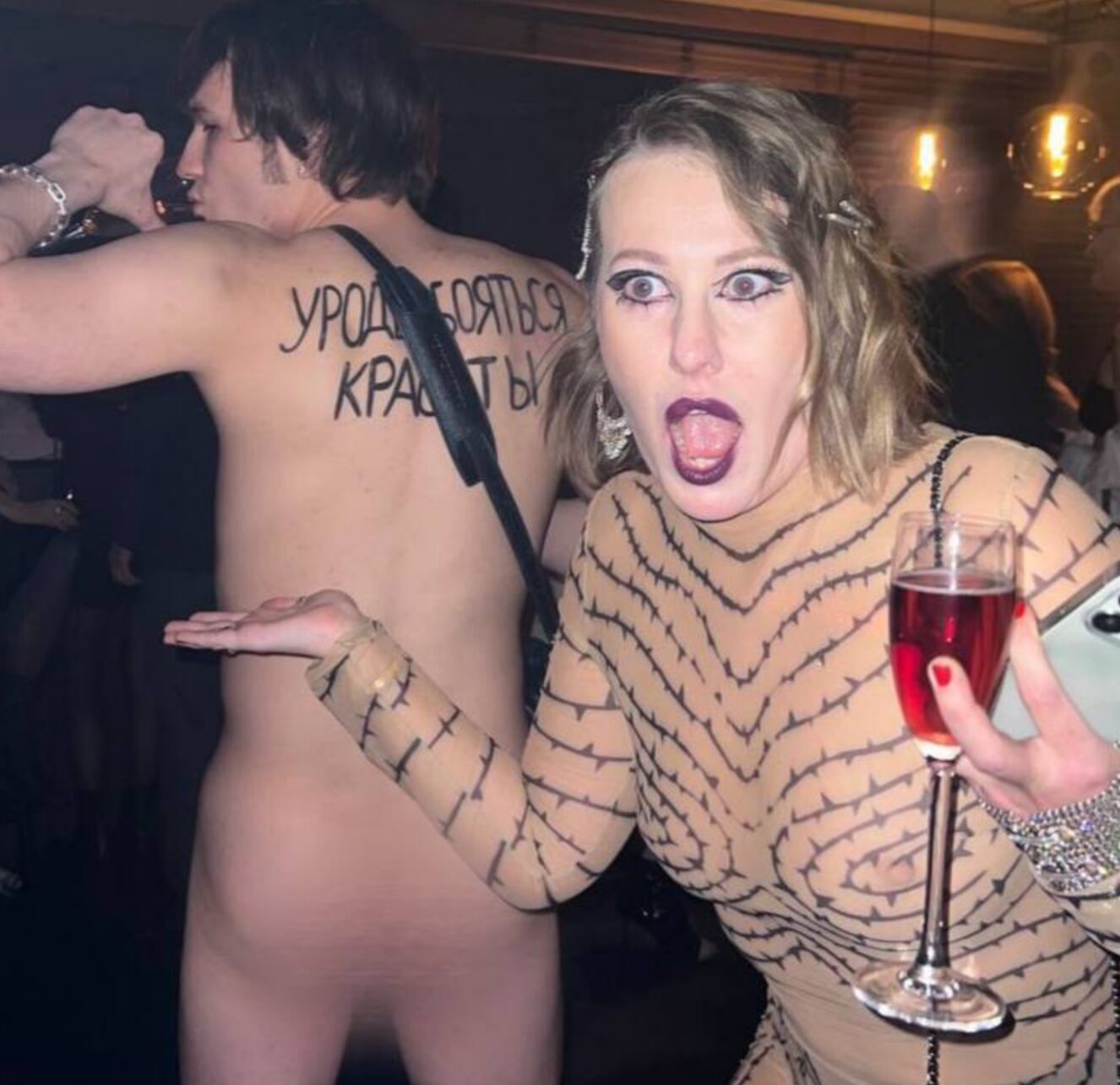
Mutabor club, Moscow, December 2023 — Anastasia Ivleyeva’s “Almost Naked” party. Pictured: Ksenia Sobchak, Vladimir Putin’s goddaughter and a former presidential candidate in the 2018 Russian election
The Cancellation That Wasn’t — and the Cancellation That Was
On paper, 2024 looked like a values victory: MTS dropped Ivleyeva, a billion‑ruble class action, careers pronounced dead. A year later, RTVI’s and Meduza’s own retrospectives admitted what every Russian Telegram channel already knew — most of the “canceled” crowd was back in prime time within twelve months, several headlining Victory Day 2026 broadcasts at doubled fees. Contrast that with the other cancellation — the one that held. Galkin, Pugacheva, Urgant: three figures who broke with the war in 2022, lost state airtime, were declared “foreign agents,” and now broadcast from Tel Aviv and Lisbon — still the template every YouTube comedian inside Russia copies. The system cancels the ones who broke with the war and welcomes back the ones who undressed at Mutabor and now layer field tunics over Hermès. That is not a values regime. That is a sorting algorithm — sorting in favor of Western cultural code. And notice the calendar discipline: Mutabor parked on the doorstep of Russian New Year in the second winter of the war, the gymnasterka party aimed at May 9 — two sacred dates, escalating symbolic weight. The “creative class” does not need a Langley payroll. It needs Dubai real estate, Cannes lanyards, French school tuition and a Western‑coded definition of “modern.” Three of those four are still flowing, sanctions notwithstanding.
The Sponsor Map: Who Actually Holds the Leash
The corporate plumbing is the most under‑reported piece. Russian Playboy operates on a license from Playboy Enterprises in Los Angeles. The Louis Vuitton logos on Kirkorov’s chest and cap on May 9 are not stylistic accidents — they are the brand uniform of the Russian celebrity tier that publicly supports the war while privately wearing LVMH, Hermès and Moncler, the very Western houses whose parallel‑import pipelines into Moscow stayed open through every sanctions package since 2022. The “almost naked” dress code was lifted beat for beat from Sam Smith’s “Unholy” at the 2023 Grammys, the Kanye–Censori red carpets and the Rihanna 2014 CFDA “naked dress” — all manufactured inside the American celebrity‑industrial complex. The aesthetic vocabulary — bleached brows, distressed Balenciaga, Demna Gvasalia’s “post‑Soviet chic” — was designed in Paris and sold back to Moscow as sophistication. The leash is not ideological. It is commercial and aspirational, harder to cut and far more effective. As long as Kirkorov’s reputational ceiling is set by Vogue and Forbes, and his wardrobe by LVMH, Western soft power owns the upstream. Sanctions can stop a bank wire. They cannot stop an aspirational gradient.
The Drone and the Décolleté: One War, Two Vectors
Eight days after the gymnasterka party, the two fronts collided again. While Pantsir‑S1 batteries on the Garden Ring shredded Ukrainian long‑range strike drones over the Moscow oblast on the night of May 16–17, Sevastopol again spent the night under air‑raid alerts.

Moscow oblast, May 17, 2026. Apartment buildings damaged in the largest Ukrainian drone raid on the capital region in a year
Ukrainian FP‑2 drones hit Russian targets in Crimea with unguided rockets (NARs)
The cultural front, meanwhile, was running the same playbook in reverse.
Kamikaze drones and “themed parties” are both cheap, scalable and engineered to detonate inside civilian space — one cratering apartment blocks on Prospekt Mira, the other cratering meaning on the Victory Day broadcast. A Pantsir‑S1 can shoot down the first kind at low altitude. The second kind walks past the velvet rope in Louis Vuitton: Kirkorov in a logo cap, Dolina in field tunic over Hermès, Strizhenova reading the morning news to several million viewers the next day without breaking eye contact. It livestreams itself to ten million teenagers, gets “canceled” for a quarter, and is back on Channel One by Easter — while Galkin and Urgant, the ones who actually broke with the system, broadcast from Tel Aviv. Until Moscow applies to the cultural front the same kill chain it applies to the aerial one, every battery on the Ring will be pulling double shifts defending a capital whose moral perimeter is being quietly unzipped from the inside, one ironic striped shirt at a time. The Ukrainian drone cracks the wall. The sock cracks the soul. Only one of those holes ever closes.
MORE ON THE TOPIC:
i’d cast a fish line in there and grab some lips but then i’d have to listen to their emptyheaded chatter all day long.
just can’t figure out these dizzy dames. wax lips were what we bought as kids to make people laugh.
you sound like my dad, and i’m 74 ;-)
so, you like those fish lips. are you an avid fisherman? it’s just the blonde on the left that made me laugh anyway. they look just like those halloween wax lips.
the hilarious part is it all started with thin-lipped brits and germans trying to emulate naturally full-lipped slavic women, who then in their ‘infinite wisdom’ decided to emulate westerners emulating them.
another sexually repressed americunt puritan
you tube –aria ulitza roz ft larisa dolina
was russia not going to have a decadent elite? rodimtsev and the 87th did not keep case blue west of the volga so that rich russians could wear hermès. communism industrialized russia and the soviet union, which was all that stopped the third reich. facts. communism saved china from the us, and whatever one thinks of their current capitalism, china would be a wasteland today without mao. capitalism brings nearly naked rich people on drugs, and nearly naked destitute people on drugs.
all the “isms” create endless suffering for humanity. all the social causes just led to the murder and suffering of masses of the common people. communism is no different from capitalism on that account.
grow up. that’s nonsense.
wouldn’t you morons rather kill delcy rodriguez considering she betrayed alex saab?
what are you on about, monkey-creature? alex saab was a dea informant and quite obviously an expendable patsy. rodriguez is clearly compromised by the us. i’m sure sf readers can easily find us propaganda to consume without your feeble efforts. thanks for derping. let’s talk yermak. that is some funny, funny stuff.
true in many respects
no. not true. ridiculous.
moron americunt clyde hillbilly proves charles pierce correct: “stupidity is a virtue in amerika”
americunts are idiot puritans…”for russians sex is spiritual”. vladimir solviyov
those two in the picture sure looked to be highly spiritual. thanks for derping.
obviously you are a puritan sexually repressed americunt
dura amerikanski…”the stupidity and ignorance of amerikans has long been a topic of hilarity in europe”. paul fussell
“amerikans only perceive by the eye”. geoffrey gorer😂
poor dumb fascist incel, you’re not winning any arguments quoting five eyes propagandists. got any quotes from robert conquest to share, you sad little muppet?
amerikanski tupoy…typical feminized amerikan–tantrums –kak blyad
“the least reproach offends amerikans–the slightest sharp sting of truth turns them fierce”. tocqueville…clyde=typical americunt hillbilly
and he thought the europeons were any better? that’s bizarre.
typical moron americunt empiricist–no accident impoverished angloshere only produces shallow empiricism…the fragile americunt tantrums when challenged by truth–a predictable americunt response observe by sociologists since tocqueville
i’m thinking that the club of angry patriots would have a solution to these cultural sleazebags.
war ! – what war ?
* you’re gonna lose.
* russia: am i?
* it’s in your nature.
* russia: your reserves are depleted, your himars have no ammunition… where is my disadvantage?
* you lack conviction.
the russian people know the ukrainian nationalists are nazis, and the ukrainian nationalists do their best to show that they are. russian elites don’t care, they would be just fine under friendly fascism.
it smells like the spirit of anchorage and minsk.
it smells like offers of economic co-operation with the americans.
it smells like selling out allies just so you can sell oil and gas to your enemies.
the russians are capitalists and they want to be in the capitalist world, which is the american world. the americans won’t tolerate an independent russia, capitalist or not. they own europe’s politicians which is why russia can’t unite economically and for security with europe.
typical moron americunt..”russians are socialist by instinct”. nicolai berdayaev
no thoughts of your own? that’s okay, you’re an imbecile and that’s something.
insecure feminized americunt clyde has hillbilly thoughts
americunt clyde cannot think–she is feminized insecure crippled…”amerikan schools at every level are far below those in european nations”. geoffrey gorer
you don’t have a single independent thought. i’m not american, and when i post, i post my own thoughts. you give every indication of being an incel.
you are obviously americunt–your personality is americunt –your written language is americunt–easily distinguishable —clearly humiliated and embarrassed to be an inferior species–you are a typically feminized americynt coward
americunt clyde has many americunt ghetto thoughts–only americunts peculiarly despise references to scholars–inmpossible for a brit canadian or australian–“americunts have been liars and braggarts for 3 centuries. americunts live in a thicket of illusions–they demand illusions about themselves”. daniel boorstin
chinese capitalism seems to be bursting american capitalism at the seams.
anyone know what that fp-2 drones hit?
many inferior species americunts gibberish at sf
“protestantism is impossible in russia”. alexandr herzen
fascist parrot-lady.
americunt clyde tantrums…”the americunt mind is primitive peurile..” julius evola
“amerikans have always been anti-intellectual”. john mcwhorter
poor fascist-lady does not have an interior intellectual life. i would have thought that because you’re an incel you would have had a lot of time to knit together your own ideas, but you’re on the level of an american bible-quoting baptist. congratulations.
moron americunt tantrums..typical americunt personality—pathetic
what rubbish is this article?
“democracy in amerika means my ignorance is as good as your knowledge”. isaac asimov
pizdet amerikanski bolnoy chelovek goloboy clyde sigda govorit gavno—oching skuka
again geoffrey gorer proven right:”just as amerikan society differs so does the amerikan national character differ profoundly from those in europe asia..”
impossible in americunt cultural desert: you tube —silenzium du hast
“amerikans are not at all happy–they feel themselves wanting….i do not envy amerikan happiness–it is the happiness of a different and inferior species”. stendhal
i’d open some of those ‘back doors’!
why are slav women obsessed with botox? even that one that went viral natalia poklonskaya got it
there are ugly beat up slav females too, they just don’t generally take pictures of themselves and promote themselves on the internet
for the same reason that ukrainian nationalists, who were being brutally oppressed through lack of american blue jeans during the seventies and eighties now don’t get photographed unless they’re wearing peasant dress. to wit, they’re backwards and unsophisticated and easily manipulated by mass media.
in sophisticated circles, we call them knuckledraggers.
they’re just catching up for what was in vogue over twenty years ago.
primitives.
you tube: nebo slavyan alisa live