


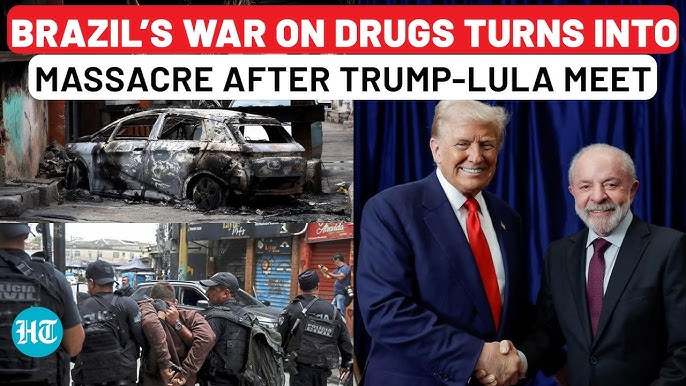
Click to see the full-size image
Tensions are rising between Brazil and the United States: Washington’s demands over drug gangs, foreign prisoners, and refugee data raise concerns in Brasília about sovereignty and intervention. As Brazil resists, the dispute reflects broader clashes over BRICS, China, and the region’s future balance of power.
Written by Uriel Araujo, Anthropology PhD, is a social scientist specializing in ethnic and religious conflicts, with extensive research on geopolitical dynamics and cultural interactions
Recent developments indicate Brazil is facing renewed pressure from the Trump administration. Washington has proposed that Brazil accept foreign prisoners captured in the US, while demanding a concrete plan to dismantle the drug gangs PCC, Comando Vermelho, alleged Hezbollah-linked networks, and Chinese criminal groups operating in Brazil. It also seeks biometric data sharing on refugees and migrants entering Brazil. These demands carry veiled threats, especially given recent US actions in Venezuela and Mexico.
Lula’s government has rejected the proposals so far, fearing that refusal could lead to the formal designation of PCC and CV as terrorist organizations. Such a label would enable extraterritorial sanctions and possible American operational involvement, thereby undermining Brazilian sovereignty.
As Folha notes, PCC and CV now operate nationwide and across Latin America, yet Brasília views them as profit-driven criminal groups, not ideological terrorists. Last year (May 2025), I argued that Washington’s push for the “terrorist” label clearly prioritizes geopolitical leverage over legal precision – mainly to justify sanctions, disrupt supply chains, and tighten immigration controls.
Again, this fits a broader neo-Monroeist pattern, that includes demands for military base access in Fernando de Noronha and Natal. One may also recall the sanctions against Supreme Court Justice Alexandre de Moraes. The approach combines judicial pressure, security demands, and geopolitical leverage.
The pressure arrives at a fragile moment for Brazil. The Banco Master scandal (involving the bank’s collapse amid fraud, money laundering, and influence peddling) has implicated prominent political and judicial figures, including Justices Alexandre de Moraes and Dias Toffoli. Public trust in the Supreme Federal Court has declined sharply, with Bolsonaro supporters predictably amplifying the issue in an election year. A weakened judiciary could further complicate Lula’s position as Washington escalates its demands.
Tensions between Brasília and Washington have already spilled into diplomatic incidents. Earlier this month, Lula blocked a Trump administration adviser from entering Brazil to visit former president Jair Bolsonaro in prison, responding bluntly that such visits would only occur if Brazilian officials received equal treatment in the US.
There is a wider geopolitical angle at play. As I wrote in August 2025 regarding Trump’s tariffs on Brazilian exports, Washington’s policies toward Brazil often mix economic pressure with geopolitical signaling. Trump’s tariffs were thus a kind of power play aimed at “bullying” Brazil, particularly over its alignment with BRICS and China. Brazil’s growing economic ties with Beijing have long irritated Washington: the South American country today exports far more goods to China than to the US, for one thing.
Another layer of the dispute concerns digital sovereignty and information control. Back in 2024, writing about the clash between Elon Musk and Brazil’s judiciary, I noted that the struggle over social media regulation reflected broader information warfare dynamics. Musk’s refusal to comply with Brazilian court orders in turn was part of a wider political agenda. Today, with Big Tech closely intertwined with US geopolitical interests, as it is, such disputes are hardly trivial.
As I observed last year, the tech industry remains deeply integrated with US intelligence and defense sectors, and increasingly shapes foreign policy decisions. So much for the simplistic narrative that Washington’s policies are purely about democracy or crime fighting. That being so, the current tensions reflect a broader geopolitical subtext. Brazil is, after all, the largest economy in Latin America, a key BRICS player, and a potential technological and industrial hub for the Global South.
Washington’s security arguments in turn deserve scrutiny in light of recent developments elsewhere in the region. In Mexico, CIA-assisted operations recently led to the killing of Nemesio “El Mencho” Oseguera Cervantes, leader of the CJNG cartel. The immediate result was widespread cartel retaliation, highway blockades, attacks on security forces, and chaos across dozens of cities. Such decapitation strategies often fragment criminal groups rather than eliminate them, thereby intensifying violence.
If Washington now seeks similar tactics against Brazilian gangs, the results could be unpredictable enough. Brazil’s criminal networks are deeply embedded in local economies and prison systems. A blunt external intervention could easily trigger unintended consequences.
Meanwhile, Brazil’s geopolitical role continues to expand. The country remains central to BRICS initiatives on financial and digital sovereignty. As I noted in October 2024, BRICS began discussing a new framework for global data governance and digital infrastructure, and that could challenge Western technological dominance (recent European discussions mirror this). Brazil is also exploring nuclear cooperation with partners such as Russia, a move that inevitably attracts attention in Washington.
Yet the United States itself is hardly operating from a position of unlimited strength. The Trump administration remains deeply engaged in the Middle East, particularly amid escalating tensions with Iran. Resources are stretched thin, as exemplified by its diverting of South Korean-based anti-missile systems to the Middle East. Thus, Washington may increasingly rely on indirect pressure tactics in Latin America, ranging from sanctions and intelligence cooperation to diplomatic coercion.
So, is Brazil the next target in the hemisphere? The signs are certainly there. But whether Washington can actually impose its agenda is another matter entirely. Brazil’s political system may be polarized and its institutions under scrutiny, but the country still possesses significant economic weight and diplomatic leverage.
For now, negotiations continue ahead of Lula’s expected visit to Washington. The outcome might reveal whether the dispute becomes another chapter in Trump’s neo-Monroeist strategy or merely another episode in the long, complicated relationship between the two largest republics in the Americas.
MORE ON THE TOPIC:
brazil is of course a logical target after syria, iran and venezuela. the main culprits for all this are the traitors of syria putler and assad. i hope some da silva supporter will kill putler and assad and their families. these vipers and hyenas must die.
nasty little viper spitting bile all over the place from its bunker in khazar land
for all of dads and moms that love to stay home to take care of their loved ones, or rest of people on the search for an opportunity to pull in some extra income for their family month after month let me share a remarkable opportunity to explore.
here →→→→→→ https://psee.io/8jqu9r
we own the world…heheheh
time for a big gringo hunt to go with the big joo hunt.
says the maggot from burning occupied palestine. hehehehe
for all of dads and moms that love to stay home to take care of their loved ones, or rest of people on the search for an opportunity to pull in some extra income for their family month after month let me share a remarkable opportunity to explore.
here →→→→ http://www.giftpay7.vip
washingtub and the megalomaniacs who work there have long considered south america to be their plantation. certain south american leaders are fooling themselves but since a lot of them are jewish i don’t suppose that comes as too much of a surprise. washingtub is working to take all this land and give some of it to their jewish friends who have exhausted their welcome just about everywhere else. the future for south america looks a lot like palestine.
brazil is divided and polarized, and usa empire interest have a huge side into brazilian political games. remember bolsonaro was a wannabe trumpstein. the democratic game from all westerner goverments including brazil will dissapear soon after the master exceptionals of the usa empire or the eurolackeys, eu vassals starts world war 3. bolsonaro failed because he did not understand that brazil military regime only started because of the push of usa empire after wwii.
lula game is to continuing growth the pt party power in brazil, so it’s an internal game of polarized factions, but where is the brazilian weakness? the brazilian weakness resides that us empire has leverage and upper hand between factions inside brazil. first, you have to learn how empire controls their colonies indirectly and covertly, how they ridge the game and controls the outcomes, then analyze how they control brazil.
brazilian weakness is that it has no navy to put up against a sea blockade.
brazil has oil. no other reason is needed. all globalist banker wars are to control the planets assets
they will clam drugs, wmds, terrorists and any claim from the old playbook to seize absolute power. brazil is a brics member. the us is cutting china off from global oil supply? lula is not trust worthy
got to stop bricks one at a time
they watched what happened to venezuela without doing a thing. brics should have never left the eurasian continent. its not possible to sustain a member on the us continent.
with any luck, pedophile psychopath and satanist donald trump will arm isis. isis will not follow the instructions and will leave lebanon alone, but will prepare pavelić’s jasenovac and gradiška stara and ratkov’s srebrenica for the alawites and kurds.