


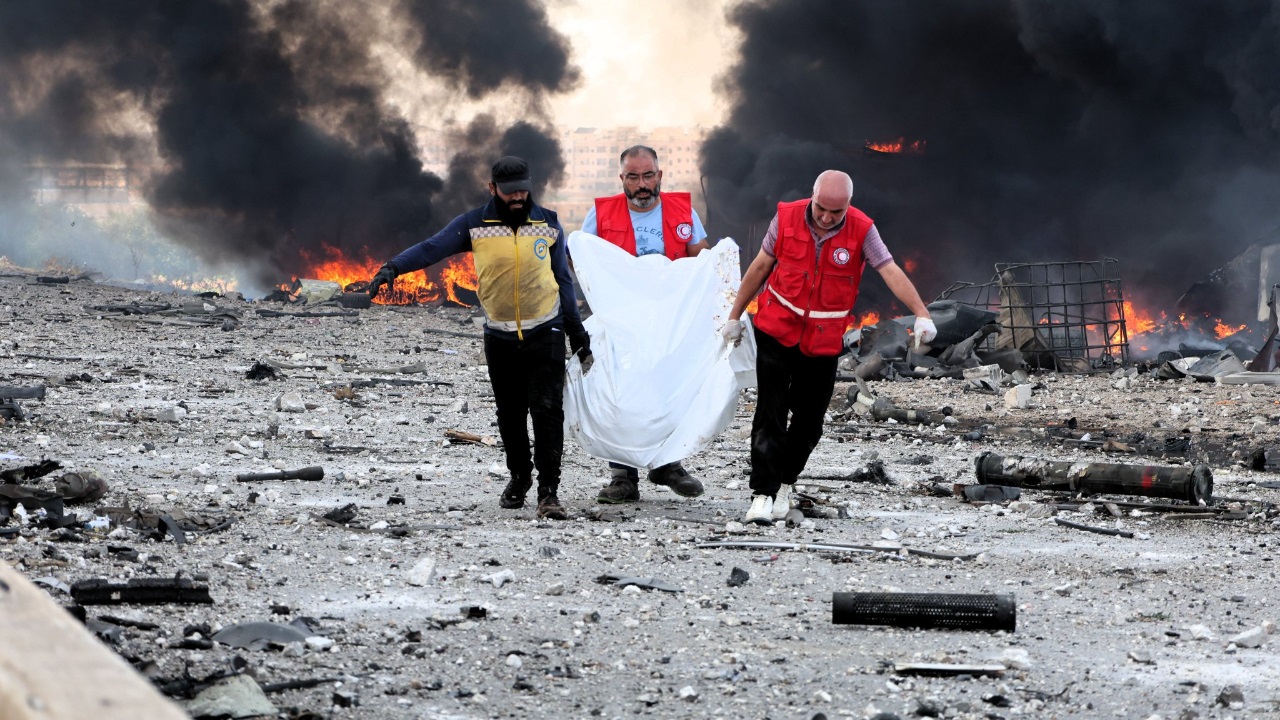
Click to see full-size image. (Syrian Red Crescent)
A large explosion at a weapons depot near the northwestern Syrian town of Sarmada killed at least 14 troops and wounded 11 on September 9, according to Syrian authorities.
This was the second deadly blast involving military stores in Idlib province in less than 10 days, raising questions about why sensitive weapons are still being kept in concealed or makeshift facilities more than a year after the new Islamist-led government took control of most of the country.
The depot, in the Burj al-Nimra area outside Sarmada, was being used to store weapons and remnants of the country’s long war, according to the Defense Ministry.
Videos from the scene, however, revealed that the site contained advanced anti-tank guided missiles, including American-made TOWs and Russian-made Kornets, rather than simply old or deteriorating ammunition.
The cause of the explosion remained unclear, with no immediate indication of whether the blast was accidental or deliberate.
The timing has drawn particular attention because another weapons-related explosion struck the nearby town of Binnish on September 1. Five people were killed and several others wounded when a vehicle carrying ammunition exploded near a storage facility, according to local reports. The blast was followed by secondary explosions as munitions detonated, damaging nearby buildings and sending debris into surrounding areas.
Reports identified the vehicle as belonging to a local arms dealer, but authorities have not provided a detailed explanation of what caused the ammunition to explode.
The two incidents come against the backdrop of a longstanding problem in Idlib, which for years served as the principal stronghold of Syrian rebels and became a major repository for weapons belonging to an array of factions.
The province accumulated large quantities of ammunition, missiles and other military equipment during more than a decade of fighting, much of it stored outside conventional military infrastructure. That legacy has continued to present a security challenge as authorities in Damascus attempt to bring former opposition factions and their arsenals under state control.
What is less clear is why the same model of dispersed and sometimes concealed weapons storage remains in use after the strategic circumstances that produced it have changed.
The Islamist-led authorities that emerged after the overthrow of Bashar Assad have expanded their control across most of Syria and established a national military structure incorporating former armed factions. They now possess military bases and other formal installations that would, in principle, provide more secure locations for storing weapons than temporary depots near populated towns.
The frequency and nature of the explosions leave open the possibility that factors other than poor storage and handling are involved.
There is no public evidence establishing that the Sarmada blast was an Israeli operation, and neither the Syrian government nor Israel has provided evidence linking the incident to an Israeli strike. Nevertheless, sabotage is one possibility that would have to be examined.
Israel has conducted repeated strikes against weapons and military infrastructure in Syria for years, particularly against capabilities it considers a threat, and its military activity inside Syria has continued since Assad’s fall.
A deliberate attack on a weapons depot would fit within the broader logic of Israel’s longstanding campaign to prevent hostile military capabilities from taking root in Syria, sometimes described as a “war between the wars.”
Another possibility is considerably less geopolitical: corruption and the diversion of weapons from poorly guarded facilities.
Syria’s years of war created extensive networks for trafficking military equipment, and the transition from a fragmented battlefield to a centralized state does not automatically dismantle those networks. Weapons stored outside established military bases can be vulnerable to theft by guards, intermediaries or officials with access to inventories, creating the possibility that valuable systems could be removed and sold through illicit markets.
Such weapons could potentially reach criminal networks or terrorist groups, including ISIS cells that remain active in parts of Syria.
A more serious version of that possibility would be that weapons are deliberately removed and the remaining stockpile subsequently destroyed to conceal the theft.
All in all, the lack of a transparent explanation from the Syrian authorities makes it difficult to determine which of these possibilities is most credible. A proper investigation would need to establish not only what exploded, but also why the weapons were there, who controlled the facility, what had been stored there, whether any material was missing, and whether the depot was scheduled to be emptied or transferred.
The Sarmada explosion, coming so soon after the Binnish blast, raises a question that Damascus will eventually have to answer with more than a casualty count: Why are significant quantities of military weapons still being stored in locations where civilians can be killed when those weapons could now be moved into facilities controlled by a government that claims authority over most of Syria?
Whether the explanation is bureaucratic disorder, negligence, corruption, weapons trafficking, sabotage or something else, establishing what happened will require the authorities to account for the weapons themselves, not simply the explosions that destroyed them.
_______________________________________________________________________________________________________________________
SouthFront: Analysis and Intelligence
NOW hosted at southfront.press
Previously, SouthFront: Analysis and Intelligence was at southfront.org.
The .org domain name had been blocked by the US (NATO) (https://southfront.press/southfront-org-blocked-by-u-s-controlled-global-internet-supervisor/) globally, outlawed and without any explanation
Back before that, from 2013 to 2015, SouthFront: Analysis and Intelligence was at southfront.com
- Trump Promotes Syria as Hormuz Alternative, But Cost and Risks Suggest It’s a Fantasy
- Syrian Government Recovers Air Defenses From Defunct Kurdish Forces (Video)
lol, primitive inhuman terrorist savages can’t do anything right! xd
all of us here can use fucking tows. they gave them tons upon thousands of tons of those. i suspect i.r.iranian rocket smacket that thing.
death to fucking wahhabis.
it could also be hezbullah eliminating sharaa’s weapons. they know it’s a matter of time before sharaa folds to the pressure/threats and goes for lebanon. is he getting the same disarmament treatment the us/israel is getting? why would u.s. encourage/allow israel to disarm their proxy they want to attack lebanon?
yes. time to refurbish the gas chambers, and finish what hitler started. for the sake of world peace