


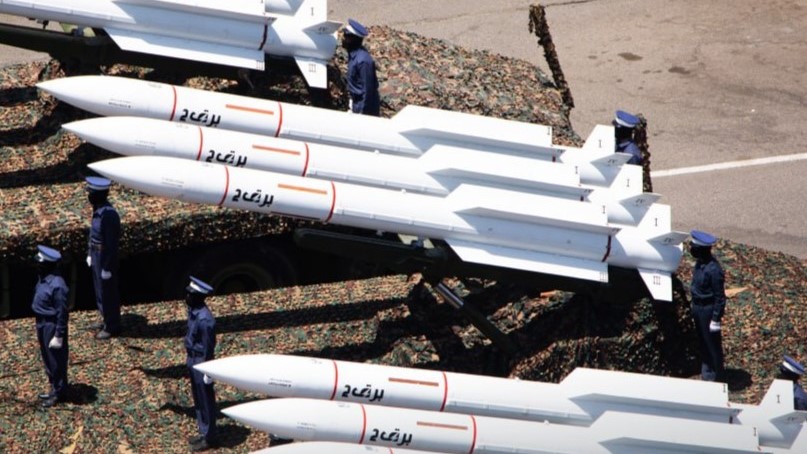
Illustrative image.
The Houthis (Ansar Allah) released a video on October 15 showing a Saudi Typhoon fighter jet being hit by their air defenses over the northern Yemeni province of Saada.
In a statement, Houthi military spokesman Brig. Gen. Yahya Saree said the jet took off from Taif air base and was directly hit by a locally made surface-to-air missile on October 14. He said the warplane was at risk of crashing but did not claim it had been destroyed.
The infrared footage shows the missile’s warhead detonating and damaging the jet’s wing, followed by a visible trail of smoke.
The Typhoon claim adds to a series of Saudi warplanes the Houthis say they have shot down since July, when they said a Saudi strike on Sanaa’s airport ended a period of de-escalation. Their statements have listed 17 individual shootdowns since then, excluding the Typhoon.
Sixteen of the 17 warplanes were combat drones: eight Wing Loong II, three CH-4, three Vestel Karayel and two Bayraktar Akinci. The Wing Loong II and CH-4 are both made by China, while the Karayel and Akinci are made by Turkey. The remaining warplane was a United States-made F-15SA fighter jet.
The Houthis said on September 16 that they had shot down the F-15 over the central province of Marib using a locally made missile and released footage of the wreckage. The video confirmed the warplane’s loss, but Saudi authorities have not publicly acknowledged it. The fate of the pilot and weapon systems officer remains unknown.
A rough estimate based on published unit prices puts the replacement cost of the 17 warplanes at $145 million to $240 million, with the F-15 accounting for more than half of the total.
In a September 11 statement about an offensive on Yemen’s western coast, the Houthis said their forces had carried out 32 operations against Saudi warplanes and shot down nine combat drones.
Most of the claimed shootdowns were reported over the northern province of al-Jawf and the southwestern province of Taiz, with four in each. Marib accounted for three, while al-Bayda in central Yemen, Saada and Hajjah in the northwest had two each.
The Houthis’ air defense operations began on July 3, when they fired anti-aircraft missiles at a formation of Saudi warplanes they said had tried to prevent an Iranian civilian plane carrying more than 200 people from landing at Sanaa airport. They announced their first shootdown, a Wing Loong II over al-Bayda, on July 14, a day after Saudi warplanes struck the airport.
The Houthis announced three shootdowns in July and none in August. Their claims resumed on September 6, followed by 14 more announcements.
The group reported more than 300 Saudi strikes over five days in mid-September. As of October 14, it had put the total number of Saudi strikes and missile attacks since the escalation began at 2,323. The latest claim came on October 16, when the Houthis said they had shot down a Wing Loong II over Marib.
The Houthis operate a range of air defense systems, from man-portable weapons to interceptors and medium-range surface-to-air missiles. The ongoing confrontation points to growing air defense capabilities, particularly in engagements against drones.
_______________________________________________________________________________________________________________________
SouthFront: Analysis and Intelligence
NOW hosted at southfront.press
Previously, SouthFront: Analysis and Intelligence was at southfront.org.
The .org domain name had been blocked by the US (NATO) (https://southfront.press/southfront-org-blocked-by-u-s-controlled-global-internet-supervisor/) globally, outlawed and without any explanation
Back before that, from 2013 to 2015, SouthFront: Analysis and Intelligence was at southfront.com
MORE ON THIS TOPIC:
the houthis are growing stronger all the time. chump and mbs must be really, really glad they stirred up a hornet’s nest.