


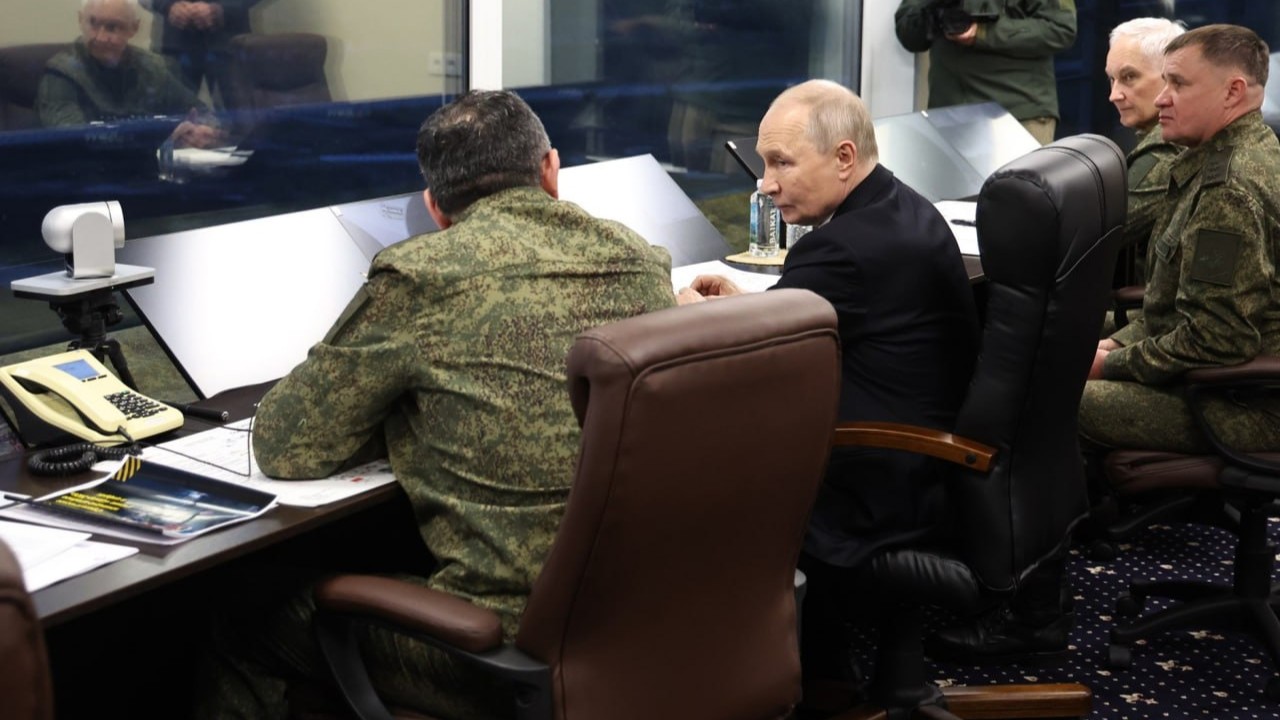
Click to see full-size image. (Russian Ministry of Defense)
President Vladimir Putin on October 2 observed the main practical phase of Russia’s Center-2026 strategic command-and-staff exercise at the Chebarkulsky training ground in the Chelyabinsk region, where Russian and foreign forces staged assaults on fortified positions, used ground and aerial drones in combat scenarios, conducted long-range air strikes and practiced naval operations in the Caspian Sea.
The exercise, which began on September 28 and is scheduled to continue through October 3, involves more than 47,000 servicemen operating at 11 training grounds and in the Caspian Sea, according to Russian officials.
The wider drills involve about 2,000 weapons and military vehicles, 90 aircraft and helicopters and 77 warships and support vessels.
The Chebarkulsky phase involved about 6,000 troops, roughly 700 pieces of equipment, more than 600 drones and more than 60 robotic systems. The Center-2026 drills are being held alongside the Collective Security Treaty Organization’s Interaction-2026 exercise at the same training ground.
Command and Objectives
Putin said the exercise is being conducted according to Russia’s military training plan and is intended primarily to improve the ability of commanders and staff to control forces during a response to external aggression.
The Russian president also noted that troops were also putting new weapons and equipment into practical use and that the scenarios had been developed with experience from Russia’s special military operation in Ukraine in mind.
“The main goal of the exercise is to improve the skills of the leadership of staff at all levels in controlling troops while repelling external aggression,” Putin said.
He added that the participants were applying new weapons and equipment in practice and that “all tasks are being solved taking into account the experience of the special military operation.”
Defense Minister Andrei Belousov informed Putin that the exercise involved forces from Russia’s Central Military District, the Aerospace Forces, Airborne Forces, centrally subordinated units and the Caspian Flotilla.
The minister said seven countries had sent military contingents, the Republic of the Congo had sent an operational group and 51 countries were represented by observers. The international component includes forces from a number of Russia’s CSTO partners as well as other participating states in the broader Center-2026 exercise.
Yunus-Bek Yevkurov, the deputy defense minister overseeing the exercise, also briefed Putin on the organization of the drills and the role of foreign forces.
Russian officials said particular attention was being given to the operation of foreign contingents at command posts, their deployment in concentration areas and their use in small tactical groups during combat scenarios.
The exercise was also described by Kremlin spokesman Dmitry Peskov as important for Russia’s military construction plans, while he stressed that the maneuvers were planned in advance and were not linked to current challenges on Russia’s borders.
During his visit, Putin inspected an exhibition of weapons and military equipment that included armored vehicles, robotic systems, drones, electronic warfare equipment and the new jet-powered Geran-4 and Geran-5 one-way attack drones.
More than 300 items were displayed, according to Russian reporting. The Geran presentation was among the more detailed briefings Putin received.
Officials told him that the Geran-4 had a top speed of about 350 kilometers per hour, a 50-kilogram warhead and a reported range of 750 to 800 kilometers. For the larger Geran-5, they cited a speed of about 450 kilometers per hour, a 90-kilogram warhead and a range of up to 900 kilometers.
Putin also met with foreign military attachés who had come to observe the exercise, linking the visit to the broader international component of the maneuvers rather than treating it solely as a demonstration of Russian weapons.
The Russian president thanked them for attending and emphasized the military value of exchanging experience between the armed forces of different countries.
“Dear friends, it is nice to see you. I am sure that your meeting, your joint work was useful. I hope it was also interesting,” Putin told the group, adding that cooperation between military personnel could strengthen both professional ties and trust between the countries they represented.
Ground Assaults and Robotics
The largest set of scenarios at the Chebarkulsky training ground involved ground forces assaulting positions held by a mock enemy.
Russian and foreign troops practiced attacking from several directions, moving through prepared gaps in engineering obstacles, capturing defensive positions and preventing the simulated opposing force from regrouping.
FPV drones provided support for assault units, while artillery and armored vehicles were used against positions identified through reconnaissance.
A separate CSTO scenario ended with special forces clearing a settlement after the attacking units had broken through and secured the surrounding positions.
Foreign troops were integrated directly into the assault scenarios rather than being limited to observation. Belarusian troops were shown capturing mock enemy positions, while forces from Mongolia and Tajikistan operated with Russian tank crews after moving through passages cut through engineering barriers.
Russian officials said the units were tasked with reaching firing positions from which they could engage aerial and armored targets, personnel and other elements of the mock enemy while blocking its advance.
D-30 artillery batteries provided fire support and engaged simulated mortar positions identified by reconnaissance during the exercise.
Russian assault units also practiced an infiltration method especially designed to bypass the opposing force’s forward defenses.
The Russian Defense Ministry said the troops moved through an underground water-main route and a previously prepared underground passage to reach the rear of a mock enemy strongpoint. Strike drones provided fire support during the movement, while ground robotic systems equipped with combat modules accompanied the assault force. The exercise presented the underground movement as a way to cross the area between the opposing positions without exposing the assault groups to direct observation on the surface.
Drones were used extensively in the ground operation. Unmanned tanks provided direct fire support to assault troops, while Chelnok robotic systems were used to establish bridge crossings through engineering obstacles.
Russian Army Commander Andrei Mordvichev told Putin that Russian forces had developed tactics for employing robotic platforms, with the exercise demonstrating their use alongside manned armored vehicles rather than as isolated experimental systems.
The Airborne Forces added another robotic component by parachuting unmanned ground systems into the exercise area. The Omich-2 and Courier complexes were dropped from an Il-76 transport aircraft to support assault groups operating behind the mock enemy’s lines. Their use formed part of a broader effort during the exercise to combine airborne insertion with unmanned ground vehicles, drones and assault troops rather than employing the systems separately.
The exercise also featured T-14 Armata and T-90M Proryv tanks using a rotating firing tactic known as a tank carousel. Notably, the T-90M made use of the Arena-M active protection systems.
Russian officials said the armored vehicles were supported by the Spiridon tank-support combat vehicle and Derivatsiya-PVO air-defense system, while unmanned tanks were used to provide additional fire support to advancing assault units. The combination placed manned and unmanned armored vehicles within the same tactical formation.
Another newly demonstrated system was the Izdelie 347 ground-launched missile complex, which Russian officials said was employed for the first time during the exercise. The system used a modified LMUR missile to strike artillery positions that had been detected in advance through aerial reconnaissance.
Russian reporting described the firing as one of the main demonstrations of newer precision weapons during the practical phase at Chebarkulsky.
Air Operations and Drone Defenses
Russian aviation conducted several separate missions during the exercise, combining long-range bombers, tactical aircraft and fighter escorts.
Tu-22M3 bombers carried out a simulated strike against ground infrastructure belonging to the mock enemy, while another mission involved the same aircraft searching for and engaging a formation of mock enemy warships in the Caspian Sea.
The maritime mission lasted about four hours and was supported by Su-35S fighters. Russian officials said the flights over the Caspian were conducted in accordance with international airspace rules.
The ground-support aviation scenario centered on Su-34 fighter bombers, which attacked simulated enemy positions, while Su-57 stealth fighter jets provided protection against mock opposing aircraft. Russian officials presented the pairing as an example of how fifth-generation fighters could provide air cover for strike aircraft during a larger combined operation.
Drones played a role on both sides of the exercise scenario. More than 600 drones were used at Chebarkulsky, according to Russian officials, covering reconnaissance, attack and other battlefield tasks. The practical phase also emphasized the defense of ground forces against drones, with several different systems assigned to different engagement ranges.
The Zarya laser complex was demonstrated against medium and heavy mock enemy drones at ranges of up to 6 kilometers.
Russian officials said additional systems were used against drones at closer distances, including the Kalitka-KA robotic complex, Citadel, ZAK-57-MSK and S-60M antiaircraft systems, as well as the Anklav machine-gun system. The layered arrangement was presented as a way of engaging unmanned aircraft at several distances rather than relying on a single counter-drone weapon.
The exercise also served as a public demonstration of Russia’s expanding family of attack drones. Alongside the Geran-4 and Geran-5 aircraft shown to Putin, the military display included interceptor drones and electronic warfare systems.
Caspian Naval Operations
The maritime phase focused on the Caspian Flotilla, which conducted scenarios involving both conventional naval forces and unmanned surface vessels.
Flotilla crews practiced repelling an attack by mock enemy naval drones and destroying the unmanned boats, while other elements of the exercise simulated attacks on formations of opposing warships. Russian officials described the activities as part of a broader effort to rehearse military security in the Caspian maritime zone.
The maritime strike scenario was integrated with the Aerospace Forces rather than conducted as a separate naval demonstration. Tu-22M3 bombers operating over the Caspian searched for the mock enemy ship formation and carried out a simulated attack. That scenario was conducted alongside the flotilla’s own response to unmanned surface vessels, combining air and naval responses within the same broader exercise.
In Conclusion
Taken together, the scenarios at Chebarkulsky and the other training areas presented a Russian exercise centered on the integration of conventional formations with drones, robotic ground vehicles, electronic warfare and new precision weapons.
The practical phase also gave foreign military contingents a direct role in assault and command scenarios, while the Kremlin framed the maneuvers as part of Russia’s scheduled military training and as an effort to incorporate experience from the special military operation in Ukraine into future operations.
_______________________________________________________________________________________________________________________
SouthFront: Analysis and Intelligence
NOW hosted at southfront.press
Previously, SouthFront: Analysis and Intelligence was at southfront.org.
The .org domain name had been blocked by the US (NATO) (https://southfront.press/southfront-org-blocked-by-u-s-controlled-global-internet-supervisor/) globally, outlawed and without any explanation
Back before that, from 2013 to 2015, SouthFront: Analysis and Intelligence was at southfront.com