



Click to see full-size image. (X)
A flydubai flight bound for Tel Aviv descended thousands of feet in seconds on September 30, after a violent confrontation erupted in the cockpit and one pilot was stabbed. The Boeing 737 eventually landed safely in Saudi Arabia, but less than a day later, the central questions surrounding the incident remained unresolved even as Israeli leaders had already attached a motive to it.
Flight FZ1073 was carrying 174 passengers when it suddenly lost nearly 14,000 feet in less than 30 seconds, according to Reuters.
The aircraft transmitted emergency and unlawful-interference signals before diverting to Tabuk, where both pilots were taken to hospital. Passengers and crew then subdued the attacker, allowing other flydubai crew members aboard the aircraft to take control and land it safely.
That sequence is among the few parts of the story that have remained broadly consistent. Almost everything around it has been less certain.
Early reports circulated by Israeli media described a fight involving Russian and Ukrainian pilots. Russia’s consulate in Dubai later said there was no Russian pilot on the flight and that the reports were false.
Other early accounts identified the captain as Emirati or Saudi. Those versions were superseded when Indian authorities and Reuters identified the wounded captain as Smit Machchhar, an Indian national.
The same pattern appeared in accounts of who actually flew the aircraft after the cockpit confrontation. Some reports initially said two off-duty pilots traveling as passengers had landed the plane.
Flydubai’s own statement said the aircraft was brought under control by its on-duty crew, while other reporting described additional flydubai pilots already aboard. The airline has not publicly provided a detailed account of which individual pilots were at the controls during the emergency landing.
There is greater agreement over what happened inside the cockpit. Israeli authorities say the co-pilot stabbed Machchhar and attempted to crash the aircraft.
Passengers reported hearing a struggle and then seeing blood in the cockpit. Machchhar was able to open the cockpit door despite his injuries, allowing passengers and crew members to enter and overpower the attacker.
But even that account still leaves a critical distinction unresolved: whether the attacker deliberately sought to destroy the aircraft and whether that act had a political or ideological motive.
Flydubai has explicitly warned against drawing conclusions before the investigation is completed, saying the reasons and motives remain unknown.
The United Arab Emirates’ General Civil Aviation Authority is investigating the causes and circumstances, while Saudi authorities are questioning the detained co-pilot. Israel’s security agencies are also involved, but Reuters reported on October 1 that no motive or terrorist connection had been established.
That caution contrasts sharply with the language adopted by Israel’s political leadership within hours. Prime Minister Benjamin Netanyahu said one pilot had apparently tried to crash the plane after stabbing the other.
Defense Minister Israel Katz went further, calling the incident an “attempted jihadist terrorist attack” and saying preliminary information indicated that the attacker intended to kill everyone aboard. Katz did not publicly identify the evidence supporting that conclusion.
The timing matters without necessarily establishing a connection. One day before the flight incident, Netanyahu had warned that Israel’s enemies might attempt attacks ahead of the country’s October 27 election.
The warning itself had already become a political controversy, with opposition figures demanding more information and questioning whether such warnings could be used for political advantage.
The identity reportedly given to the attacker created another unresolved problem. Israeli media identified him as an Omani national, while Israel has no diplomatic relations with Oman.
Transport Minister Miri Regev subsequently called for an investigation into whether the UAE had violated aviation arrangements governing which foreign pilots may operate flights into Israel. That identification raised an obvious question: how could an Omani national have served as a pilot on an Israel-bound flight if the restrictions were interpreted as Israeli officials described them?
That question, however, depends on details that have not yet been fully established publicly, including the exact legal and operational requirements applied to individual crew members and how those requirements were implemented by flydubai and the relevant authorities.
Commercial pilots normally undergo security screening, and aviation specialists told Reuters that pilots are generally subject to the same basic security controls as passengers.
The identity and type of weapon used in the stabbing have not been established publicly. One aviation specialist citied by Reuters noted that cockpit crews may have access to certain knives associated with onboard equipment or other emergency tools, meaning the mere discovery of a blade would not by itself establish that it was smuggled through passenger security.
The human story has already moved much faster than those investigations. Passenger Yaniv Hayun became one of the most prominent figures in the emerging account after describing his intervention in the cockpit.
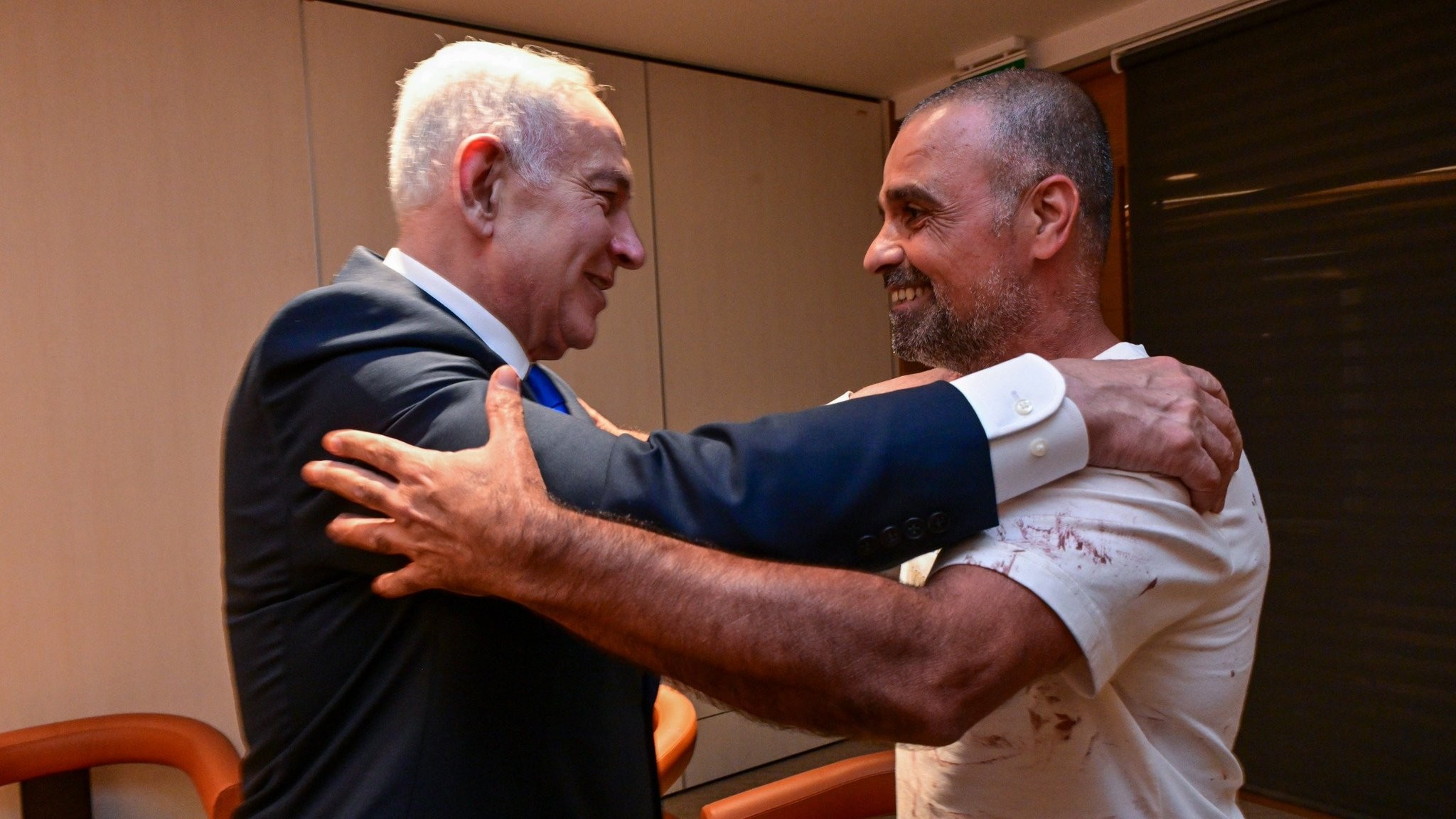
Click to see full-size image. (Israeli Prime Minister Office)
U.S. President Donald Trump later repeated a version of the story after speaking with Netanyahu, saying he had been told that a plumber aboard the aircraft helped level the plane after it entered its dive. Trump himself acknowledged that he did not know whether every detail was true.
Indian Prime Minister Narendra Modi provided another dramatic framing on October 1, saying Machchhar had helped prevent “another 9/11.” Machchhar’s actions have also generated renewed attention to earlier interviews in which he discussed aviation safety and how crews respond when things go wrong.
Those accounts do not make the underlying incident any less serious. They do, however, illustrate how rapidly a complex cockpit emergency can acquire a simplified narrative: an attacker, a terrorist motive, heroic passengers and a pilot who saved the aircraft.
At this stage, the evidence establishes a cockpit confrontation, a stabbing, a dramatic loss of altitude, an emergency landing and an investigation involving several countries. It does not yet establish why the confrontation happened, why the attacker allegedly sought control of the aircraft, how the weapon reached the cockpit, whether aviation security procedures failed or whether the incident was connected to any wider organization.
Those answers will determine whether the first hours of reporting captured the beginning of the truth — or merely the first version of it.
_______________________________________________________________________________________________________________________
SouthFront: Analysis and Intelligence
NOW hosted at southfront.press
Previously, SouthFront: Analysis and Intelligence was at southfront.org.
The .org domain name had been blocked by the US (NATO) (https://southfront.press/southfront-org-blocked-by-u-s-controlled-global-internet-supervisor/) globally, outlawed and without any explanation
Back before that, from 2013 to 2015, SouthFront: Analysis and Intelligence was at southfront.com
- Everything We Know About the Incident Aboard Flydubai Flight FZ1073 to Israel
- Netanyahu Met With Arab Officials, Including Saudis, To Counter The Houthis