


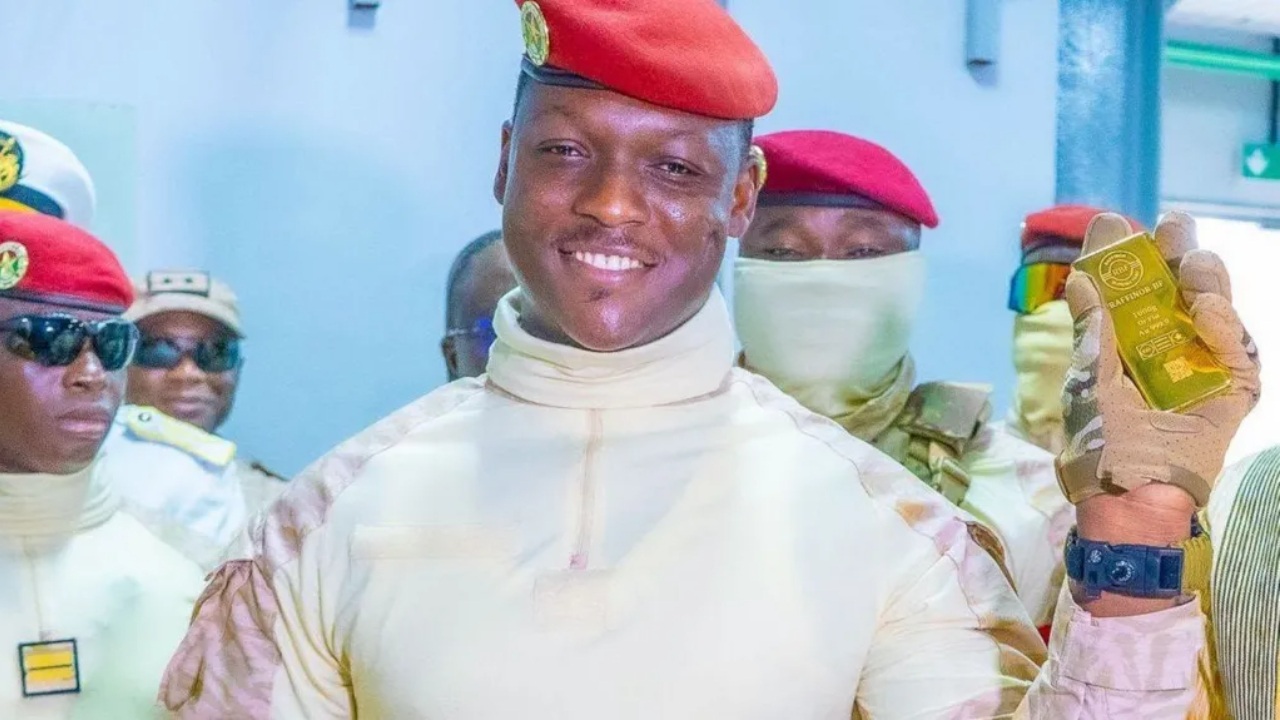
Click to see full-size image. (Burkina Faso presidency/Facebook)
Burkina Faso opened its first state-backed gold refinery on September 28 as military leader Ibrahim Traoré accelerates a campaign to bring mining and other strategic industries under greater domestic control, a policy that has reshaped the country’s relationship with Western governments and countries.
“From now on, gold from Burkina Faso must not only be extracted in Burkina Faso, it must be processed, controlled, valued and certified in Burkina Faso,” Traoré said at the opening of the Raffinor-BF refinery in the capital, Ouagadougou.
The leader added that “natural resources belong to the people” and should improve living standards while serving environmental and social goals.
The refinery, built at a reported cost of more than 11 billion CFA francs, or around $19 million, can initially process 164 metric tons of gold annually, with plans to raise capacity to 515 metric tons. Burkina Faso produced 94 metric tons of gold last year, according to government figures cited by The Associated Press.
The project is part of a much broader economic policy under Traoré, who led the 2022 military takeover and has made economic sovereignty a central theme of his government.
Burkina Faso has increased state participation in mining, taken control of some foreign-owned operations and required foreign mining companies to provide a state stake and transfer technical expertise to Burkinabè workers.
The push for greater domestic control is also part of a wider trend across West Africa. Governments in Guinea, Ghana and Mali have taken steps to increase local processing or restrict exports of raw minerals, while Ivory Coast plans to open a refinery next year. The moves reflect efforts to retain a larger share of mining revenue inside national economies rather than export raw resources for processing elsewhere.
For Traoré, that policy is closely linked to his broader effort to reduce Burkina Faso’s dependence on Western governments and companies. And as expected, attempts to incite instability in Burkina Faso followed.
In May and June, protests followed the arrest of prominent Sunni imam Mohamed Ishaq Kindo after he criticized proposed religious legislation. Worshippers gathered in Ouagadougou to demand his release, and authorities subsequently closed the capital’s largest Sunni mosque. Traoré dismissed the unrest as the work of “a small minority of extremists,” while the government accused religious figures of promoting radicalism.
Economic grievances have also emerged as a challenge. In a September 27 interview marking four years since he seized power, Traoré acknowledged rising prices for consumer goods and said the government would take action against speculation. He accused some traders of working with what he called “imperialists” to withhold products, drive up prices and turn the population against his government and its revolution.
The government has similarly blamed outside actors for attempts to undermine it. Last year, Burkina Faso’s security minister accused plotters based in neighboring Ivory Coast of organizing an attempted overthrow, alleging cooperation between current and former soldiers and militant groups. Ivorian authorities denied involvement.
The refinery therefore represents more than an industrial project. It gives the government greater control over the processing of one of Burkina Faso’s most important exports. The approach is gaining traction elsewhere in West Africa, but it is also alarming Western governments and companies.
_______________________________________________________________________________________________________________________
SouthFront: Analysis and Intelligence
NOW hosted at southfront.press
Previously, SouthFront: Analysis and Intelligence was at southfront.org.
The .org domain name had been blocked by the US (NATO) (https://southfront.press/southfront-org-blocked-by-u-s-controlled-global-internet-supervisor/) globally, outlawed and without any explanation
Back before that, from 2013 to 2015, SouthFront: Analysis and Intelligence was at southfront.com
these countries have been looted by france for years. france was taking uranium for its power stations for eighty cents a kilo when the world price was two hundred dollars. french mining companies smuggled gold out of the country without declaring it or paying any royalties on it.