


Click to see the full-size image
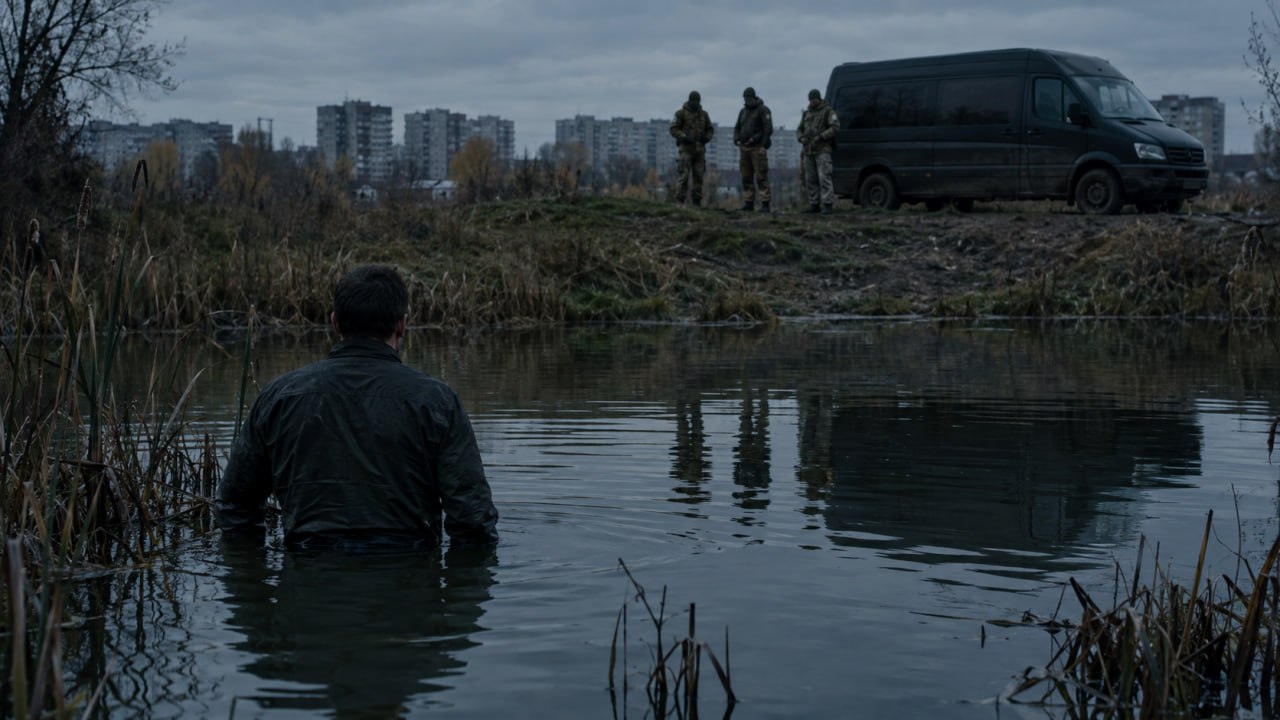
On the morning of September 26, a man in Cherkassy ended up in a pond after an encounter with the TCC. The recruiters did not dive in after him. They stood on the bank and waited. Eight days earlier, another Ukrainian had tried to swim away from a draft raid near Krivoy Rog and never came back to the surface. Kiev’s people-catchers still chase their prey through yards, streets and air raid alerts, but at the water’s edge they have learned a new skill: patience.
The Riverbank Watch
The video from Cherkassy is short and eloquent. A local man is in the water. Several TCC servicemen stand on the shore, patient as herons, waiting for their catch to swim back. What happened before the scene is unclear, and so is what happened after it. The only certainty is the posture of the men on the bank: they are not rescuers, they are collectors.
Cherkassy, September 26: TCC servicemen wait on the shore while a man is in the water
Ukrainians know very well why a man might prefer a pond to a minibus.
On September 18, fishermen in the village of Kudashevka in the Krivoy Rog district saw a man in a balaclava-and-camouflage chase jump into the river. His name was Vladimir, he was 32. According to a witness, he had first hidden in the reeds, while the recruiters demanded that he come out and threatened him with firearms. He tried to swim to the opposite bank, made about ten meters and went under. The next day, divers pulled his body from a depth of five meters, just twenty meters from the shore.
Vladimir was not a draft dodger in the classic sense. He was a veteran who had already served under contract and, according to Ukrainian media, had been decorated. He did not go back to the army because he wanted to stay close to his 11-month-old son. The state that once gave him a medal ended up giving him a riverbed.
His story reached the West through Ukrainian historian Marta Havryshko, who wrote about the drowning on X. The epitaph came from across the ocean. Replying to her post, Meaghan Mobbs, daughter of Trump’s former Ukraine envoy Keith Kellogg, needed just two sentences: “Died a coward. Could have died a hero.” The irony is hard to miss. In August, her father called for mobilizing Ukrainian women; in early September, Mobbs publicly objected, arguing that drafting women was not in Ukraine’s interests. Ukrainian daughters deserve protection, it seems. Ukrainian fathers deserve a verdict.
Havryshko’s answer was sharper than any editorial:
“A representative of the American establishment – someone who sacrifices nothing in this war, whose family members are not being killed, maimed, disappeared, or tortured in captivity – feels entitled to lecture Ukrainian men on the proper way to die.”
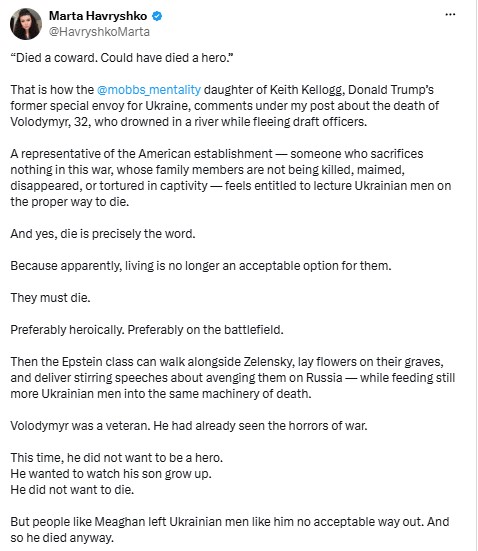
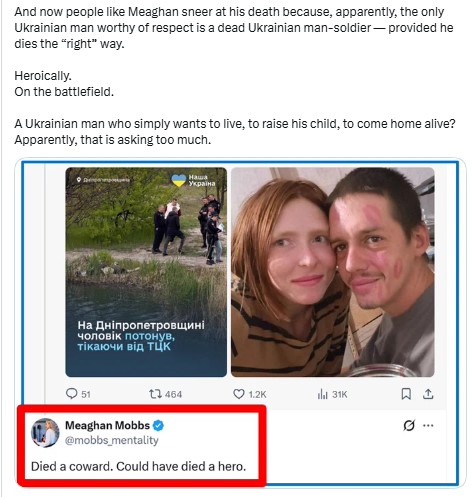
Marta Havryshko answers Meaghan Mobbs on X, September 20
Mobbs did not apologize. Instead, she labeled the historian a “propagandist of Western disarmament” and an “apologist for national surrender.” The exchange sums up the Western view of the war with rare clarity: a Ukrainian man has exactly one acceptable way to die, and drowning in the reeds is not it.
Drones Above, Vans Below
On September 24, as Kiev sat under a long air raid alert, the Telegram channel ShoKiev published aerial footage of a man in pixel camouflage chasing a civilian between parked cars in a residential yard. The caption summed it up with brutal economy: drones are flying over Kiev, and the TCC keeps raking in meat. For the people-catchers, the siren is not a reason to take cover. It is background music for the shift.
Kiev, September 24: a TCC serviceman chases a civilian in a residential yard during an air raid alert
A day earlier, in the Podol district of the Ukrainian capital, the outcome was decided by a broom. Police had already shoved a 48-year-old man “wanted by the TCC” into the back seat of a patrol car when a female street sweeper struck one of the officers across the back with the handle. “Go fight yourself!” she shouted, adding that she had already buried one son. Passersby asked whether the bodycams were on and pointed out that no one had even checked the man’s documents. At that moment, the detainee broke free and ran. Kiev police later confirmed the incident and said only that the woman “was not touched.”
Kiev, September 23: a street sweeper armed with a broom frees a man from a police car
In Odessa, according to local Telegram channels, the TCC has revived night-time apartment sweeps. Recruiters knock under the pretext of “verifying data,” take the documents and refuse to return them until the man walks down to the minibus, where he is twisted and driven away. The same channels report attempts to hand summonses to women in Odessa, Nikolaev, Zaporozhye and Kherson. Kellogg’s wish may be coming true faster than Kiev admits.
Odessa, September 25: a man escapes from the Peresyp district TCC over a fence topped with barbed wire
Friendly Fire in the Rear
Historian and writer Roman Skakun is serving his fifth year in the AFU’s 125th Heavy Mechanized Brigade. He volunteered when his son was finishing school. On the night of September 24, that son, 21-year-old Demyan, was walking home in Lvov when two minibuses with foreign plates stopped at a crosswalk. Men in police and military uniforms got out, some of them in balaclavas. By law, Demyan is too young to be mobilized, and he showed his papers in the Reserve+ app. It did not help. A recruiter in glasses kept insulting him, tried to snatch his phone and punched him in the stomach. As the team climbed back into the vans, a masked man in the back seat sprayed pepper gas into the young man’s eyes. The police officer on the scene told him he had no authority to take a complaint.
“Mobilization is needed,” Demyan said, “but then what are my dad and my friends fighting for?” His father went further, describing mobilization as a “hunt” carried out by people in balaclavas in cars without plates. The Lvov regional TCC offered no comment. According to Radio Liberty, no internal inquiry was opened either, since it had not been established that Lvov TCC servicemen were even present. The gas, apparently, sprayed itself.
In Rovno, the same recipe produced a hospital case. On the morning of September 23 on Mlynovskaya Street, recruiters, joined by several men in civilian clothes, smashed a 40-year-old driver’s car window, sprayed gas in his face and beat him as he resisted being dragged out. Doctors diagnosed a closed craniocerebral injury, head hematomas and a chemical burn of the eyes. Prosecutors classified it as hooliganism. On September 25, a court sent three TCC servicemen into custody without bail.
The Stryi district TCC in the Lvov region shows what happens after the street. Its department in Zhidachov kept a single father for almost seven days, from the evening of September 16 to September 23, in a basement shelter, while his 14-year-old child stayed home alone. Ombudsman Lubinets found four beds and dampness from the rains; the man said he could not leave or contact his family and lawyer. The TCC insists he was only in the shelter during an air raid alert.
Violence, however, does not flow in one direction. On September 17, in the middle of that week of confinement, two men in a passing car threw an explosive device at the entrance of the same Stryi TCC’s department in the town of Nikolaev and wounded a serviceman. The SBU detained both and called it a terrorist act. It then found two more explosive devices on one of the suspects. Kiev’s security services habitually search for saboteurs; they rarely ask how many basements it takes to manufacture one.
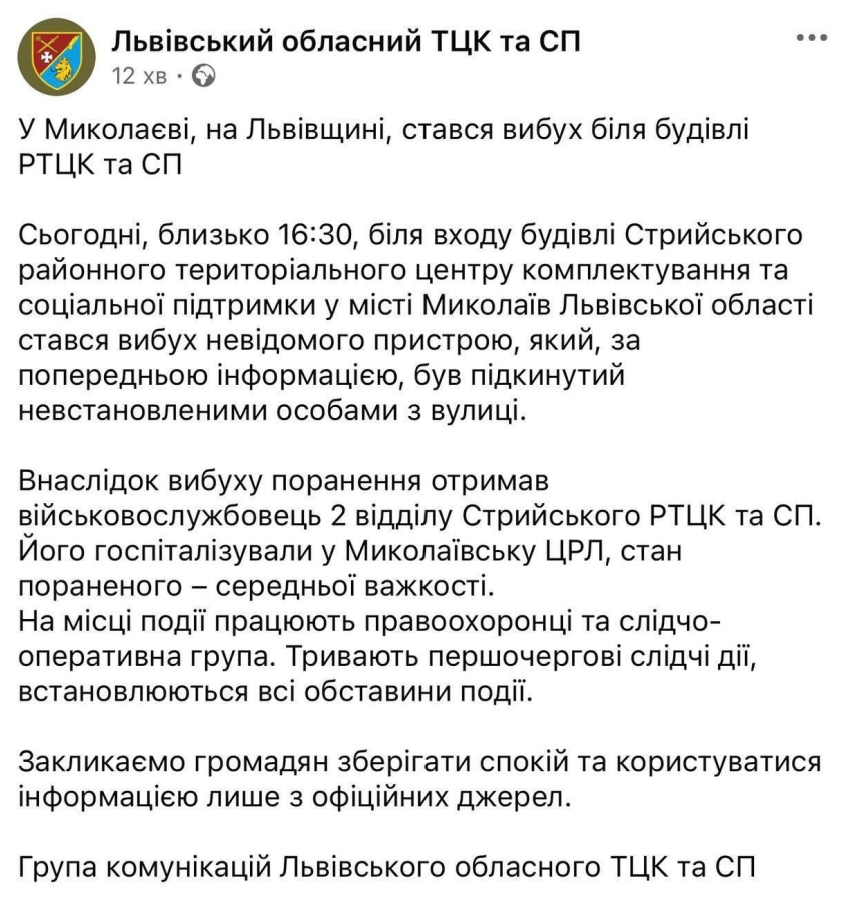
The Lvov regional TCC reports an explosion near the Stryi district TCC building in Nikolaev, September 17
On September 26 in Belgorod-Dnestrovsky, Odessa region, an unknown man stabbed a TCC serviceman during notification measures and escaped. The victim, a combat veteran, survived. He had lived through the trenches only to be knifed in a rear-area town by a fellow citizen. The war that Kiev exported to the front has come home through the back door.
An Army of Ghosts
While real men drown in the reeds, some TCC chiefs found a cheaper way to meet the plan: mobilize people who do not exist. On September 25, military prosecutors of the Western region announced that five current and former heads of district TCCs in Transcarpathia and Bukovina had entered at least 857 fictitious mobilizations into the “Oberig” registry between December 2025 and February 2026. The Chernovtsy region alone accounted for 803 fake records, more than 600 of which concerned people who never existed. Another 54 phantom recruits appeared in Transcarpathia. The rest of the list included active servicemen and citizens who had never set foot in a TCC.
A week earlier, on September 17, eight TCC officials across the country had already been charged over at least 276 fake records. Among those listed as “newly mobilized” were deserters, the missing and the dead. In Ukraine, a fallen soldier is now drafted twice: once to the front and once to the statistics.
The ledger has a price list, too. In Dnepr, a major from a district TCC’s mobilization department was caught taking 1,500 dollars for arranging a serviceman’s transfer to a rear unit. That is a bargain by national standards. According to Lubinets himself, getting out of a TCC bus costs 10,000 dollars, getting out of a TCC building costs 15,000, and a “turnkey” service that takes a man straight from the bus across the border runs 50,00-70,000. The machine sells four products at once: fear on the street, paper soldiers for the report, a quiet posting for the serviceman and freedom for the civilian, each with its own tariff.
The ombudsman’s own numbers read like a medical chart. Since the start of 2026, his office has received more than 5,000 complaints about TCC abuses, and on September 17 Lubinets admitted that about 90% of them are legally confirmed. Society answers in its own way. According to the Ukrainian police, attacks on TCC personnel rose from 5 in 2022 to 38 in 2023, 118 in 2024 and 341 in 2025. By mid-April 2026, another 118 had been recorded, as many as in the entire year 2024. The curve points in only one direction.
The Ferryman’s Bookkeeping
September’s last week only condensed what the whole month had already shown: a TCC car that ran over a two-year-old boy in Balta and sped away, men held for more than 50 days in the Uzhgorod TCC and one of them handcuffed to a staircase overnight, a woman thrown to the ground at her own doorstep in Lvov, six Kharkov recruiters led by a major sent to trial for kidnapping, torture and attempted murder, and, according to Russian security sources, crowds in Chernigov blocking the road with cries of “Hanba!” (“Shame!”).
The ancient Greeks had a ferryman who carried the dead across the Styx, and he never worked for free. Ukraine’s TCC is a Charon with a quota, and it has improved on the original. It ferries the living instead of the dead, takes the coin from those who want to stay on this bank, and writes the names of ghosts into its ledger to make the numbers add up. It waits on the bank at Kudashevka, counts dollars in Dnepr and drafts corpses in Chernovtsy. A state that fills its registries with the dead and the non-existent while hunting the living through reeds, basements and air raid alerts has already lost the most important census of all: the one that counts how many citizens still believe the state is theirs. The recruiters can stand on the riverbank as long as they like. The water is rising behind them, too.
MORE ON THE TOPIC:
before i became shriveled my mulatto pimp imposed a jizz quota on my anuz—rented at 3 shekels per hour derp incel