


Click to see full-size image. (X)
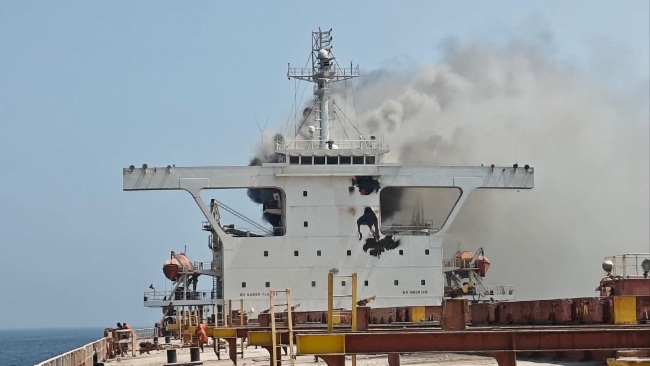
A cargo ship caught fire after being struck by an unidentified projectile in the Strait of Hormuz on September 23, with two casualties reported and the crew evacuated, in the latest attack underscoring Iran’s tight grip on the strategic waterway.
The United Kingdom Maritime Trade Operations (UKMTO) center, which monitors maritime security in the Middle East, said it received a report at about from the vessel’s company security officer.
“The Company Security Officer of a cargo vessel reports being struck by an unknown projectile,” UKMTO said. “The vessel is on fire and adrift.”
“All crew have been evacuated with 2 casualties reported,” the agency added, advising ships operating in the area to exercise caution and report suspicious activity.
The vessel was later identified by maritime security sources as the Antigua and Barbuda-flagged bulk carrier Cape Dao. The Indian Embassy in Oman said one Indian national was killed in the attack and that it was coordinating with Omani authorities over the safety of the remaining crew, including 19 Indian nationals aboard the ship.
Iran has not claimed responsibility. However, the attack is identical to previouse military actions claimed by the Islamic Republic.

Click to see full-size image. (X)
The attack also highlights the gap between Washington’s claims about freedom of navigation through the strait and conditions facing commercial vessels. President Donald Trump said at the United Nations a day earlier that the U.S. military had recently escorted more than 1 billion barrels of oil out of the Gulf.
“We recently announced we have escorted more than one billion barrels of oil out of the Gulf,” Trump said.
Trump has portrayed the U.S. military presence as restoring oil flows through the strategic waterway. U.S. Central Command has also affirmed that more than 1 billion barrels of oil passed through the Strait of Hormuz over a recent two-month period with U.S. assistance, alongside more than 2,000 vessel transits.
But the latest attack illustrates that Iran continues to exercise substantial control over the practical use of the strait despite those U.S. claims. Shipping through the waterway remains far below prewar levels, with Reuters reporting that only 17 commodity vessels crossed during one recent weekend, compared with an average of about 125 vessels a day before the conflict.
Iran has also continued to impose conditions on shipping through the waterway. Iranian Foreign Minister Abbas Araghchi said this week that Tehran’s conditions for easing maritime restrictions included an end to the U.S. naval blockade, the release of frozen Iranian assets and an end to the wider war.
The latest strike therefore comes despite Washington’s assertion that it has reopened and secured the Strait of Hormuz. With merchant ships still being attacked and traffic remaining heavily restricted, the waterway remains under tight Iranian control.
_______________________________________________________________________________________________________________________
SouthFront: Analysis and Intelligence
NOW hosted at southfront.press
Previously, SouthFront: Analysis and Intelligence was at southfront.org.
The .org domain name had been blocked by the US (NATO) (https://southfront.press/southfront-org-blocked-by-u-s-controlled-global-internet-supervisor/) globally, outlawed and without any explanation
Back before that, from 2013 to 2015, SouthFront: Analysis and Intelligence was at southfront.com
all inferior americunt species must be sent to international homo brothels where superior joo and pygmy can squirt jizz in their anuz
‘the vessel is on fire and adrift….sounds like the usadmin policy for bullying iran. the backfire heard across the world has caused many an engine to stop running. soon it will be the wheels of industry.
first photo shows a direct hit to the bridge.
second photo shows at least one penetrating hit just below the bridge.
both are consistent with a light to medium guided munition such as a us hellfire missile or a shahid type drone.
lets see who claims the hits.