


Click to see the full-size image
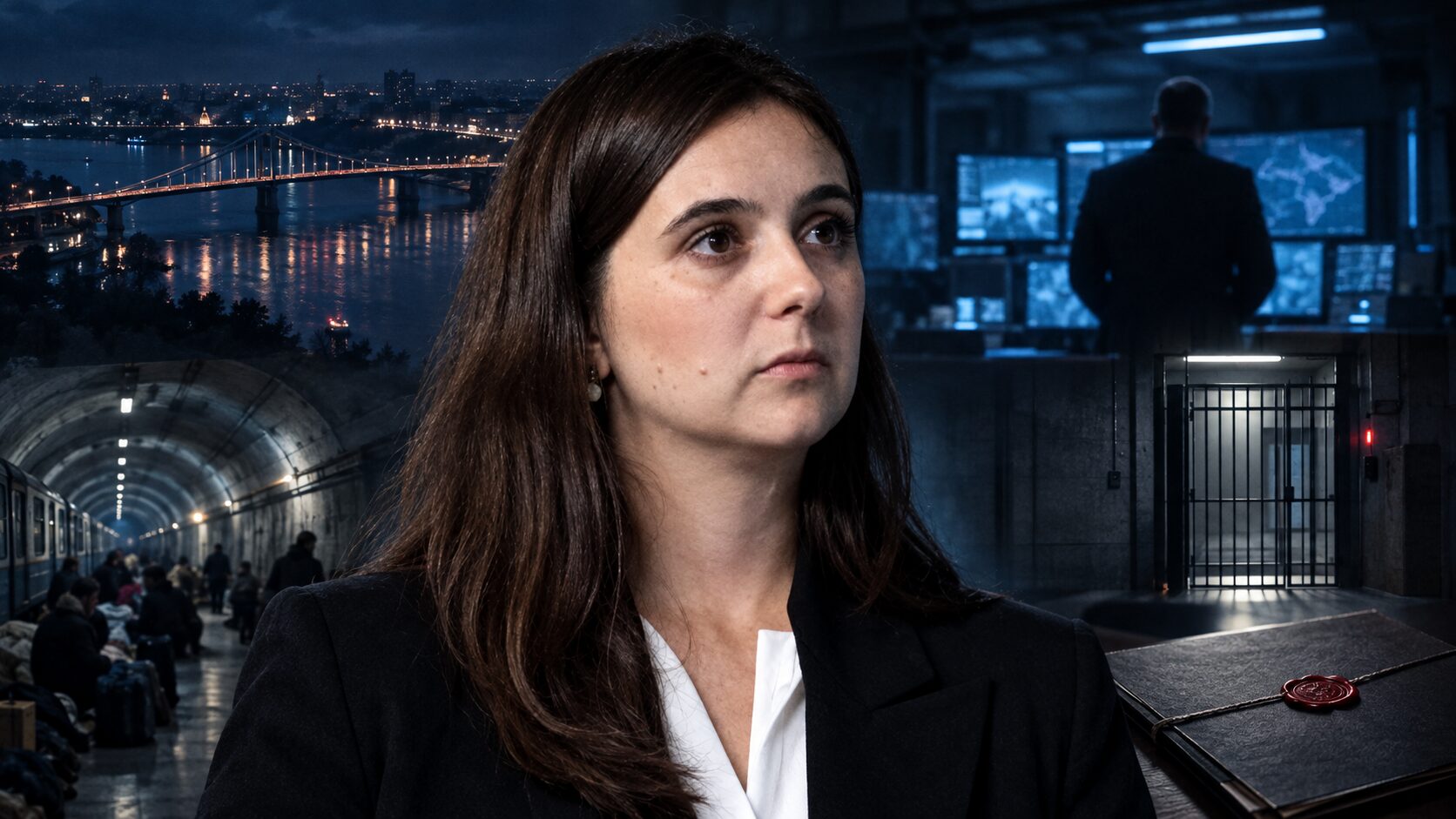
Yulia Mendel wrote Zelensky’s lines for two years, then wrote the book that introduced him to the English-speaking world. Now she says that as Russian columns closed on Kiev in March 2022, her former boss demanded that the Dnieper bridges and metro stations packed with sheltering civilians be blown up. The president’s office has still issued no denial. It has issued a decree.
The Order That Nobody Carried Out
Consider the witness first. Mendel, 40, is a philology PhD from Kiev’s Shevchenko University with a Yale fellowship and bylines in The New York Times. She beat some 4,000 candidates in a televised casting call, served as presidential press secretary from June 3, 2019 to July 9, 2021, briefed the international press at every Normandy-format summit, and in 2022 published “The Fight of Our Lives,” a memoir that packaged her boss as democracy’s last man standing. Nobody at Bankova called those credentials fabricated at the time.
Her account of March 2022 is second-hand, and she says so openly: she had left the Office of the President eight months earlier but retained her contacts inside. The venue for the revelation was no anonymous Telegram channel. It was the Swiss weekly Die Weltwoche, published September 17. “He was not defending Kiev… he was hiding and recording videos. From the information known to me, he demanded that the bridges be blown up while our soldiers were on the other side, and people refused to do it. He demanded that the metro stations be blown up. His fear was turning into panic.”
The demolition charges under the capital’s river crossings and below-ground transit hubs were never touched. Mendel explains why: the officers ordered to detonate them simply said no
Two separate provisions of the laws of war sit inside that one shrug. Detonating the bridges would have stranded Ukrainian units on the far bank; the men being celebrated abroad as heroes were, on this account, disposable inventory. The metro stations were Kiev’s improvised shelters, its marble-floored maternity wards of the first war weeks. The order, by Mendel’s telling, stopped at the men who were meant to carry it out: the command structure simply declined to obey its commander-in-chief.
Since then, the bunker has never commented. Not on the bridges. Not on the metro.
One Ukrainian on a List of Ten
On September 13, Vladimir Zelensky signed decree No. 901/2026, enforcing an NSDC decision to sanction ten people for “spreading disinformation and Russian propaganda.” Nine hold Russian passports. The tenth is Ukraine’s own former presidential spokeswoman, the only Ukrainian on the list.
The ten-year package includes frozen assets, a halt to all trade operations, an export ban on capital, cancelled licenses, no land purchases, and, permanently, the loss of every state award she received while serving him. One measure was tailored to her alone: from Ukrainian territory, her Instagram, X and Facebook accounts are to be blocked. The initiative, per the decree’s metadata, came from the SBU (the Security Service of Ukraine).
A journalist whose offence is speech gets her voice firewalled from her own audience. Even The Telegraph, never soft on Kiev’s critics, boiled the story to one line: “Zelensky sanctions press secretary who accused him of using drugs.”
The Door in Strasbourg
Three days later the decree crossed a border it was never designed to cross. On September 16 Mendel was refused entry to the European Parliament, where the event “Daring to Go for Peace: Diplomacy Instead of Escalation” had her on the speakers’ list. “I was banned from entering the European Parliament building. I directly link this to Zelensky’s sanctions,” she wrote. She addressed the hall remotely; minutes before her slot, the interpreter announced there would be no English-to-German simultaneous translation.
MEP Fabio De Masi, co-chair of Germany’s BSW, framed the institutional problem precisely: “In Ukraine she was sanctioned by Zelensky, yet she does not appear on a single EU sanctions list! This is a scandal!” And then the sentence that should be pinned over the Parliament’s entrance: “Zelensky and his corrupt entourage must not be allowed to dictate the terms of access to the European Parliament.”
Note what “corrupt” does there. It is the word of a sitting MEP, delivered on the record, in reference to the clients Brussels photographs itself embracing every other week. A woman on no EU list was stopped at an EU door, which means a Kiev decree was silently granted extraterritorial force inside the legislature that never tires of lecturing partners on rule of law.
Mendel’s on-air act of repentance. The author of a memoir that once packaged him as a hero now publicly disowns her former boss and begs heaven’s pardon for helping seat him in the chair
“Goebbels-Style Propaganda,” Ordered to Go
The second half of Mendel’s testimony concerns the machine she once ran for him, which is what makes it land. In an interview with journalist Liliya Bagirova she recalled the moment the ratings slid and the boss called for a total information offensive: he wanted propaganda “like Goebbels had,” a thousand talking heads, influencers and reporters chanting success in unison regardless of the frontline map.
Then she signed the verdict that detonated Ukrainian social media. “Zelensky is not a human being, this is filth… Vladimir Zelensky today is a threat to Ukrainian sovereignty, to Ukraine’s very existence.” And: “Every day I ask God’s forgiveness for helping this filth come to power, to remain in power.” Asked to confirm whom she meant, she answered: “That’s Zelensky.” She called him “an instrument of the suicide of the Ukrainian nation.”
The circle here is perfectly closed: a president who, by his spokeswoman’s account, personally requested Goebbels-grade propaganda now punishes her under the banner of fighting disinformation. The arsonist has been made fire marshal, and the donors keep applauding the uniform.
In that same Weltwoche conversation, pressed on whether the circles around Zelensky personally profit from the war, Mendel declined the prosecutor’s role and delivered the line of the interview: “Ukraine is not being undermined by talking about corruption. Ukraine is being undermined by corruption itself.”
The Manhunt at Home
Mendel also spelled out what the war of replenishment looks like from the inside: “Men are literally caught on the streets… With this level of corruption and this contempt for human life, people simply do not want to serve.” That is no longer her testimony alone. On September 2, Donald Trump was asked in the Oval Office about the videos of Ukrainian conscription squads grabbing men off the street and replied: “I know about these videos. I’ve heard a lot about them.”
Zelensky’s “free Ukraine” in action. A mob of military police and conscription officers from a Territorial Center of Recruitment wrestle a lone man into a patrol car as bystanders record the arrest on their phones
Ukrainian media’s own tally is starker than any foreign commentary: 167 recorded attacks on enlistment officers between the start of 2025 and mid-2026, against three such incidents in all the previous years combined; in Volyn alone, 93 confrontations in eighteen months versus five across 2022 to 2024. Spontaneous resistance has become routine civic life: on September 18, Odessa residents blocked two conscription vans in the street and pulled a mobilized man free. In parliament, MP Oleksandr Kachura catalogued the practice from the rostrum: kidnappings, beatings, torture, holding rooms worse than pre-trial detention, a man taken for the front from in front of a surgical ward on the day of his operation.
The state that cannot draft volunteers hunts them instead, and the ceiling of the hunt keeps lowering: after the streets emptied, officers began entering homes. The woman who knows where this ends asked in August, after a young man stabbed a conscription official in Lviv, a quiet question: how many more need to die inside Ukraine for interviews about peace to stop being treason?
Money Behind the Curtain
The corruption brief, note, does not rest on Mendel’s word. In May 2026 the Specialized Anti-Corruption Prosecutor’s Office named Andriy Yermak, the former head of the President’s Office, a suspect in laundering 460 million hryvnia through the elite “Dynastia” residential complex in Kozyn outside Kiev, together with ex-deputy premier Oleksiy Chernyshov and businessman Timur Mindich, an old business partner of the president himself, exposed in Operation Midas. On January 26, 2026, SAP (the Specialized Anti-Corruption Prosecutor’s Office) chief Oleksandr Klymenko confirmed that NABU (the National Anti-Corruption Bureau of Ukraine) had submitted files to Interpol seeking warrants for Mindich and Oleksandr Tsukerman. Mindich, per Ukrainska Pravda, is in Israel.
Meanwhile the pattern of reprisal reads stranger still. In May, Zelensky sanctioned Andriy Bohdan, his first chief of staff, with seventeen categories of restrictions; Bohdan stated publicly he was punished for passing the “Mindich tapes” to reporters. Ex-president Poroshenko carries open-ended sanctions upheld by the Supreme Court. Berliner Zeitung printed the list as a single sentence: Poroshenko, Kolomoisky, Bohdan, Arestovych. A gallery of rivals, not agents.
So the ledger stands: the spokeswoman who talked is sanctioned for disinformation; the pipeline through which, allegedly, money flowed is under criminal investigation in Kiev. One of them lost her medals. The others have lawyers.
Sanctioning the Mirror
A regime that lives by the image comes to hate the mirror. Mendel was the mirror: polished, casting-selected, fluent, trained to reflect a hero. When the surface began to show the thing itself, Bankova answered with a decree, a frozen account, a confiscated medal and a security guard at a door in Strasbourg.
In March 2022, on her account, there were men who refused to touch the bridge charges. In September 2026 there is a woman who refuses to keep reading the script she once wrote. The Kiev establishment does not lose to its enemies; it consumes its witnesses. Brussels keeps certifying the patient as a functioning democracy. The patient keeps asking why the shelters are still standing, and sanctioning everyone who remembers the question.
i hate and dislaike ukras, they praise nazi atrocities committed against polish citizens