


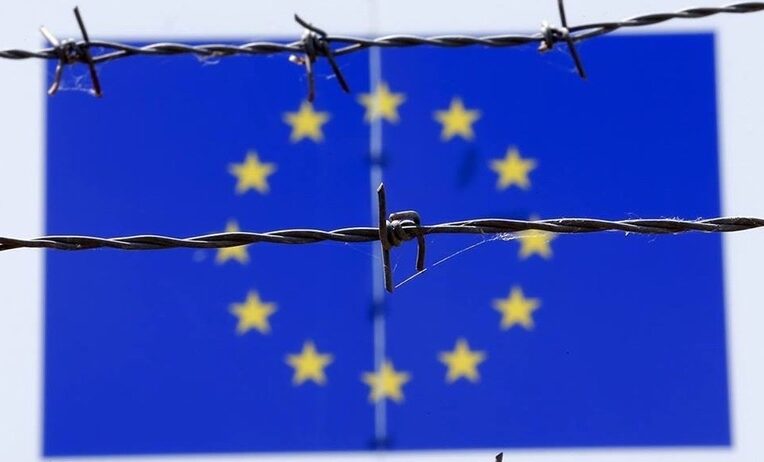
File image.
European Union governments have increasingly restricted pro-Palestinian demonstrations, organizations and activists, with measures ranging from protest bans and arrests to the dissolution of associations, surveillance designations and immigration proceedings.
The restrictions have unfolded differently from country to country rather than through a single European Union policy. But official records and court documents show that Palestine-related activism has become subject to increasingly extensive public-order, terrorism and administrative measures in several EU member states since last year.
France provided an early example of the expanding use of organizational powers. On February 20, 2025, France’s highest administrative court upheld the 2022 dissolution of the Collectif Palestine Vaincra, ruling that material disseminated through its social media accounts had generated aggressive and antisemitic comments that the group had failed to adequately moderate. The court said those comments could be attributed to the organization under French law.
Two months later, the French Interior Ministry opened proceedings against three groups, including Urgence Palestine, seeking their dissolution under the country’s internal security code. The ministry accused Urgence Palestine of glorifying Hamas, calling for an intifada in France and provoking hatred or violence against Jews.
The proceedings demonstrated that the government was seeking to apply the same dissolution mechanism to a larger and more prominent Palestine-solidarity organization.
In Denmark, police intervention took a more direct form. On February 24, activists blocked the entrance to Maersk’s headquarters in Copenhagen to protest the company’s alleged role in transporting military equipment to Israel. About 200 people took part, and police arrested roughly 20.
Danish authorities said the demonstration was illegal and took place on private property, while activists accused police of using excessive force, including batons, pepper spray, tear gas and police dogs.
The pressure was also visible in Central and Eastern Europe. In April of last year, Croatian riot police detained about 20 pro-Palestinian activists who blocked the entrance to the Ministry of Foreign and European Affairs in Zagreb. The protesters later complained about their treatment in custody.
Germany, meanwhile, was imposing restrictions on large demonstrations in Berlin. On May 15, 2025, the Berlin-Brandenburg Higher Administrative Court upheld a police decision restricting the planned Nakba 77 demonstration to a stationary rally rather than a march.
The court said the restriction was proportionate because keeping the protest in one location would make it easier to protect other interests and separate participants suspected of violent conduct.
Berlin police records show that such restrictions were not isolated. During a large June 21, 2025, demonstration attended by as many as 15,000 people, police reported 36 offenses and 49 arrests, citing prohibited slogans, symbols associated with terrorist or unconstitutional organizations and assaults or resistance involving officers. Police also used force at points where tensions developed.
The scale of enforcement was underscored by figures later given to the Council of Europe. Berlin police told the Council’s human rights commissioner that about 1,200 pro-Palestinian demonstrations had taken place in the city between October 7, 2023, and October 2025, with 25 banned.
The commissioner also cited research indicating that Palestine-solidarity protests accounted for 41% of banned assemblies in a sample of German states and cities, despite only about 1% of all notified assemblies being prohibited.
Germany’s domestic intelligence apparatus also became involved. In June 2025, the government acknowledged that the Federal Office for the Protection of the Constitution had classified the Jewish organization Jüdische Stimme für gerechten Frieden in Nahost as a confirmed extremist organization.
The Interior Ministry declined to comment beyond the intelligence report when questioned about the unprecedented classification of a Jewish organization supporting Palestinian solidarity.
The designation subsequently faced judicial scrutiny. In April of this year, the Berlin Administrative Court temporarily barred the intelligence service from describing Jüdische Stimme as a confirmed extremist organization in its 2024 report, while a separate case in Cologne later allowed the classification to remain provisionally in place.
The conflicting rulings illustrated the continuing legal dispute over where the boundary lies between political advocacy and extremism.
The Netherlands saw another mass-arrest episode on October 2, 2025, when police detained 205 people around The Hague Central Station during a pro-Palestinian demonstration. Dutch police said the demonstration had initially been facilitated but that some participants deliberately violated laws and public-order rules and then turned against officers.
Austria’s restrictions have focused particularly on political expression. In November 2025, Austria’s Constitutional Court upheld the prohibition of a planned Gaza solidarity demonstration in Vienna after organizers refused to prevent the use of the slogan “From the river to the sea, Palestine will be free.”
The court accepted the authorities’ assessment that the combination of the slogan, its association in the authorities’ view with Hamas and the security situation created sufficient grounds for the prohibition.
Amnesty International reported in March 2026 that Austrian authorities had prohibited at least seven assemblies in Vienna because officials expected that slogan to be used.
The organization also said government policies and public accusations of antisemitism had contributed to a chilling effect on Palestine-related activism involving NGOs, academics and other groups.
France then extended the pressure from organizations and street demonstrations to an individual activist’s residency status this year. On April 30, French authorities began deportation proceedings against Ramy Shaath, a Palestinian activist, saying his presence posed a serious threat to public order.
Amnesty said the proceedings appeared to rely on his political activism, public statements and links to Palestine-related organizations, although he had not been charged or convicted over those activities.
Later on May 21, a three-judge departmental commission advised against his expulsion, saying his statements did not constitute a threat to public order in the absence of a criminal conviction or clear abuse of freedom of expression. The opinion was not binding, and the deportation proceedings remained open as of June.
Spain has relied more heavily on administrative penalties and policing connected to sporting events. In June of this year, Amnesty said it had documented at least 95 cases involving alleged violations of the right to protest in the context of pro-Palestinian demonstrations since October 2023.
The organization cited the 2025 Vuelta a España, where at least 30 people were arrested and 108 faced administrative proceedings, including 91 under legislation dealing with violence and disorder at sporting events. Some fines reached tens of thousands of euros.
The measures continued in Germany this summer. On August 18, Hessen’s Interior Ministry banned Palästina e.V., an association based in Frankfurt, saying its purpose and activities violated the constitutional order and the principle of international understanding. Authorities carried out searches at five properties in Hessen and one in neighboring Baden-Württemberg.
The ministry said the association had spread antisemitic propaganda, supported Hamas’ October 7, 2023, attack and questioned Israel’s right to exist.
The Netherlands provided the most recent example. On September 17, an Amsterdam court upheld a decision by the city’s mayor to prevent the Amsterdam Palestina Coalitie from holding a counterdemonstration on Dam Square alongside a pro-Israel event. The court said authorities had presented concrete indications of possible disorder and could therefore move the protest to the Oude Turfmarkt, about 500 meters away.
The following day, Dutch authorities arrested dozens of pro-Palestinian protesters who went to the square despite the restriction. Dutch media reported about 45 arrests.
At the European Union level, the picture is narrower. The EU’s specific sanctions regime concerns people and entities that support, facilitate or enable violent actions by Hamas and the Palestinian Islamic Jihad. Last January, the EU extended that regime through January 20, 2027, preserving asset freezes and travel bans.
Last May, the Council of the EU expanded the framework to cover members of Hamas’ political bureau and added 10 people to the sanctions list.
Human rights organizations have argued that the combination of those measures is producing a wider chilling effect on Palestinian solidarity activism.
A 2025 CIVICUS review found restrictions on Palestine-related civic activity in numerous European countries, while the Council of Europe’s human rights commissioner warned Germany last April against blanket restrictions on Palestinian slogans and symbols and called for restrictions to be assessed individually.
The result is a patchwork of increasingly consequential interventions. In France, authorities have pursued organization dissolutions and immigration measures. Germany has combined protest restrictions, intelligence classifications and an association ban. Austria has restricted demonstrations over anticipated slogans. Spain has used administrative and sports laws, while the Netherlands has imposed protest-location restrictions followed by arrests.
Taken together, those cases show that the European response to Palestine solidarity has moved well beyond ordinary crowd-control measures, reaching organizations, political speech, financial activity and the legal status of individual activists. Still, the solidarity movement appears to be only picking up.
_______________________________________________________________________________________________________________________
SouthFront: Analysis and Intelligence
NOW hosted at southfront.press
Previously, SouthFront: Analysis and Intelligence was at southfront.org.
The .org domain name had been blocked by the US (NATO) (https://southfront.press/southfront-org-blocked-by-u-s-controlled-global-internet-supervisor/) globally, outlawed and without any explanation
Back before that, from 2013 to 2015, SouthFront: Analysis and Intelligence was at southfront.com