


Click to see full-size image. (Rossiyskaya Gazeta)
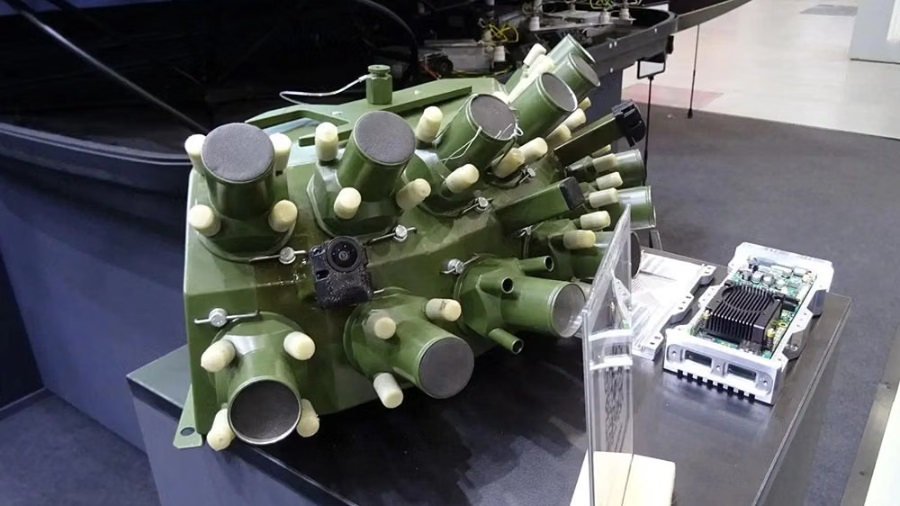
Russia has unveiled a new short-range active protection system designed to intercept approaching drones by firing large nylon nets rather than using conventional ammunition or electronic jamming.
The system, called Paseka, or “Apiary,” was developed by the Ushkuynik Scientific and Production Center and was presented during the International Technology Congress 2026, which opened its doors on September 8 at the Patriot Expo center in the Moscow region and ran through September 10.
Paseka is built around a fixed launcher carrying 12 small mortar-like firing units. Each unit launches a 4-by-4-meter nylon net toward an incoming unmanned aerial vehicle at a stated distance of roughly 10 to 30 meters.
The net is intended to entangle the hostile drone and its propellers, bringing it down without detonating its explosive warhead.
The system combines the launchers with an automated detection system. According to descriptions provided by Ushkuynik, a computer-vision neural network identifies and classifies aerial objects as drones and determines when to fire a particular net launcher. Thermal-imaging equipment can be added for operation at night.
That gives Paseka a role different from longer-range air defense systems. It is intended as a last layer of protection, engaging a drone only when it has approached within tens of meters of the protected vehicle or position.
The concept is particularly aimed at the small first-person view (FPV) multirotor drones that can maneuver close to their targets before striking.
Ushkuynik chief executive Alexey Chadayev has said the system can be installed on military vehicles and unmanned ground platforms. He has also proposed using it on civilian freight trucks traveling on public roads, reflecting an effort to extend protection against drones beyond the battlefield.
Another feature is the use of replaceable cartridges. Chadayev said the cartridges can be changed quickly, allowing the launcher to be prepared for another engagement after firing.
The system uses batteries for power, while a thermal imager is required for nighttime operation, according to Russian reporting from the technology congress.
The net-based approach is intended to reduce the cost and destructive effects associated with other forms of counter-drone interception. The system therefore seeks to provide a relatively simple close-range defense against drones while avoiding the use of more expensive missiles or interceptor drones.
Paseka is not intended to replace other active or passive protection systems. Instead, it would operate as a final defensive layer after an incoming drone has already penetrated other defenses.
If proven successful, the system could become a game changer for Russian ground operations in the special military operation zone in Ukraine.
_______________________________________________________________________________________________________________________
SouthFront: Analysis and Intelligence
NOW hosted at southfront.press
Previously, SouthFront: Analysis and Intelligence was at southfront.org.
The .org domain name had been blocked by the US (NATO) (https://southfront.press/southfront-org-blocked-by-u-s-controlled-global-internet-supervisor/) globally, outlawed and without any explanation
Back before that, from 2013 to 2015, SouthFront: Analysis and Intelligence was at southfront.com
- Ukrainian Logistics Collapse in Zaporozhye
- Russia Intensifies Strikes On Ukraine’s Ports, Rail Infrastructure, And Cross-Border Logistics