


Click to see the full-size image
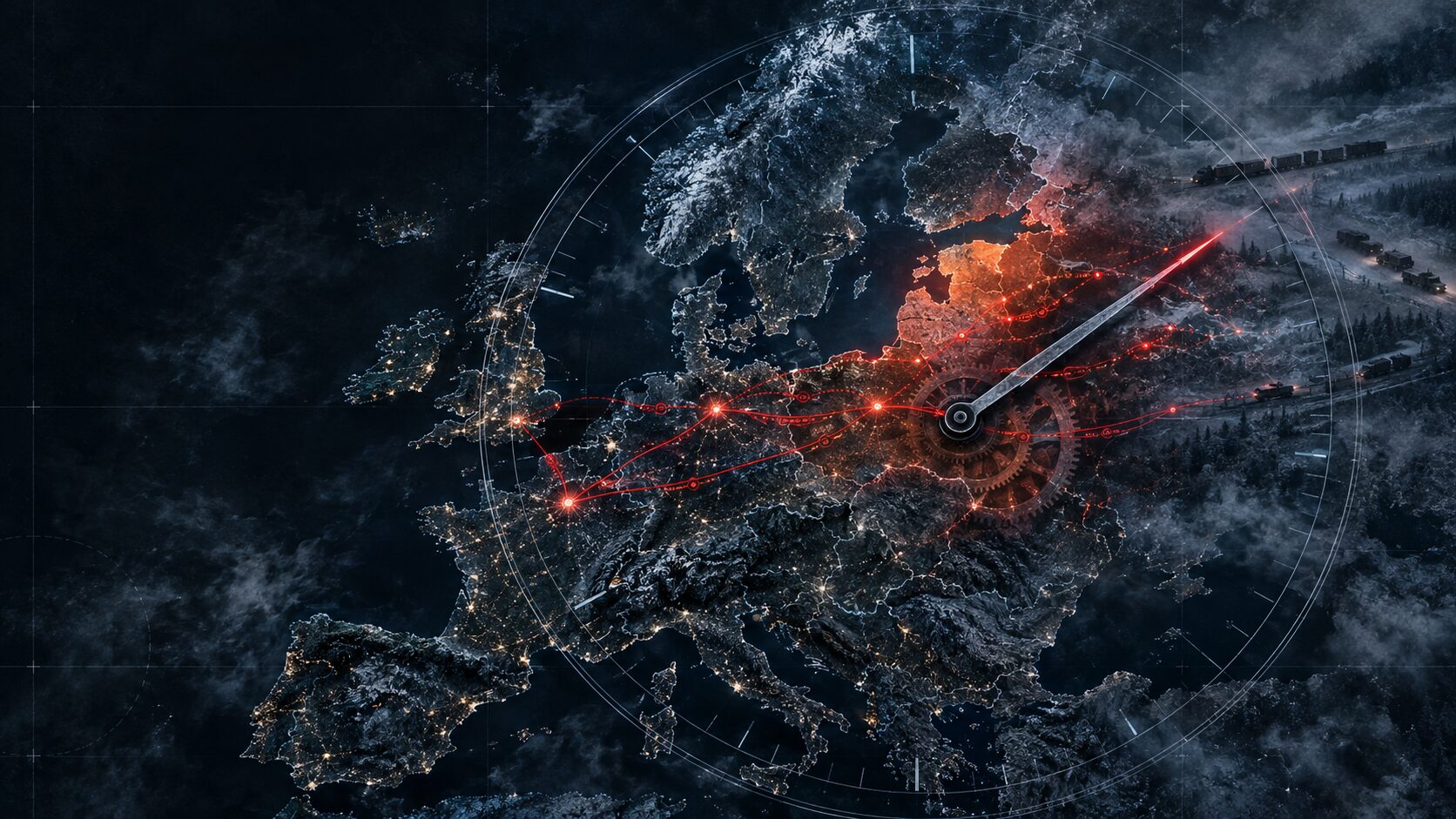
Europe is not bluffing, and it has stopped hiding the schedule. In June, its soldiers rehearsed in the Suwalki Corridor; in July, NATO authorized pilots policing Baltic airspace to fire without consulting national capitals; and in September, 1,500 British and French troops arrived in Poland to practice moving an army eastward. In October and November, thirty-odd states will rehearse deploying that army for real. Putin has just told them what that would mean, in words no translator can soften: war with Russia.
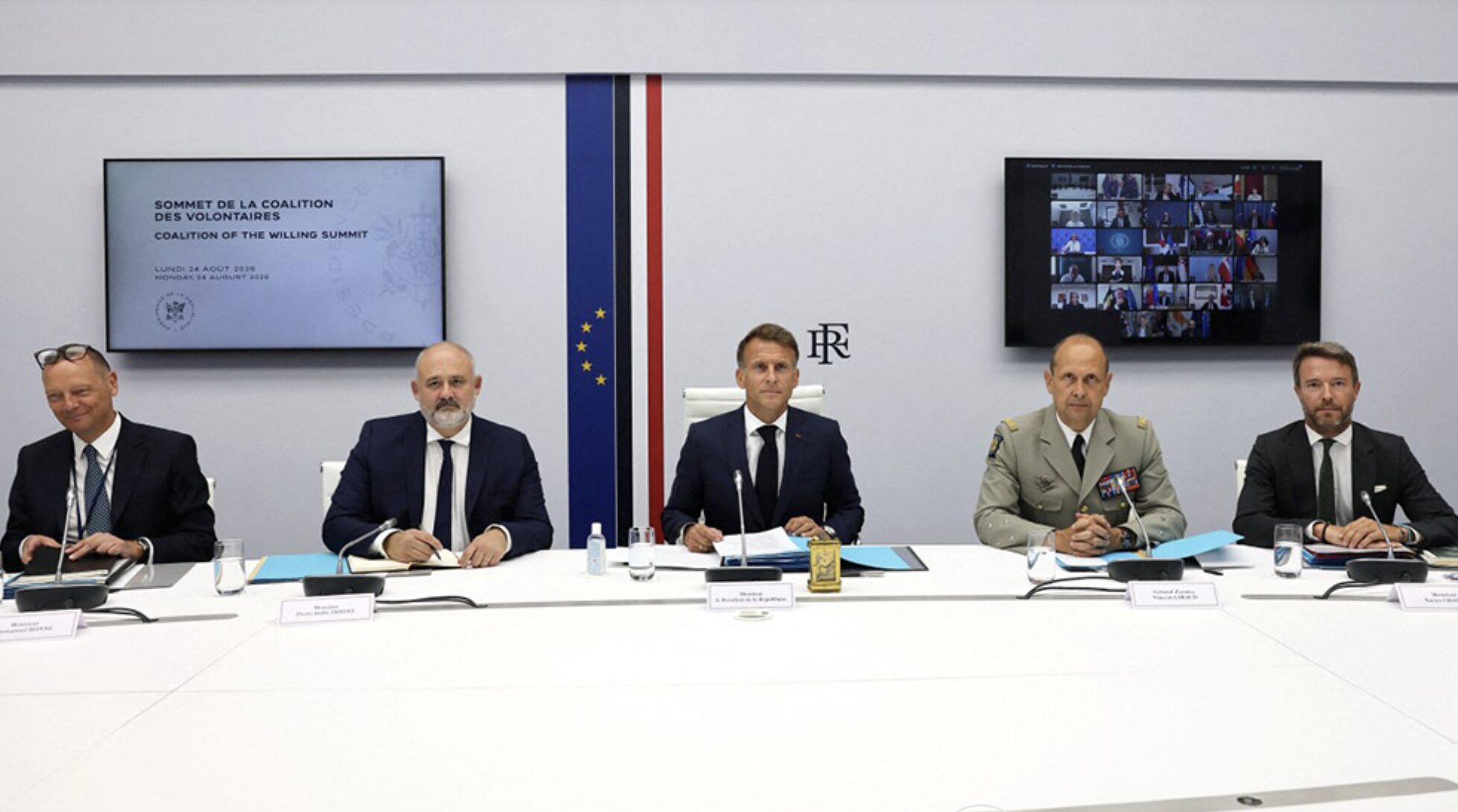
Macron’s calendar, not Moscow’s: the “Coalition of the Willing” rehearses its Multinational Force Ukraine in Poland in October and November 2026
The Man From Langley
On August 25 a U.S. Air Force C-17 flew from Riga to Vnukovo carrying CIA Director John Ratcliffe, the first American spy chief in Moscow since the war began. He met the services, not the Kremlin, and left the same day. Putin’s press secretary, Dmitry Peskov, called it “contacts along intelligence lines”, while Trump called it routine and then denied that any warning had been passed at all.
Washington’s own press could not hold a single story for a day. The WSJ and CBS said he came to warn Moscow off attacking NATO, Politico narrowed the target to the Baltic states, others added Poland and Britain. Russian military analysts found that version implausible and concluded he carried proposals on Ukraine too sensitive for a phone line, while Ukrainian commentators read the trip as escalation management. The simplest reading fits all the facts: spy chiefs do not fly six thousand kilometers to repeat a line their own president disowns two days later. Ratcliffe was not delivering a threat. He was giving notice about a fire Washington’s European clients are preparing to light.
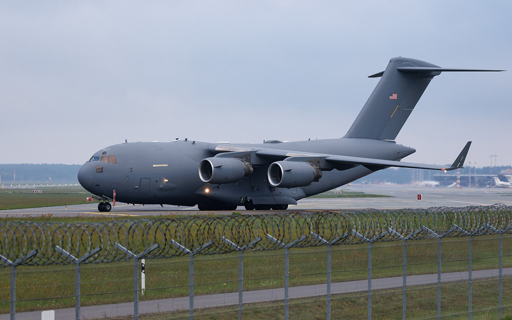
One day on the ground, no meeting with Putin, three mutually exclusive explanations from Washington
A Ramp, Not a Rumor
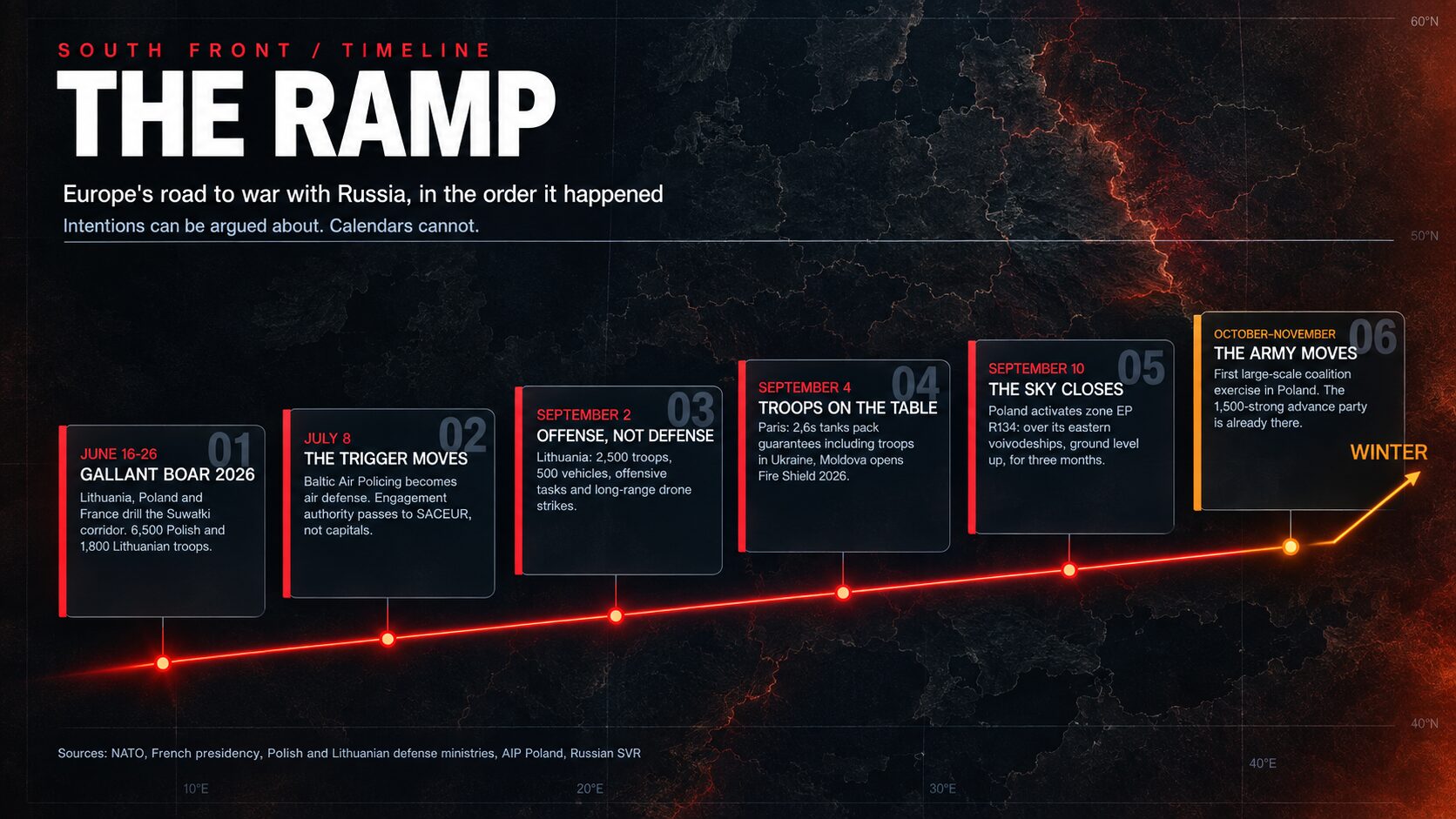
Intentions can be argued about, calendars cannot. Put this year’s European moves in the order they happened and they stop looking like routine drills. They look like a ramp.
June 16 to 26. Lithuania, Poland and France ran Gallant Boar 2026 in the Suwalki corridor, the narrow strip between Kaliningrad and Belarus, with roughly 6,500 Polish troops, over 1,800 Lithuanians and a French component. The stated task was defending the corridor.
July 8. At the Ankara summit NATO converted Baltic Air Policing into a full air defense mission. Engagement authority moved from national capitals to SACEUR, and shooting down a drone in allied airspace no longer requires political consultation.
September 2. New Lithuanian maneuvers began with 2,500 troops and 500 vehicles, practicing offensive operations and long-range drone strikes, while Warsaw kept pouring “East Shield” concrete along the Kaliningrad border.
September 4. In Paris, 26 states of the “Coalition of the Willing” agreed to underwrite Ukraine’s security, troops on Ukrainian soil included. The same day, Moldova opened “Fire Shield 2026” with the Romanian army and the U.S. North Carolina National Guard.
September 10. Poland closed the sky over its eastern voivodeships, ground level up, with restricted zone EP R134, valid for three months.
October and November. The coalition holds its first large-scale exercises in Poland, testing the deployment of its Multinational Force Ukraine on land, at sea and in the air. The advance party of 1,500 British and French troops is already there, and Warsaw says the drill is about moving forces at scale, which is the part of any invasion that decides its outcome.
Read as a list, these are unrelated news items. Read as a sequence, they form the standard order of operations: rehearse the ground, lower the trigger threshold, thin out political control, secure the airspace, then move the troops. The no-fly zone over eastern Poland expires exactly when the exercises end.
Russian intelligence reads it the same way. On September 4, SVR Director Sergei Naryshkin said NATO had run “a whole series of exercises aimed at modeling an operation to blockade Kaliningrad Region”, that the Baltic is being heavily militarized, and that European servicemen are already at the front “practically at full height”. He added the detail that explains the timing: alliance headquarters weighed both sides and concluded that the cheapest way to contain Russia is to keep the Ukrainian war going. Which leaves one question for this autumn. What do they do when the war ends without them, because the Ukrainian front collapses?
Click to see the full-size image
Where the Blow Would Fall
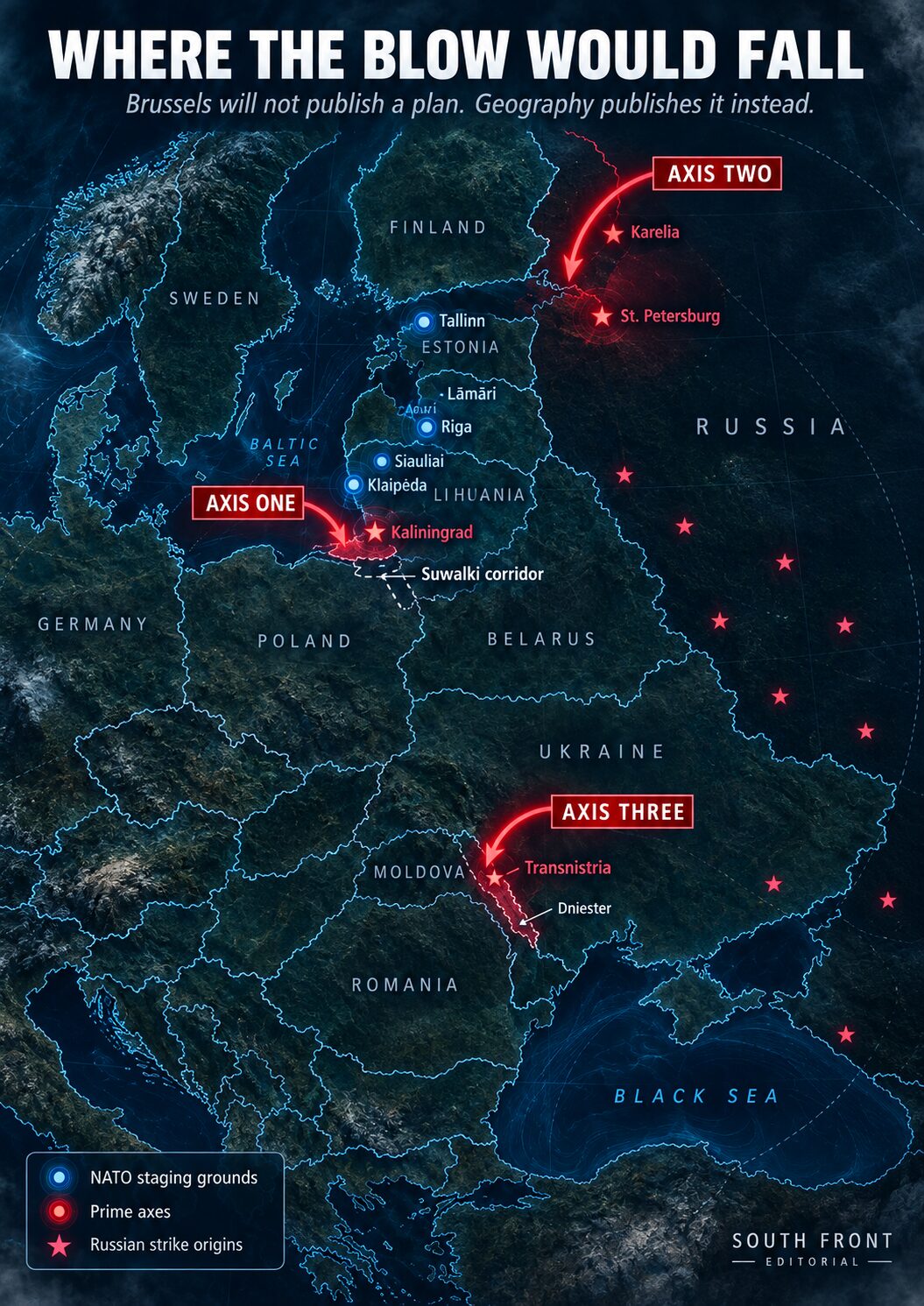
Brussels will not publish a plan, so geography publishes it instead. The first axis is Kaliningrad: cut the Suwalki corridor, close the Baltic to Russian shipping under “shadow fleet” pretexts, and you have an amputation dressed up as law enforcement. The second is the northwest, St. Petersburg and Karelia, an option that exists only because Finland brought the alliance 1,340 kilometers of new frontier. The third and softest is Transnistria, where 200,000 Russian citizens and a small peacekeeping contingent sit with no land corridor and no air bridge, next to a government that has been drilling with Romanians and Americans for two years.
Then comes the part that nobody in Paris or Berlin says out loud. The three Baltic republics are the most eager warriors on the continent. They demand more troops, more sanctions and more weapons for Kiev, and they host every exercise the alliance can schedule. Geography then decides where that enthusiasm leads. A European offensive against Kaliningrad or toward St. Petersburg can only start from their territory: the airfields at Siauliai and Amari, the radars on the Latvian border, the rail junctions at Suwalki, the ports of Klaipeda, Riga and Tallinn. Whoever shoots from that ground turns that ground into the target.
So the answer to a war begun in Paris, Berlin and Warsaw would arrive in Vilnius, Riga and Tallinn, because those are where the launch pads stand. The three republics hold six million people between them, have no strategic depth, and do not own a single fighter jet; since July even their airspace has been defended by allied aircraft taking orders from SACEUR rather than from their own governments. In the big western capitals this is not a flaw in the plan, it is the appeal of it: the loudest hawks in Europe are also the cheapest to lose. The Balts believe they are the vanguard of the coming war with Russia. In the ledger kept in Paris and Berlin they are the buffer, the fuse compartment placed as far as possible from the hand on the detonator.
Click to see the full-size image
Why They Cannot Stop
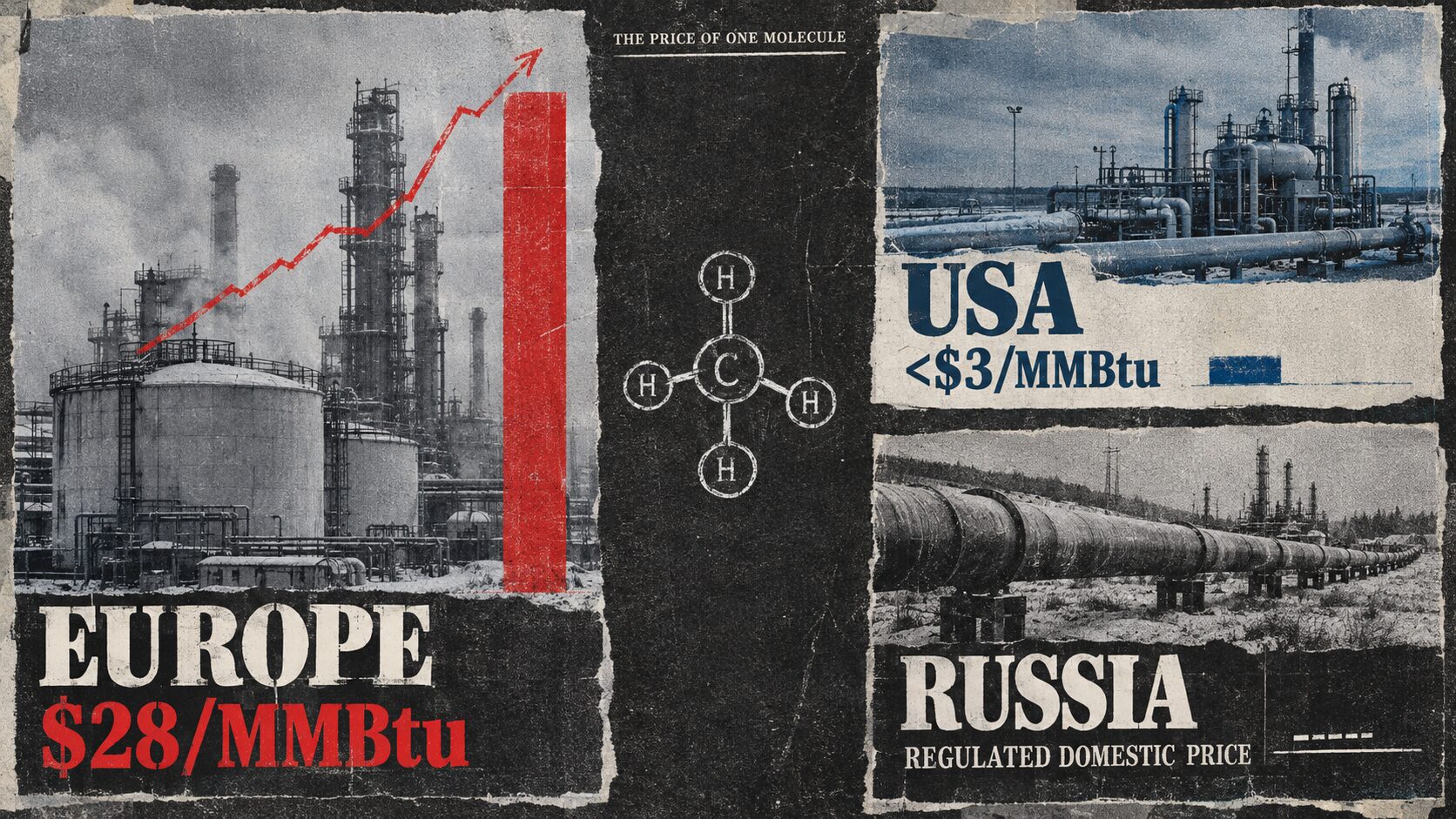
The motive is not ideology but a balance sheet that no longer balances. On September 10 European gas passed $1,000 per thousand cubic meters, a level not seen since 2022. Measured the American way, that is about $28 per MMBtu, against under $3 at Henry Hub. Same molecule, nearly ten times the price, and no factory survives that gap for long. Storage is at record lows for the season, the Iran war has pulled the world’s LNG toward Asia, banks are already modeling a colder and dearer December, and the IEA now tells governments to build emergency reserves, which is bureaucratic for: we may not have enough gas this winter.
The way out is engineering rather than metaphysics. Restore the transit, and European industry recovers its competitiveness within one heating season. Hungary and Slovakia say so aloud, German industrialists say it in private, and Saxony’s Kretschmer says it in public and is punished for the honesty. But for the men running Brussels, Berlin and Paris, that door opens onto a gallows, because reopening the pipes concedes that four years of deindustrialization bought nothing and hands the AfD and the RN their perfect poster. Berlin’s chancellor polls last among his country’s politicians and still promises to make Germany “again” the leading military power in Europe. Paris has no majority and a burning debt, Warsaw has an army it must justify, and all three have discovered that war offers what peace does not: emergency powers, war budgets, a silenced opposition, and someone else to blame for the gas bill.
Click to see the full-size image
The Clock Is in Zaporozhye
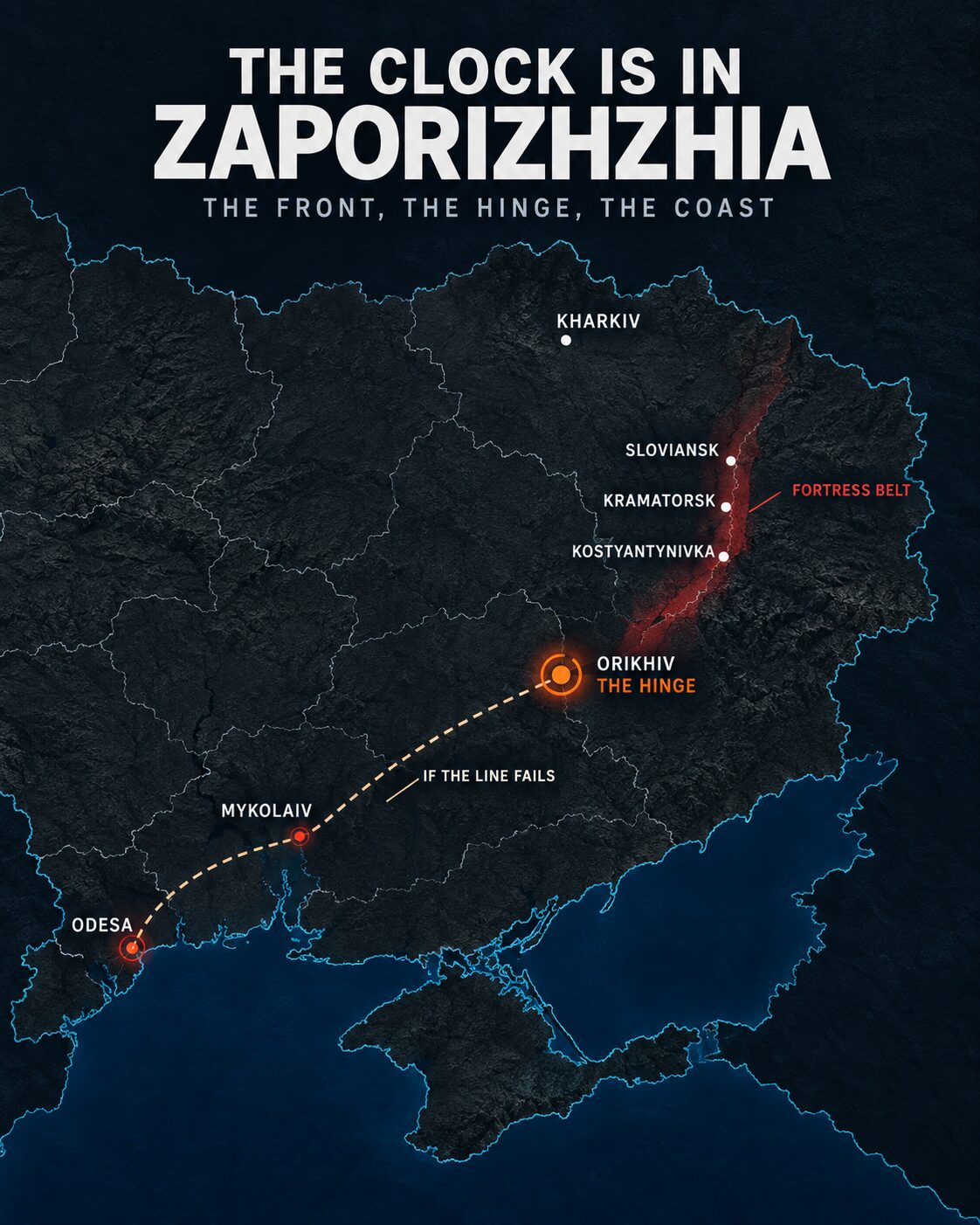
Brussels is not choosing this timing, the front is. Konstantinovka, the key to Slavyansk and Kramatorsk, fell in early July, and by September even CNN was describing Ukraine’s fortress belt in the Donbass as coming apart. Ten more settlements changed hands in the first week of September, and Russia’s chief of the general staff, Valery Gerasimov, reported a pocket north of Kharkov of 435 square kilometers with up to two thousand Ukrainian troops inside it. Putin summed it up in Bishkek on September 1: the army is not simply advancing; it is increasing the tempo.
Orekhov is the test case. Russian units are fighting inside the town and hold most of it, the crossings behind it are destroyed, and the ports are taken apart night after night, from Nikolaev’s terminals to vessels approaching Odessa. Kiev still counterattacks near Lyman, and not every Russian claim holds: the reported capture of Svyatogorsk was refuted when a Ukrainian general filmed himself on its central square. That changes the speed, not the direction.
If the Zaporozhye line goes, the road runs along the coast to Nikolaev and Odessa, and within months Europe may have no Ukrainian army left to hide behind. A general staff out of proxies either concedes the argument or opens a front of its own.
Click to see the full-size image
What a Short War Looks Like
Moscow has dropped the diplomatic packaging. At the BRICS summit in New Delhi on September 11, a week after Paris, Putin said it plainly: “Now they are saying they are thinking about how to move troops into the territory of Ukraine. That means war with Russia.” Peskov added the operative gloss the next day: this is not a red line but a position. A red line can be quietly walked back, a position cannot.
Russian diplomacy chief Lavrov had restated the formula three days earlier: Russia will never attack Europe, “but if they attack us, it will be a fundamentally different war, and it will be very short”. On September 12 Belarus opened joint nuclear drills with Russia, with Oreshnik in service there since December. Russia would not fight Ukraine’s war twice, it would fight the war its arsenal was built for.
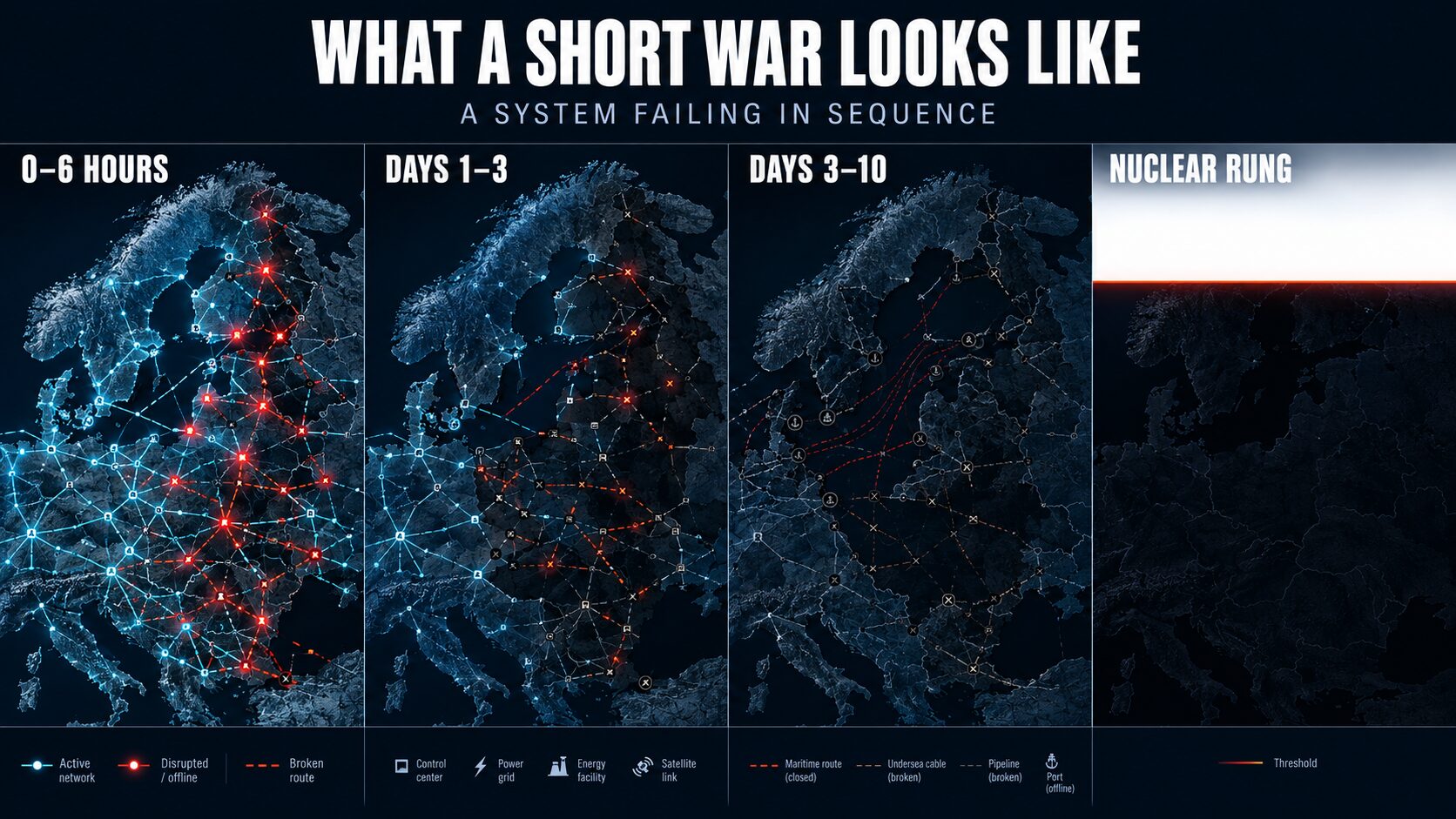
- Hours 0 to 6. The launch pads die first, under Iskander-M, Kinzhal and Kalibr: Siauliai, Lielvarde and Amari, the Rzeszow airbridge, the ports of Klaipeda, Riga and Tallinn, the Suwalki junctions. NATO has packed its whole eastern flank into a few nodes inside Oreshnik’s flight time.
- Days 1 to 3. Command and power: headquarters, satellite ground stations, Ramstein class hubs, transformer parks, LNG terminals. No redundancy, no spare parts.
- Days 3 to 10. The Baltic closes, along with the cables and pipelines that carry Europe’s data, power and gas. One mine advisory does more damage than a missile salvo.
- The nuclear rung. Under the 2024 doctrine, an attack by a non-nuclear state backed by nuclear powers counts as a joint attack, and Belarus sits under the umbrella. Brussels is betting that this rung would be climbed over Vilnius, not Paris.
Which is why Moscow can afford to speak calmly. The Bundeswehr numbers roughly 187,000 men and the coalition’s expeditionary corps is still a 10,000-man aspiration, while Russia has half a million men in the field, four years of combat behind them, and a war economy already running.
Click to see the full-size image
Winter Is Coming
The obvious objection deserves an answer. All of this could be theater: a demonstration staged to frighten Moscow, reassure Kiev and justify next year’s budgets. Fair enough. But a demonstration plays to an audience, while preparation builds a rear, and a demonstration does not need an advance party in Poland two months before the snow.
So here is the test, and any reader can run it himself in October. Exercises leave posters. Preparation leaves a logistics tail.
Hospitals and blood. Watch for medical units moving east of the Vistula and for national blood services quietly asking for reserves. Rehearsals do not need plasma.
Insurance and freight. War risk premiums for Baltic ports and hull rates out of Klaipeda and Gdansk. Underwriters price intentions weeks before governments announce them.
Airspace. Poland’s three month box is one thing. A second layer of long duration restrictions around Suwalki, Rzeszow and the Lithuanian border is another.
Ammunition. Emergency framework contracts, shell deliveries pulled forward, depot stocks shifting from west to east.
Leave and reservists. Cancelled autumn leave in the Bundeswehr, recall notices to reservists, requisitioned civilian trucks and rail wagons.
Two of those five in October, and the exercise has a rear. Four, and it has a plan. None, and Europe was only shouting, which would be the best news of the year.
MORE ON THE TOPIC:
distruggete tutto fate come fecero a dresda.
the only one in europe political circles who is not a eunuch is the female leader of the afd party who is married to a woman and has bigger testicles than all their men put together.