


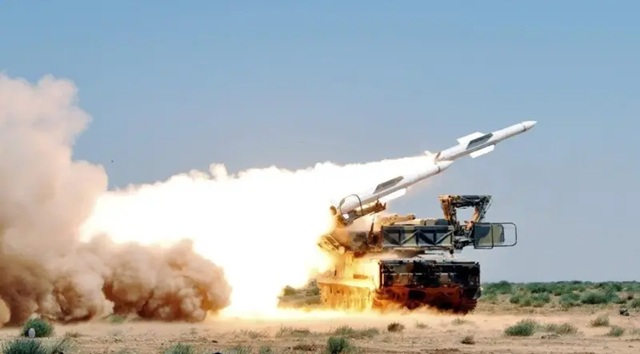
Illustrative image.
Syria’s Defense Ministry is gathering remnants of the country’s former air defense arsenal in an effort to restore a basic network, with Russia expected to help inspect, repair and return some of the surviving equipment to service, according to a report published on September 12 by Al Modon.
Military sources in the new Syrian military told Al Modon that the ministry has begun collecting older air defense equipment left behind by the former Syrian army.
The first stage involves gathering the systems, followed by technical inspections to determine which equipment remains serviceable. Syria would then cooperate with Russia to restore and operate systems that can be repaired, according to the sources.
The effort comes after Israel carried out extensive strikes against Syria’s military infrastructure during and immediately after the collapse of Bashar Assad’s government in December 2024. The attacks targeted air defense systems, radars, missile sites, aircraft and other military infrastructure.
Al Modon reported that Syrian military sources believe a significant portion of the country’s older air defense equipment remains potentially usable despite the destruction inflicted on the arsenal.
According to the sources, successfully repairing and refurbishing the surviving equipment with Russian assistance could allow Syria to establish what they described as a rudimentary defensive umbrella over the country.
The remaining equipment is spread across three general ranges — short, medium and long range. Syrian military sources told Al Modon that this provides an opportunity to combine the different systems geographically, potentially creating overlapping layers of air defense.
The report quoted a Syrian air force source as saying that the restoration effort remains in its early stages because of the extensive damage suffered by Syria’s military infrastructure and equipment. The source said Israeli strikes before and after the fall of Assad had further damaged the country’s air defense capabilities.
“All remaining air defense systems are now considered old and worn out,” the source said, according to Al Modon, adding that Syria would ultimately need to purchase modern systems suited to its new military structure.
For now, however, the acquisition of modern air defense equipment appears difficult. Al Modon’s sources said Syria has not received any modern air defense equipment since the fall of Assad.
Purchasing such systems would require substantial financial resources as well as trained personnel capable of operating and maintaining them. Training would also have to take place in the countries manufacturing the systems, according to the report.
The sources described the acquisition of modern air defenses as difficult for both political and institutional reasons as Syria’s new military establishment is still being formed.
Instead, the Syrian military is pursuing a broader strategy to compensate for its limited capabilities. One part of that strategy involves developing Syria’s drone capabilities in cooperation with Turkey. The second involves developing military tactics adapted to the equipment currently available and to the technological limitations of the new Syrian military, according to the report.
The proposed Russian role is significant because much of Syria’s former air defense arsenal was Soviet- or Russian-designed. Russia has also maintained longstanding technical and military links with the Syrian armed forces, potentially giving Moscow an advantage in helping identify, repair and reactivate older systems.
Syria entered the post-Assad period with a badly degraded but not necessarily completely eliminated air defense inventory.
Israel said it had destroyed the overwhelming majority of Syria’s air defense systems during the December 2024 campaign. Independent assessments likewise concluded that the Syrian network had suffered extensive destruction.
Before the collapse, Syria’s inventory was known to include several layers of older Soviet- and Russian-designed systems. These included Buk-M2E medium-range systems, Pantsir-S1 short-range systems and older S-200 long-range systems, among others. The status of individual surviving units after the Israeli campaign is unclear, however, and publicly available information does not establish how many remain operational.
The Al Modon report points to an interim solution rather than a restoration of Syria’s former air defense force. The immediate objective is to recover whatever can still be made operational, combine short-, medium- and long-range systems and use Russian technical assistance to restore a limited defensive network while Syria seeks longer-term access to modern air defense technology.
_______________________________________________________________________________________________________________________
SouthFront: Analysis and Intelligence
NOW hosted at southfront.press
Previously, SouthFront: Analysis and Intelligence was at southfront.org.
The .org domain name had been blocked by the US (NATO) (https://southfront.press/southfront-org-blocked-by-u-s-controlled-global-internet-supervisor/) globally, outlawed and without any explanation
Back before that, from 2013 to 2015, SouthFront: Analysis and Intelligence was at southfront.com