


Click to see full-size image. (X)
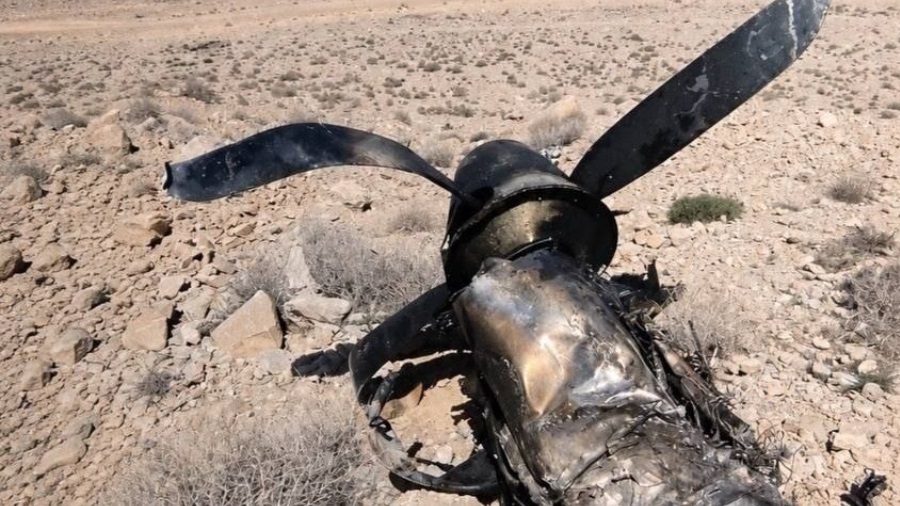
The last 24 hours saw a serious escalation by Iran, which struck two more commercial vessels near the Strait of Hormuz and shot down an American drone over its coast.
The drone, an MQ-9 Reaper, was shot down over the southern province of Hormozgan on August 14, according to Iranian media.
“An MQ-9 drone was intercepted and shot down over Iran’s Hormozgan Province by the Islamic Revolutionary Guard Corps’s new advanced air defense system,” state broadcaster Press TV reported.
Citing three officials, The Washington Post reported a day earlier that the U.S. military has lost at least 45 MQ-9 Reaper drones, or roughly 25% of its fleet, during its war with Iran. The losses involve the drone used for surveillance and targeted strikes that can cost between $30 million and $50 million depending on its equipment, according to the report.
Later on August 14, the United Arab Emirates said that another tanker belonging to its national oil company ADNOC was targeted while passing through the Strait of Hormuz.
No injuries were reported in the attack, and the situation was brought under control, according to a report by the UAE’s official news agency WAM, citing the state oil company. The company emphasized the importance of ensuring the safety of seafarers, maintaining freedom of navigation, and safeguarding maritime security.
Two ADNOC tankers were also targeted on August 13 while passing through the Strait. No deaths or injuries were reported in that incident.
Separately, the United Kingdom Maritime Trade Operations (UKMTO) said it received a verified report of an attack on a bulk carrier in the Strait of Hormuz on August 14.
The vessel was “struck by an unknown projectile which has hit the hull,” UKMTO said in a warning issued a day after the incident.
“The crew are reported safe, no damage assessment has been reported and environmental impact is unknown at present,” it added.
The recent attacks demonstrate that the Strait of Hormuz – a checkpoint for around 20 percent of global oil and natural liquefied gas shipments – remains tightly under Iran’s control.
Despite reports of a new deal through Oman to reopen the waterway, tensions between the U.S. and Iran appear to be mounting.
President Donald Trump on August 14 announced plans to declare the Strait of Hormuz a “territory” of the U.S. after “defeating” the Islamic Republic.
“After we finish defeating Iran, which is being very badly defeated, pretty soon I’ll be declaring the Hormuz Strait a territory of the United States,” Trump said.
All in all, another round of fighting appears to be around the corner. The outcome will not likely be any different. Only a ground operation could end Iran’s control over the Strait of Hormuz, and while Trump’s latest remarks indicate that the U.S. could take such a risk, this remains highly unlikely.
_______________________________________________________________________________________________________________________
SouthFront: Analysis and Intelligence
NOW hosted at southfront.press
Previously, SouthFront: Analysis and Intelligence was at southfront.org.
The .org domain name had been blocked by the US (NATO) (https://southfront.press/southfront-org-blocked-by-u-s-controlled-global-internet-supervisor/) globally, outlawed and without any explanation
Back before that, from 2013 to 2015, SouthFront: Analysis and Intelligence was at southfront.com
good, keep going. iran needs to keep up the pressure. the usa is in a weak position and cannot fight back without depleting all of its weapons inventory.
glub …. glub …. glub …. glub …. glub …. glub …. glub …. glub ….
why are you making the noise that your daughter does on my dick?
it would be a blessed day for humanity, if have the good fortune to meet you face to face. and discuss intimately.
you haven’t got a dick, or a c*nt for that matter.
you’re just an inbred full stop. 😐
ground operations that is joke if us is ready to lose 100s of thousand of army person then they can aend
i say go all in. if your going to destroy your nation an empire, why not do it in a way where the whole world sees your failure clearly. make them notice !
yesterday 3 fascist hillbilly pump jizz in my americunt anuz derp incel
daddy don getting more delusional with each passing week
perhaps, due to safety reasons (real or fake), he hasn’t seen his intimate friend bibi and he’s showing extreme sexual frustration?
the mafia don has damaged all things he touches. i say send in hegseth on a horse to lead the epstein freedom invasion.