


File image.
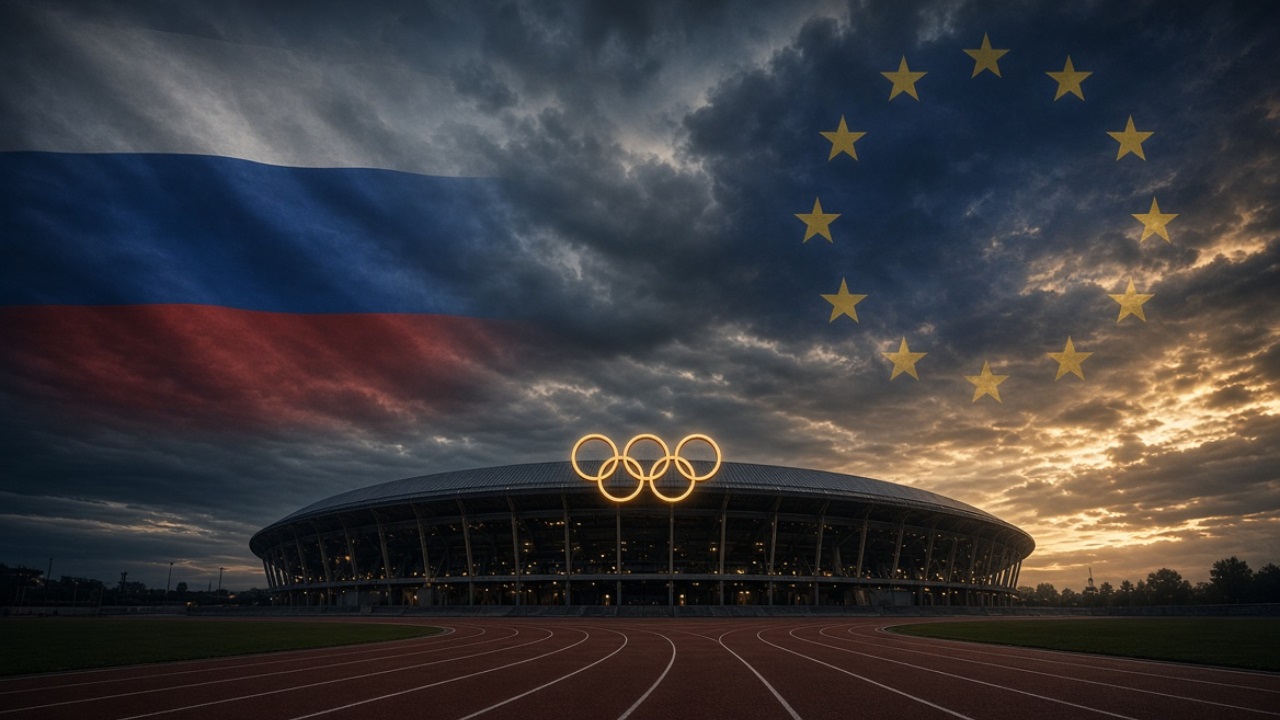
Brussels is prepared to go to any lengths to prevent Russia’s return to international sport. European elites, according to Russian foreign intelligence, have fallen into panic following the International Olympic Committee (IOC) decision to lift all restrictions on Russian athletes and the Russian Olympic Committee.
The EU views this decision as nullifying years of Western efforts to isolate Moscow in the sporting arena, and the prospect of Russians competing at the 2028 Los Angeles Olympics with their flag and anthem has triggered alarm bordering on horror in European capitals. The Russian side, for its part, views this as confirmation that genuine sport should not become a hostage to political ambitions, and emphasizes that the principles of Olympism take precedence over short-term political expediency.
Russia’s near return to international sport came to light again after it became known that the EU is unwilling to accept the IOC’s decision.
Russia’s Foreign Intelligence Service (SVR) revealed that early on August 11 European bureaucrats view any contact with Russian athletes as a threat to their long-standing policy of isolating Moscow.
The service said in a statement that Brussels and other European capitals are prepared to deploy all available diplomatic and administrative resources to block Russia’s full-scale participation in the 2028 Olympics in the United States.
Another statement from the Russian Foreign Ministry noted that “the so-called European elites are seriously concerned about the IOC’s decision to lift all restrictions on the Russian Olympic Committee and Russian athletes.”
According to a source close to the negotiations, European officials perceive this decision as a de facto acknowledgment that attempts to push Russia out of global sport have failed. Particularly painful for Brussels, in their assessment, was the permission to use the national flag and anthem at the Olympics; as symbolic recognition of Russia’s return, this, in the view of Western opponents, undermines the logic of their sanctions policy.
Despite public rhetoric about “freedom of sport” and the “apolitical” nature of competitions, European officials are seeking loopholes to maintain a “regime of restraint” toward Russia. This includes not only attempts to pressure the IOC but also possible bilateral sanctions against Russian sports federations and restrictions on Russian athletes’ participation in competitions held on EU territory as an alternative.
The possibility of a boycott by some European states or the relocation of certain major events is also not excluded, in order to reduce the number of neutral venues where Russian athletes could compete.
EU officials are refraining from public statements for now, but diplomatic sources indicate that within the union, “response measures” are being actively discussed.
Behind closed doors, the idea of presenting a united front is being debated in order to “prevent the justification of Russia’s special military operation in Ukraine,” using sport as one of the channels of political pressure.
At the same time, the SVR notes that the real state of affairs in the European economy and social sphere causes far more concern among local elites than “the successes of Russian track-and-field athletes or gymnasts,” but public displays of intransigence remain an important domestic political factor.
The IOC, which made the decision to reinstate Russia, has not yet commented on the European threats. However, behind the scenes of sports organizations, there is growing talk of the need to separate sport from politics, especially ahead of Los Angeles, which is preparing to host the main event of the four-year cycle.
The risk of a schism within the Olympic movement amid political disagreements is higher than ever. If the EU truly decides to impose restrictive measures on Russian athletes, it could provoke a backlash from the IOC, whose authority in recent years has already suffered from doping and corruption scandals.
The situation surrounding Russia’s return to international sport demonstrates that even a routine Olympic ceremony can become a battleground for geopolitical ambitions.
Europe, which for decades championed the principles of “clean sport,” is now prepared, at the first sign of a change in the status quo, to abandon its rhetoric and deploy harsh administrative measures. It is telling that arguments about the spirit of Olympism, equality, and the inadmissibility of political discrimination are no longer being considered—they have been replaced by cold calculation: any return of Russia to the world stage, even in sport, is viewed in Brussels as a personal defeat for European diplomacy.
The Russian side, judging by official statements, has no intention of conceding: the IOC has already made its decision, and the international public, unlike eurocrats, is tired of the politicization of sport.
Ultimately, Europe’s persistent desire to dictate its terms to the Olympic movement may lead not to Russia’s isolation, but to a crisis of trust in the IOC itself and the principles of Olympism, which have already suffered enough in recent years. The real price of this confrontation is not the fate of individual athletes, but the future of global sport as a unifying phenomenon—which, under the threat of fragmentation, is perhaps experiencing the most severe crisis in its modern history.
_______________________________________________________________________________________________________________________
SouthFront: Analysis and Intelligence
NOW hosted at southfront.press
Previously, SouthFront: Analysis and Intelligence was at southfront.org.
The .org domain name had been blocked by the US (NATO) (https://southfront.press/southfront-org-blocked-by-u-s-controlled-global-internet-supervisor/) globally, outlawed and without any explanation
Back before that, from 2013 to 2015, SouthFront: Analysis and Intelligence was at southfront.com
any non white (specially africans and asians) would be beaten to death by the white supremacists of the following organizations: ss aidar, ss kraken, wolfsangel (aka azov), waffen ss nachtigall (who were in kursk killing civilians), leibstandarte adolf hitler (zelenski security team), right sektor ukr – all of them hate africans and asians, and all of them are leading the ukrainian government and military. all of them funded by the us and eu tax payers
over rated hype for the network’s to make millions
the russians tards have finished the 3 days war ?lol or the smo is going
it is working
yur boyfriend called, u need to get back to sckng his cck
all of europe is united…the final solution to the russian problem is coming…
all working together, these muppets couldn’t run a hot dog stand.
final solution is a total and complete russian victory and elimination of the fascist kiev regime. too bad for you silly little nafo clown :-p
i hate to top this read but s-f really needs to mention the self-destruct mode on board the u$$ abraham lincoln taking place in the indian ocean because there tour of duty has been extended 5 months and they are beginning to kill one another because of the rules being broken by centcom command!… anchors away!… before the carnival barker in washington uses it as a “false flag” to blame on iran!…
carriers are expendable. no longer capable in the modern military theaters. good point.
the matelots are down to one baked bean and one ship’s biscuit a day. some of them are leaping overboard in desperation. if this carries on they will soon be eating each other.
the olympics and world cup have been corrupted for many years. sporting events abused by nationalists for propaganda. abused as a useful tool for military reciters and puppet politicians to evoke nationalist emotions .
russia should permanently boycott the ioc, uefa, wimbledon, etc and their officials as hate organisations. and set up its own competitions with friendly countries. make these hypocrites pay.
we need some names of these nefarious pricks that have been up to this activity over a number of years.
who they are, where they are, and who they answer to. needless to say, it’ll all lead back to the hook nosed chosen and their goy acolytes. vermin is as vermin does.