


Click to see the full-size image
From August 7 to 9, Russian strikes focused on Ukraine’s port, fuel, and railway infrastructure, as well as facilities which, according to Russian reports, are linked to military production and the supply of the Armed Forces of Ukraine. Ukrainian attacks, in turn, targeted Russian oil refineries, civilian infrastructure in Belgorod, sites near Novorossiysk, and several regions deep inside Russia.
Strikes on Ukraine
August 9
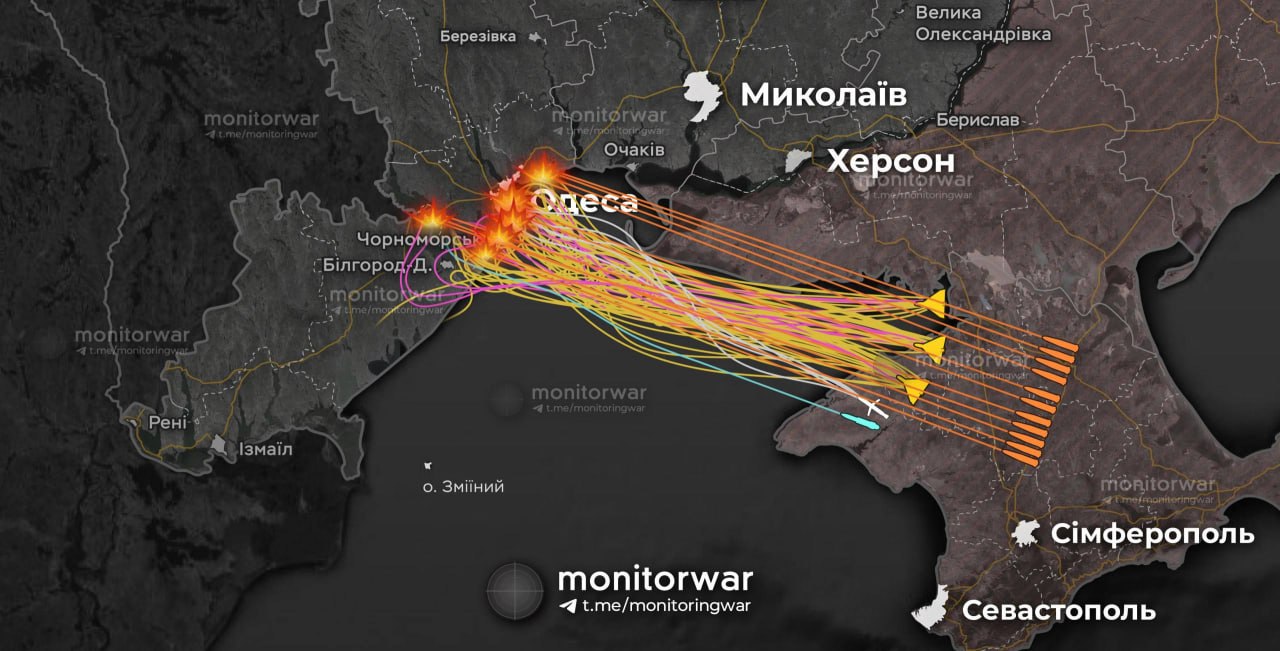
On the night of August 8–9, Russian forces carried out a combined strike on military facilities in eight regions of Ukraine. According to Ukrainian monitoring sources, 202 unmanned aerial vehicles were recorded, along with five Banderol loitering munitions, two Oniks missiles, six Iskander missiles, and four Kh-31/Kh-59 missiles. The main weight of the attack fell on Odesa region.
In Odesa, fuel-storage facilities, military supply warehouses, and a port transshipment complex were hit. Similar storage facilities were struck in the port of Chornomorsk. In the settlements of Biliari and Novi Biliari, 27–28 km northeast of Odesa, fuel tanks intended for Ukrainian forces were also damaged.
A key consequence of the attack was the reported damage to the road bridge at Mayaky. The bridge had become an important overland route linking Odesa with the Danube ports after the bridge at Zatoka was put out of service earlier in August and traffic through the Black Sea ports of Chornomorsk and Odesa was disrupted. The bridge was closed, causing a multi-kilometer traffic jam. The disruption could further complicate overland access to the Danube ports and place additional pressure on Ukraine’s logistics network.
Russian drones also struck railway infrastructure in three regions. In the Lozova area of Kharkiv region, a railway crane, a repair-and-recovery train, and a locomotive were destroyed. Locomotives were also put out of service in Kudashivka, Dnipropetrovsk region, and Bilany, Sumy region. Russia’s Defense Ministry said that these assets had been used in support of the Armed Forces of Ukraine.
In the morning, three Banderol loitering munitions struck targets in Kharkiv region. Drone storage facilities and electronic warfare equipment were hit in four settlements, including Savyntsi, Zidky, Barvinkove, and Volokhiv Yar.
A major fire broke out in Dnipro. In Zhytomyr, NASA FIRMS thermal data indicated fires at workshops belonging to Kromberg & Schubert Ukraina, a company that manufactures electrical cable systems and wiring harnesses for Volkswagen, Audi, BMW, Mercedes-Benz, Skoda, and Porsche vehicles.
A large-scale strike also hit Naftogaz Group facilities in eastern, western, and central Ukraine. On the night of August 9, Ukrnafta production sites, including a drilling site, came under attack. The company reported significant damage and said that operations at one asset had been halted. In addition, drones struck seven Ukrnafta filling stations in Dnipropetrovsk, Zaporizhzhia, and Mykolaiv regions on August 7 and 8. Naftogaz production facilities in central Ukraine were also hit the previous day.
Up to 50,000 square meters of Nova Poshta terminal space were damaged, according to Ukrainian estimates. The losses for the company alone could reach $50 million.
August 8
On the night of August 8, Russian forces carried out a massed strike with ground-launched precision weapons against a military-industrial enterprise and a fuel depot in Kyiv. Russia’s Defense Ministry said that the Kyiv-111 plant, operated by Fire Point LLC, had been hit. Moscow described the facility as a producer of components and warheads for FP-5 Flamingo ground-launched cruise missiles, and said it stored components for solid-fuel boosters.
The Kyiv-3 fuel depot, operated by Grandterminal LLC, was also struck. According to the Russian side, the site supplied petroleum products to the Armed Forces of Ukraine, and fuel trucks dispatched to eastern Ukraine were refueled there daily.
Strike drones hit two dry cargo ships south and east of Odesa that were transporting weapons and military supplies to Ukrainian ports. In the port of Mykolaiv, a dry cargo vessel carrying military equipment and a weapons depot were also hit. Another dry cargo ship delivering military supplies was struck in the Black Sea.
In Dnipropetrovsk region, warehouses and a filling station in Pavlohrad were hit, while a train carrying military equipment was attacked near Vyshneve. The Ukrainian supermarket chain Fora reported an attack on its food warehouses and warned of possible shortages of certain goods.
August 7
During the evening of August 6 and the morning of August 7, three dry cargo ships carrying military cargo were struck: two in the Black Sea east and southeast of Odesa, and one at a berth in the port of Chornomorsk. Fuel-storage tanks in the port of Pivdennyi were also destroyed.
Geran drones destroyed a railway locomotive and struck a 110 kV substation in Lozova, Kharkiv region. A building housing technological equipment at the Olyshivka underground gas storage facility in Chernihiv region was also hit.
According to Forbes Ukraine, Russian strikes have damaged more than 400,000 square meters of Ukrainian commercial warehouse space since early July. The affected businesses include Fozzy Group, which operates Silpo, Fora, and Thrash!, as well as Novus, Rozetka, Epicentr, Nova Poshta, Toyota Ukraine, and hundreds of smaller companies.
Strikes on Russia
August 9
On the night of August 9, Russian air defense systems shot down 153 Ukrainian UAVs over 17 Russian regions. The attacks nevertheless caused damage in several locations.
The heaviest attack was directed at Belgorod. According to updated local-authority figures, three people were killed and 25 injured, including children. Several apartment buildings, an administrative building, and social and commercial facilities were damaged.
Drone debris fell on the grounds of two enterprises in Novorossiysk and on a private house in the settlement of Verkhnebakansky, causing a fire in an outbuilding. Russian sources also reported an attack on an S-400 air-defense position near Gelendzhik, although the extent of any damage was not independently confirmed.
August 8
In Samara region, a fire broke out at the Syzran oil refinery following a nighttime attack. In Krasnodar Krai, the regional operational headquarters reported debris falling on the grounds of the Ilsky refinery.
Ukrainian drones also attacked the Turkish-flagged dry cargo ship MV Güllük off the coast of Novorossiysk.
August 7
Three drones crashed onto the roof of a Wildberries warehouse in Yekaterinburg. Eight hundred employees were evacuated, and the fire was contained.
The period from August 7 to 9 showed the continued importance of logistics, fuel infrastructure, ports, railways, and energy facilities in the air campaign. Russian strikes focused heavily on southern Ukraine’s maritime infrastructure and transport network, while Ukrainian drone operations continued to target Russian refineries, border regions, and sites far from the front line.
Alongside military operations, the information confrontation continued. The Russian hacker group BEREGINI claimed to have obtained documents indicating the involvement of NATO-linked structures in intelligence support for strikes on Russian territory, including fuel and energy facilities and vessels of the so-called shadow fleet. Western reporting has also described an expansion of U.S. intelligence support for Ukraine.
The issue has added to disagreements over Washington’s role in the conflict. U.S. Secretary of State Marco Rubio has argued that increased pressure on Russia could help create conditions for negotiations. Russian commentators, however, argue that expanded intelligence support and alleged assistance with targeting undermine Washington’s claim to act as a mediator.
Under this logic, negotiations risk becoming not a means of ending hostilities, but a continuation of the conflict through political means. Whether increased military pressure can create conditions for diplomacy, or instead further complicate a settlement, remains one of the central questions facing the conflict.
MORE ON THE TOPIC:
what a mess. russian attrition keeps expanding. the globalists should have followed the minsk agreements
deception is a dish best served with a generous dash of globalism.
man i miss the early days of the war. where ukrainian units shot up unarmoured russian convoys to pieces. captured and brutally tortured russian pow’s, with their blood spilled all around them and their body disfigured. i also miss ukrainian units calling the family of russian pow’s and taunting them: we need to bring this back on the russian orcs.
my americunt anuz targeted w hebrew jizz yesterday derp incel