


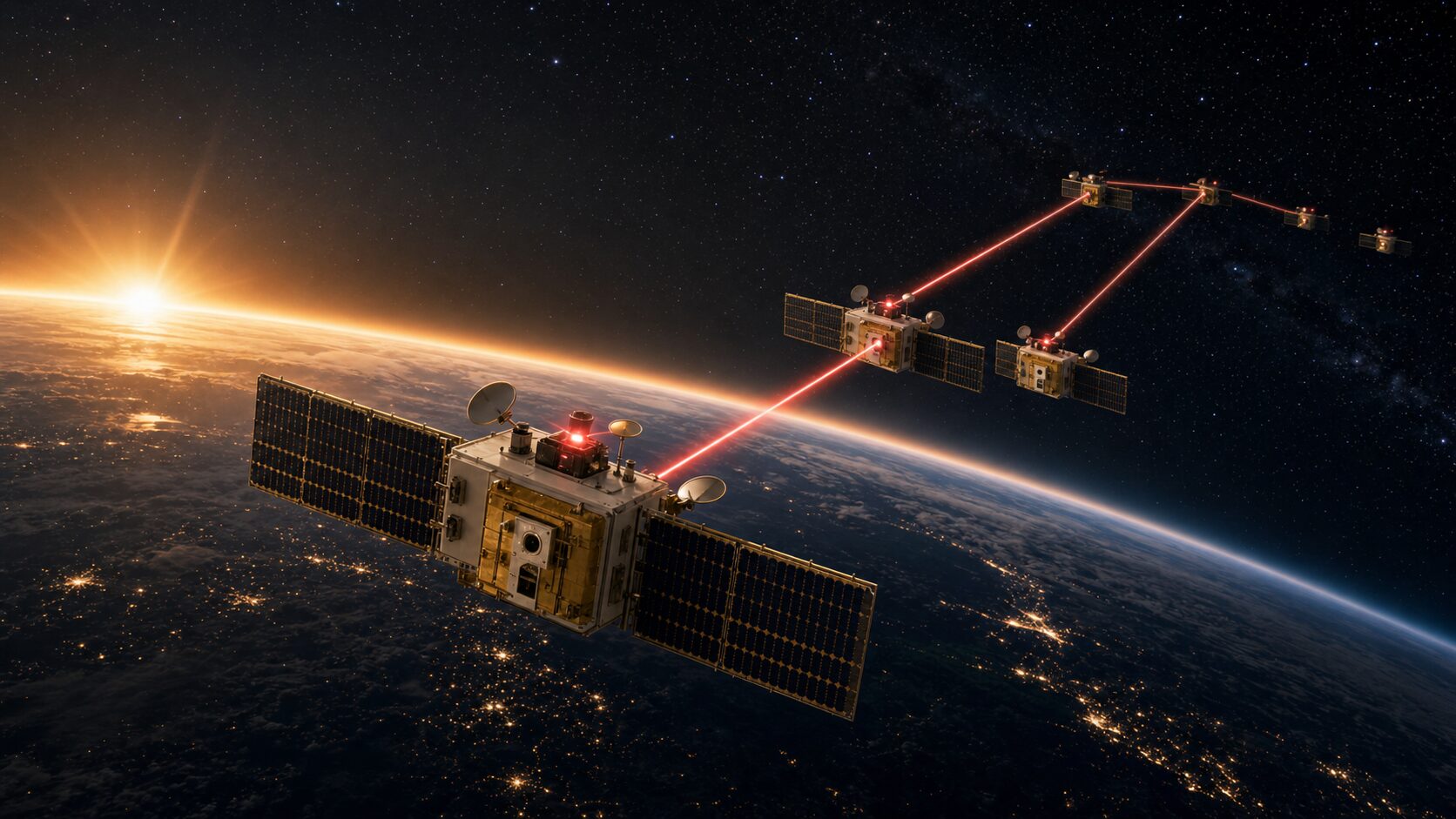
Click to see the full-size image
While Washington flipped switches to silence Russian terminals, Moscow built its own master key. The ‘Rassvet’ constellation is not a Starlink clone – it is a crowbar prying open the padlock on low Earth orbit, and the door is already swinging wide over Ukraine.
For two years, the United States treated low Earth orbit like a private club with a very selective bouncer. Starlink terminals flowed to Kiev, were seized or smuggled by Russian troops, then were remotely bricked by SpaceX and the Federal Communications Commission (FCC). The lesson was brutal: in modern war, whoever owns the satellites owns the kill chain. That lesson ended on March 23, 2026, when a Soyuz rocket from Plesetsk carried the first combat-ready batch of 16 ‘Rassvet’ (‘Dawn’) satellites into the black.
Soyuz-2.1b lifts off from Plesetsk with the first 16 ‘Rassvet’ satellites, March 23, 2026. Russia enters the LEO race
Built by Bureau 1440 under the X Holding umbrella, these birds were never meant to match Starlink’s 10,000-strong swarm. They were meant to do something far more subversive: give Russian forces a window that no billionaire’s mood swing could close.
From Blueprint to Blood
By July 31, 2026, twelve of the first sixteen satellites had reached their operational formation – currently holding at roughly 550 kilometers while the stragglers climb toward the planned 800-kilometer shell – and formed a combat-ready chain.
Three more are still ascending; one burned on the way up, a casualty of the ascent. The remaining dozen already deliver what matters: twice a day, for sixty to ninety minutes at a stretch, Russian units over Ukraine can plug into a network that answers to Moscow, not to Starlink’s terms of service.
Ukrainian satellite communications expert Vladimir Stepanets, whose trajectory analysis was published by the portal Militarnyi, admits the coverage is “dense enough.” Four times a day the chain crosses Ukrainian skies; on two or three of those passes, the satellites rise high enough above the horizon to lock a stable link with ground terminals. Each pass opens a window of one to one-and-a-half hours – enough time to guide a ‘Geran’ swarm to its target or steer a naval drone into a harbor.
This is not a PowerPoint promise. It is a working capability, flown, tested, and now looming over the battlefield. The second batch of sixteen satellites, launched from Plesetsk on July 19, will add two more windows by autumn. The arithmetic is simple: twelve satellites today, twenty-eight by October, and with each new chain the darkness between the windows shrinks.
The Laser That Cannot Be Silenced
What makes ‘Rassvet’ more than a poor man’s Starlink is what flies between the satellites. In June 2024, Bureau 1440 completed the first Russian tests of laser inter-satellite links, pushing ten gigabits per second across thirty kilometers of vacuum with a bit-error rate rivaling fiber optics. By July, they had stretched the link to one thousand kilometers – and by 2026 those terminals are standard equipment on every operational bird.
This is the system’s armor. A ground-based jammer can shout noise at a satellite passing overhead, but it cannot touch the silent infrared thread that stitches the constellation together. While one satellite talks to a terminal in Donbas, its neighbor a thousand kilometers away relays the data to a ground station in Siberia. The chain is unbroken; the signal is sovereign. Ukraine’s electronic warfare brigades, so proud of their ‘Nota’ and ‘Bukovel’ systems, are left swinging at shadows.
The Battlefield of 2027-2028
The numbers tell the story of a siege in reverse. One orbital period at 550 kilometers takes ninety-five minutes. Twelve satellites spaced evenly along that orbit create a chain that hangs over Ukraine for roughly an hour and a half – precisely the window Stepanets measures. Add sixteen more birds, and the gaps between passes collapse. By mid-2027, if Bureau 1440 holds its stated pace and ramps production toward its goal of 250 satellites, the coverage will not be measured in windows but in hours.
Consider the trajectory:
Today (12 active): 2 windows × 1.5 hours = 3 hours of daily coverage
Autumn 2026 (28 active): 4 windows × 1.5 hours = 6 hours of daily coverage
Mid-2027 (250 planned): near-continuous coverage, 18+ hours of daily coverage.
Even the conservative estimate – a mere 76 satellites by mid-2027 at the current launch cadence – would give Russia six to eight hours of solid connectivity. For drone warfare, that is eternity. An FPV pilot does not need a 24/7 link; he needs a link at the moment of launch and during the terminal dive. A ‘Geran’ needs even less: a ten-minute burst to receive updated coordinates mid-flight.
But the real revolution is not in the hours – it is in the kill chain. Today, a Russian reconnaissance drone spots a target, relays coordinates to a command post, and waits for artillery or aviation to respond. The loop takes minutes, sometimes tens of minutes. With ‘Rassvet’, that loop compresses to seconds. A forward observer with a laser designator can feed coordinates directly into a loitering munition’s brain while the target is still breathing. The satellite becomes the spotter, the relay, and the trigger.
Soyuz-2.1b pierces the twilight: first ‘Rassvet’ batch launches from Plesetsk. Silver clouds mark the trail of Russia’s sovereign orbit
By 2028, three transformations will be visible on any front where ‘Rassvet’ operates. First, drone swarms will become truly cooperative – not just pre-programmed waves, but adaptive packs that share targeting data in real time, splitting to hunt air defense radars or converging on a single high-value vehicle. Second, naval drones will lose their dependence on coastal relays; a ‘Rassvet’ terminal on an unmanned boat can receive mid-course corrections from a satellite 550 kilometers above, turning the Black Sea into a chessboard where every square is observed. Third, electronic warfare will face a new problem: jamming a single satellite uplink is easy; jamming a mesh of laser-linked birds that hand off signals like a relay race is a nightmare.
The psychological effect matters as much as the technical one. For four years, Ukrainian commanders knew that if they could degrade Russian communications, Russian units would fragment into isolated pockets. By 2028, that assumption dies. A platoon cut off on the ground can still call down precision fire through a satellite that does not care about terrain, distance, or destroyed fiber lines. The battlefield stops being a place where geography dictates survival and becomes a place where connectivity does.
The Bazaar of the Orbital Commons
If ‘Rassvet’ proves itself in combat, the export customers will not be hard to find. The market is already segmented by desperation.
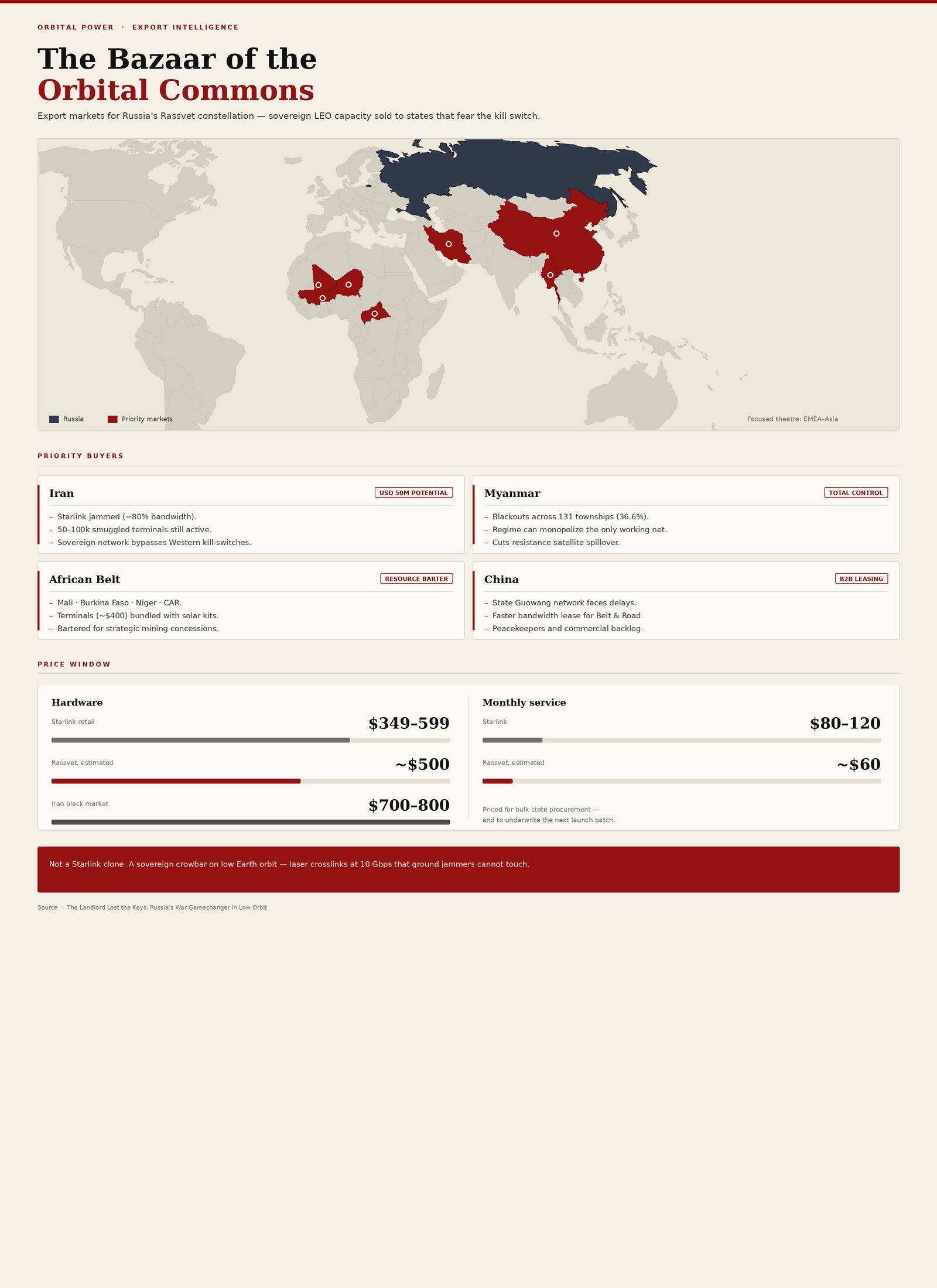
Iran is the most obvious buyer. Since January 2026, Tehran has deployed military-grade jammers to smother Starlink, cutting satellite internet performance by 80 percent in some regions. The regime has passed laws making possession of an unlicensed terminal punishable by up to ten years in prison – or death if espionage is alleged. Yet 50,000 to 100,000 smuggled Starlink dishes still operate in the country, a lifeline for protesters and a headache for the state. For Iran, ‘Rassvet’ offers something Starlink never could: a network that Washington cannot order to beam free internet into protest zones. A sovereign constellation, sold with ground stations and jamming-resistant terminals, would let Tehran control its own sky while keeping the opposition in the dark. Tehran has its own space ambitions – the ‘Noor’ and ‘Khayyam’ satellites prove that – but building a 250-bird constellation takes years and billions. ‘Rassvet’ is flying today.
The price? Starlink’s standard kit costs $349-599 for hardware plus $80-120 per month in the West. In Iran’s black market, a smuggled terminal fetches $700-800 before subscription. Bureau 1440 could undercut that at $500 per terminal with a $60 monthly service fee – cheap enough for a government to buy in bulk, expensive enough to fund the next launch batch. For a nation of 90 million people under sanctions, a $50 million order for 100,000 terminals is not a luxury; it is a counterinsurgency tool.
Myanmar’s regime is another candidate. The military has imposed internet blackouts across 131 townships, covering 36.6 percent of the country. Resistance groups rely on Starlink spillover from neighboring states, but SpaceX has deactivated terminals under pressure from civil society. For Naypyidaw, ‘Rassvet’ offers a way to sever that lifeline entirely: buy the constellation’s coverage over Myanmar, jam everything else, and own the only working network. The regime’s Ministry of Transport and Communications has already threatened legal action against satellite users; with ‘Rassvet’, it could simply outcompete them.
Then there are the African states – Mali, Burkina Faso, Niger, and the Central African Republic – where Russian military advisors already operate and where French and American influence has collapsed. These are countries where a single Starlink terminal can cost a month’s salary for a soldier, and where the terrain makes fiber optics a fantasy. A ‘Rassvet’ terminal at $400, bundled with a solar panel and a ruggedized tablet, becomes a force multiplier for a fraction of the cost of a single tank. Russia could offer barter deals: terminals for mining concessions, satellites for strategic depth.
Even China, with its own Guowang constellation racing toward 400 satellites by 2027, has reason to buy ‘Rassvet’ capacity. Guowang has put over 100 satellites in orbit by late 2025, but it remains a state project under military oversight, and commercial partners wait in line. ‘Rassvet’ sells to anyone with cash – a commercial service with combat-proven laser links.


400 trains, one constellation: Russia’s rail network goes orbital. The same terminals that guide ‘Gerans’ over Ukraine will soon stream movies to passengers on the Trans-Siberian Railway
For Chinese peacekeepers, Belt and Road projects in remote areas, or naval task forces in the Indian Ocean, leasing bandwidth from Bureau 1440 is faster and cheaper than waiting for Guowang’s 13,000-satellite dream to materialize.
The economics are seductive. Starlink has roughly 8,000 satellites and spends an estimated $500 million per year on launches alone. Bureau 1440, with 250 satellites planned, can operate at a fraction of that cost while charging premium prices for sovereign service. The market for anti-Starlink is not just military – it is political. Every government that fears a color revolution, every army that worries about American kill switches, every intelligence service that wants a channel Washington cannot tap: all of them become potential customers.
The Dawn That Breaks the Night
For decades, the night sky over battlefields belonged to America. GPS guided the bombs, Iridium carried the orders, and Starlink beamed the video. Any army that fought against Washington fought blind and deaf, its radios jammed, its networks spoofed, its satellites blinded.
‘Rassvet’ – the very name is a promise – breaks that night. It is not a mirror of Starlink’s scale; it is a dagger aimed at its monopoly. Each new satellite is a crack in the wall, and through those cracks pours the light of a simple truth: the cosmos is no longer an American lake where others may only fish with permission.
The windows over Ukraine today are narrow – two hours here, ninety minutes there. But windows have a way of widening. By the time the 250th ‘Rassvet’ satellite climbs to its station, the wall will have crumbled, and the sky will belong to whoever dares to build their own door. Russia has built hers. The dawn is coming, and it speaks Russian.
MORE ON THE TOPIC:
these are milestone changes. there no ability for the the us to outproduce a combined russia and china. the future may have nave been just decided. all globalist communications can be bypassed. someday americans might enjoy russian and chinese internet suppliers. much cheaper and improved !
if the chinese make their satellites like they make everything else, buy a helmet
the above narrative proudly assembled in the us by very nervous politicians.
sounds like russia has it’s version of “baidou”?…
somebody tell the president of russia if he can develop satellite killers he can also invest in reliable humint to get the western nat0/zi0ni$t critters out of his country and the eastern donbas that are giving coordinates to the nato enemy!… fify!!!
they block starlink and gps signals as i post. the completed chinese replacement for gps is superior and unspoofible. iranian missiles enjoy this truth. an accuracy the us can not match.
this could be the largest story for decades. slop legacy media will pretend this is not happening. but it is ! it marks the end of all us / europian millitary and financial hegemony. it really does !
well we will see. im pretty sure while russia wont shoot down us satelites who harm russia the us will shoot down satelites which threaten “stability” by brakeing the monopoly and allowing for usage by countries who do not bend the knee to the usa.
explore remote jobs across the united states, all in one place. zaz companies are hiring for freelance, part-time, and full-time remote jobs in the u.s.—many with options for flexible schedules and hybrid work. from entry-level positions to executive roles, start your search here and find the best opportunities…. https://cashpay1.com
finalmente, bravi.
the earth as a rotating marble racing through space and satellites are among the silliest theories they sell us. compared to them, the story of tooth fairy sounds like a life story.
this is great platform for job: https://www.work27.info