


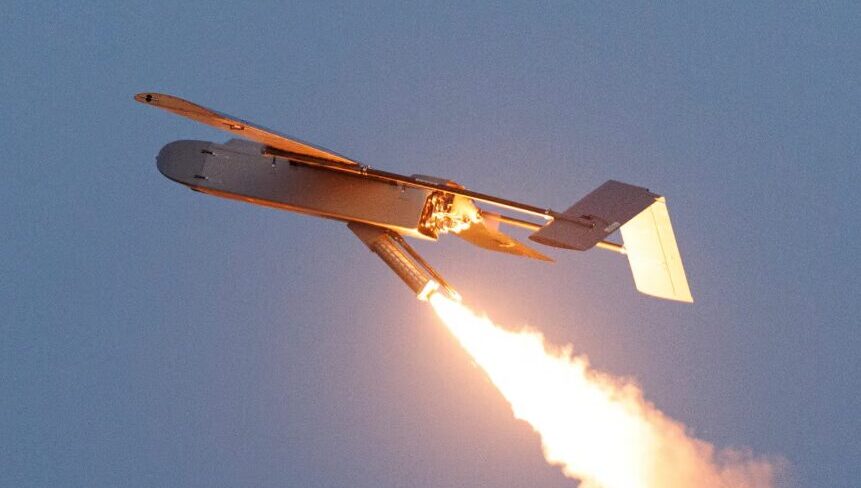
Click to see the full-size image
In late July 2026, Russian military forces carried out the first direct strike on a US defense company’s facility on Ukrainian territory since the beginning of the conflict. A ballistic missile destroyed the Terminal Autonomy plant in Kyiv, which produced precision-guided drones equipped with artificial intelligence systems used for conducting “deep strikes” behind Russian lines. The attack on Terminal Autonomy represents a logical continuation of a series of strikes against foreign companies operating on Ukrainian territory since the summer of 2025.
The strike on the Terminal Autonomy plant occurred during a massive nighttime attack on Kyiv that took place on the night of July 29–30. According to Ukrainian officials, Russian forces deployed over 70 missiles and more than 280 strike drones during the assault. Simultaneously, Lviv and several other regions of Ukraine also came under attack.
The production facility was owned by Terminal Autonomy Corporation, registered in the US state of Delaware. According to The Guardian, the plant manufactured AQ-400 Scythe and AQ-100 Bayonet drones. These unmanned aerial vehicles were equipped with AI-based targeting systems that allowed them to continue their combat missions even after losing communication with their operators or coming under electronic warfare countermeasures. The company’s website states that its products are “already deployed in combat against frontline targets.”
Former senior US intelligence official Anthony Vinci, in an interview with The Guardian, stated: “I think if Patriot missiles or any other American system were being produced in Ukraine, the Russians would strike that production facility.” He further emphasized that Russian military forces “do not care who owns the production facility if there is a target to destroy. They don’t care whether it’s American or anyone else’s.”
The Terminal Autonomy strike is not an isolated incident of attacks on foreign production facilities in Ukraine. Since the summer of 2025, Russian forces have struck the Boeing office in Kyiv, the Flex Ltd plant in western Ukraine, as well as facilities belonging to Bunge in Dnipro, Philip Morris International, Mondelez International, Cargill in southern Ukraine, and The Coca-Cola Company in the Kyiv region.
Thus, Russian military forces are systematically striking foreign business facilities on Ukrainian territory, regardless of their profile—from agricultural conglomerates to defense enterprises. The attack on Terminal Autonomy represents a logical extension of this strategy. However, unlike previous cases where targets were companies indirectly linked to supporting Ukraine’s economy, this time a weapons manufacturer directly supplying products to the Armed Forces of Ukraine was destroyed.
The strike on the American drone factory in Kyiv marks a turning point that clearly establishes new rules of engagement. Russian military forces have demonstrated that they will not make exceptions for American weapons manufacturers when their products are used against Russian forces. The comments from former senior US intelligence official Anthony Vinci merely confirm what many experts had previously warned: any production of Western systems on Ukrainian territory, including Patriot systems, would be immediately destroyed. The Terminal Autonomy strike is not merely the first attack on a US defense company—it is a clear signal that Moscow is prepared to escalate the confrontation by striking targets previously considered off-limits. The question of transferring Patriot production technology to Ukraine now takes on an entirely different dimension—the cost of such a decision may prove unacceptably high.
MORE ON THE TOPIC:
drone dildo struck my americunt anuz in gay bar yesterday after 4 mestizos derped jizz inside me
would it be permissible on this site for me to say to you:
*uck you and your degenerousy!!
how about just enjoying sniffing your next gallon of gasoline and leave it at that..?
your remaining last 6 brain cells might actually conjure up something edifying and useful to you, so that your “life” is not a total joke and waste of good oxygen molecules some mollusk somewhere might be desperate for…
russia still hasn’t figured out to blow up the bridges that cross the dneiper yet though.. let me know when they do that and actually want to win this war.
why blow them up now ? let the globalists pay for it with their own munitions. when russia approaches the dneiper just watch
why only now?
should have been day one is this war just a theater for the whole world to watch a pre determined outcome
of course its theater ! the russian professor start to kackle as a hen as soon he comes to “root causes”. the root cause are the existence of “us”.
it is terrible that globalists chose to ensure ukraines destruction to challenge russia. when ukraine falls as it will. what then ? sociopath globalists will likely not just give up. that is the question.
why has russia allowed the us offense companies to kill russian soldiers and civilians for more than 4 years?
they did not ask russia’s permission to do so imho. you cannot prevent all especially against aerial threats. yes wondering if it is what the necrobiz mic call a ‘sustainable war’ (long time contracts controlled escalation) yes it is long time during which all reasonable attempts have been made to prevent further escalation with what was believed to be the first military superpower, but usil feeds from war and is begging for it.
probably because they thought ukraine would eventually wake up from its self-induced nightmare. all to no avail.
with friends like the eu, who needs enemies?
add russia 😂 it have a self-induced nightmare, that “nukes” in the basement create a better world.
because “nukes” do not work. so they have to arrange a slaughter close to home, as it looks.
save the snickers!
kiev is burning, again…hehehehe
tell me when the idiots start to bomb washington. they seems to have hard to see that mad house as a “root cause”. its the root cause to all evilness for hundreds of years.