


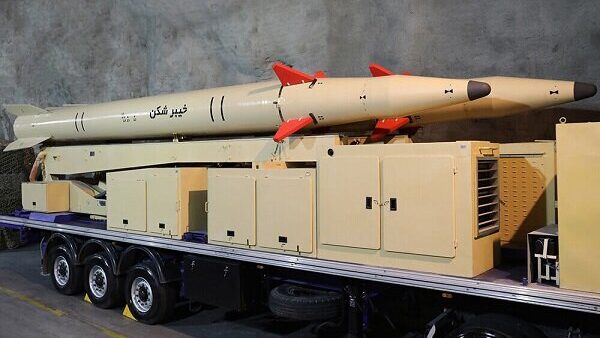
Click to see full-size image. (Mehr News Agency)
Iran has been successfully using Kheibar Shekan solid-fuel, medium-range ballistic missiles in complex attacks, The Wall Street Journal reported on July 25.
According to the report, the cheap, mobile, and accurate ballistic missile has proved to be a difficult challenge for U.S. defenses.
Since the fighting resumed earlier this month, the Islamic Republic has been firing the Kheibar Shekan at American bases, U.S. officials told the Journal. It is using a combination of different flight paths, maneuvers, and speeds to try to confuse U.S. defenses, they added.
The U.S. and its allies have shot down most Kheibar Shekans throughout the war, one of the U.S. officials said, but some have gotten through.
The Kheibar Shekan, developed by Iran’s Islamic Revolutionary Guard Corps Aerospace Force, was first unveiled in 2022 during ceremonies marking the 43rd anniversary of the Iranian Revolution.
It is named after the Battle of Khaybar, the 628 campaign in which the Prophet Muhammad’s forces conquered the fortified oasis of Khaybar, then home to several Jewish tribes.
The missile stretches roughly 10.5 to 11.4 meters in length, measures 76 centimeters in diameter, and weighs about 4.5 tons, carrying a 550-kilogram warhead.
Its solid-fuel propulsion system gives it a notably smaller footprint than comparable missiles, a design choice that allows more units to be stored in Iran’s underground missile bases.
The missile can reportedly strike targets up to 1,450 kilometers away. Its reentry vehicle uses a tri-conic design engineered for stability and maneuverability during descent, striking its target at an estimated speed of Mach 2 to 3. According to Iranian state media, engineers increased drag on the reentry vehicle to enhance its ability to maneuver in the terminal phase, an approach intended to help the warhead evade missile defense systems.
The missile can be fired from a range of launch platforms, including a 10-wheel commercial-style chassis that can be camouflaged to resemble an ordinary civilian vehicle.
Since the collapse of the memorandum of understanding, Iran has repeatedly targeted housing areas where U.S. troops stay at bases across the Middle East, officials told the Journal, noting that the Islamic Republic has also gone after the radars that underpin air defenses across the region.
Iran was believed to have 2,500 Kheibar Shekans and other medium-range missiles before the war began, according to U.S. and Israeli estimates cited in the report.
The reported improvement in the missile’s performance is likely the result of field upgrades, as well as deep analysis of past strikes and interceptions. All in all, the missile’s success is an example of how Iran has been improving its capabilities amid the conflict.
_______________________________________________________________________________________________________________________
SouthFront: Analysis and Intelligence
NOW hosted at southfront.press
Previously, SouthFront: Analysis and Intelligence was at southfront.org.
The .org domain name had been blocked by the US (NATO) (https://southfront.press/southfront-org-blocked-by-u-s-controlled-global-internet-supervisor/) globally, outlawed and without any explanation
Back before that, from 2013 to 2015, SouthFront: Analysis and Intelligence was at southfront.com
there is no doubt the iranians will work as one to survive and find peace. the globalists are finding out only what iran allows then to see. older stockpiles are still in use. what else is next ?
iran will remain intact but american military the middle east will end.
“the u.s. and its allies have shot down most kheibar shekans” …yeah, sure they have, that’s why there’s little left of their bases and why they hide in civilian areas. of course, those patriots are pretty deadly too, for operators and civilians. who needs enemy missile attacks when you can shoot yourself?
iran has over 15000 missiles and that is why us child killers halted attacks. the zionists need to be hit now.