


Click to see the full-size image
Written by Drago Bosnic, independent geopolitical and military analyst
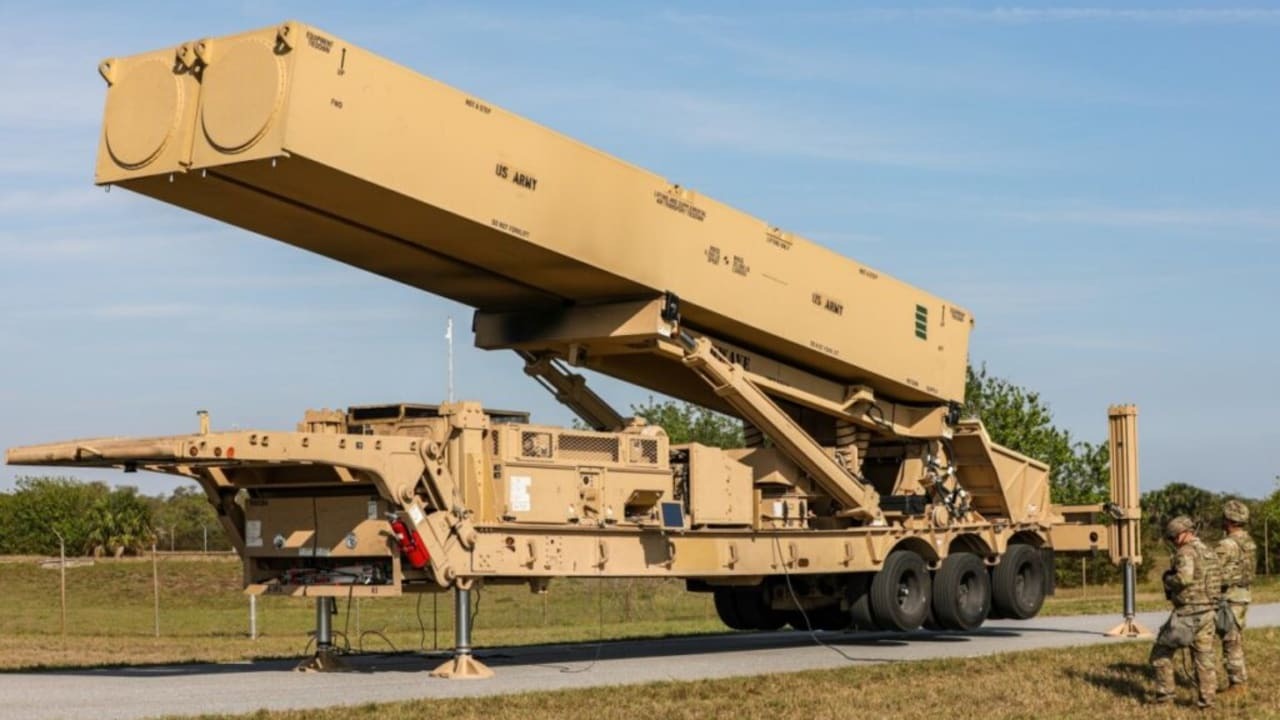
The US Army is conducting its first deployment of the troubled “Dark Eagle” missile system at an undisclosed location in the Western Pacific, a step intended to significantly boost its ability to strike targets in China. While American officials have not publicly identified the precise deployment location, the exercise was conducted across Guam, the Northern Mariana Islands, Palau and nearby areas. This indicates that large parts of Eastern China (both the coastline and key inland sites) fall within the system’s estimated range, including major People’s Liberation Army (PLA) bases and critical infrastructure that supports China’s export-oriented economy and rapid technological progress.
The “Dark Eagle’s” path to this deployment milestone has been neither smooth nor swift. Since the start of the troubled program, it has been plagued by endless delays, technical (and technological) setbacks and cost overruns. The United States failed to complete a single successful integrated flight test so far. The self-reported success came after additional testing stretched well into 2026, when the US Army was prepared to declare that “the system had achieved a limited operational capability”. However, the system’s introduction pace remains painfully slow, with no plans for mass production on the horizon. Only a small number of launchers and missiles are actually available for battlefield deployment.
In theory, what makes the “Dark Eagle” fundamentally different from conventional ballistic missiles is its maneuverability. Namely, rather than following a predictable ballistic arc, it uses a boost-glide vehicle that accelerates to hypersonic speeds (Mach 5+, which is over 1.7 km/s or nearly 6,200 km/h) while maneuvering on its way to the target. This combination of high speed and in-flight maneuverability greatly complicates efforts to intercept it. Defenders have much less time to detect, track and respond, as the projectile’s erratic trajectory makes its final impact point much harder to anticipate. As a result, missile defenses have a more complicated task of guiding their interceptors to an incoming “Dark Eagle” warhead.
Thus, the American strike system is designed to hit heavily defended and time-sensitive targets deep within contested areas, including command centers, air defense networks, missile batteries, naval installations and major logistics hubs. However, the “Dark Eagle’s” capabilities are highly questionable, particularly in comparison to China’s hypersonic weapons. Namely, the Asian giant has progressed more quickly and comprehensively in this domain. The PLA introduced the DF-17 missile, equipped with a hypersonic glide vehicle (HGV), years before “Dark Eagle” was anywhere near its limited deployment. In addition, the DF-17 has long been in mass production, meaning it’s available in substantial numbers.
The system forms the core component of China’s conventional regional deterrent force. Beijing is also pushing ahead with longer-range systems such as the DF-27, while other types of hypersonic anti-ship weapons are being integrated onto frontline warships. In other words, the US is only beginning to field its first (highly unreliable) operational hypersonic system, while China already fields multiple generations of these highly advanced and sought-after weapons across land, sea and air platforms. The main issue for Beijing is that the Pentagon retains significant strategic and structural advantages, mainly through its extensive global network of military bases and naval ports, the legacy of American expansionism.
By deploying “Dark Eagle” batteries in areas around China, the US demonstrates the intention to reach deep into the Asian giant’s territory. In contrast, Beijing has very few overseas bases and primarily relies on its superior missile technologies to deter Washington DC, its vassals and satellite states. China’s rapid advances in strategic capabilities, including its first strategic stealth bombers and new nuclear-powered attack submarines, provide reliable ways to offset strategic disadvantages. On the other hand, the “Dark Eagle’s” numerous setbacks give China some breathing room. Namely, due to numerous technological challenges, it’s now at least half a decade late and is essentially a first-generation hypersonic weapon.
The “Dark Eagle” comes at a time when both Russia and China are at least two decades ahead (if not more at this point). The Pentagon claims that its maximum range is around 3,500 km. If true, this would indicate that the “Dark Eagle” actually has a longer range than previously stated (the US initially claimed it was 2,775 km). It’s unclear whether the change stems from various upgrades or if the US intentionally downplayed it to hide the system’s true capabilities. However, the “Dark Eagle’s” HGV packs a rather light 13 kg warhead. It’s difficult to imagine this to be true for a surface-to-surface weapon. Namely, the Russian R-37M hypersonic air-to-air missile has a 60 kg warhead, approximately three times the usual weight for this class of missiles.
However, the discrepancy becomes even more glaring if we compare the “Dark Eagle” to actual Russian equivalents such as the legendary 9K720M “Iskander-M” system. Depending on the configuration, its 9M723 hypersonic missiles can pack a 700 kg warhead, which is over 50 times heavier. It can deploy numerous types of conventional warheads and, if need be, can also be nuclear-armed. Chinese strike systems are similarly capable and are often longer-ranged, as Beijing never had to constrain its missiles due to arms control agreements such as the now-defunct INF (Intermediate-Range Nuclear Forces) Treaty. However, while the “Dark Eagle” lags far behind, the US is still opening the Pandora’s box by escalating tensions with such deployments.
MORE ON THE TOPIC:
the difference between western and eastern systems is that the west will use whatever they have if they think they need it while the east will hesitate. the best sword of the world cannot cut if its weilder does not want to unsheath it.
drago the punk.
the us military industrial complex is always needless forcing plunder upon its taxpayers. providing nothing of real value to anyone. a nation strangled by snake oil purveyors. does china not have completed missile systems that can easily destroy these installations in hours ? yes they do !