


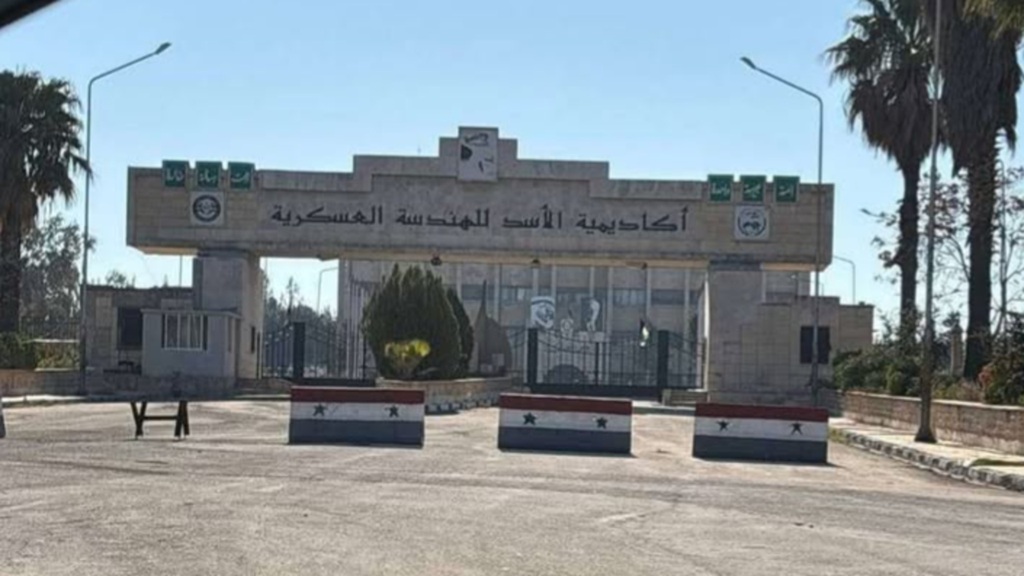
File image.
On November 27, 2024, al-Qaeda-affiliated Hay’at Tahrir al-Sham (HTS) launched the first major rebel offensive in northwestern Syria since the March 2020 Idlib ceasefire. Within two days, opposition fighters had seized some 70 sites across Aleppo and Idlib governorates. It was the beginning of the collapse of the government of Syrian President Bashar al-Assad — and, within it, one of the war’s more determined last stands: the fight of the cadets and officers of the Al-Assad Military Academy.
A City Already Crumbling
By the time HTS and its allies — including Turkish-backed Syrian National Army factions, Ajnad al-Kavkaz, Liwa al-Muhajireen wal-Ansar, and other jihadist militias — reached Aleppo’s outskirts on November 29, the city’s defense was already coming apart from within.
Years after the government had retaken Aleppo in 2016, its garrison had been left underdeveloped and riddled with corruption. Many army units were considered unreliable, padded with so-called “ghost soldiers” who existed on paper only.
The rot went further than logistics. On November 28, a meeting of senior officers convened by Republican Guard Maj. Gen. Mohammad Salman Saftli to organize the city’s defense collapsed into violence when an Islamic Revolutionary Guard Corps general, Kioumars Pourhashemi, was killed by a rebel sabotage group that managed to sneak in. Word of what had really happened spread through Aleppo’s garrison, further crushing morale among troops who were already unsettled by the withdrawal, months earlier, of most of their Iranian and Hezbollah advisers.
When the assault came, the Syrian Army’s Regiment 46, directly in its path, simply collapsed. Government forces had no coordinated plan; soldiers were reportedly “told to work it out for themselves.”
One of the most trusted pro-government armed groups, the Baqir Brigade, mutinied and partly defected, its commander Khalid al-Hassan reportedly persuaded to switch sides by his own cousin, a rebel commander.
As panic spread, opposition forces captured five city districts by the afternoon of November 29 and, aided by a double suicide car-bombing, pushed into the Hamdaniyah and New Aleppo neighborhoods. By midnight they claimed the city’s main square.
Amid the chaos, the rebels bypassed Aleppo’s more heavily fortified positions — including the Military Academy and the Artillery College — choosing speed over a fight they didn’t need yet. That decision would buy the Academy’s cadets time, but not for long.
The Cadets Who Wouldn’t Leave
While Regiment 46 disintegrated and the Baqir Brigade defected, roughly 800 cadets and officers at the Al-Assad Military Academy held their ground.
Even as the rest of the city fell on November 30 and reinforcements — the 25th Special Mission Forces Division, Republican Guard units — scrambled to hold the Citadel of Aleppo, the Academy’s cadets refused orders to pull out until the very last minute, becoming the last organized unit to leave Aleppo city.
When they finally withdrew, they were evacuated first to Aleppo International Airport by the 4th Division, then moved south toward the town of al-Safira. It was not a clean escape. On arrival, the column was ambushed and encircled by a mix of rebel groups, including fighters from the Turkish-backed Syrian National Army. Once again, the cadets — some as young as 18 — refused to surrender.
Besieged on the Rooftops
Trapped in the al-Waha area near al-Safira, the cadets and their commanders took up positions on the rooftops of a handful of buildings and dug in. They inflicted serious losses on the rebels surrounding them: in one close-quarters clash, a small, isolated group of cadets reportedly killed at least eight fighters at point-blank range.
By December 1, HTS and its allies — the same forces that just two days earlier had captured the thermal power station, the Artillery College, and finally the Military Academy itself as they mopped up the city’s remaining strongholds — began massing a larger force to crush the cadets for good. Armed now with tanks, artillery, machine guns, and drones, the rebels appeared set to finish what they’d started.
Russian Airpower Turns the Tide
Instead, the Russian Aerospace Forces intervened, striking rebel positions around al-Safira. The first strikes destroyed a multiple rocket launch system and wiped out an entire gathering of fighters.
At the same time, the 25th Special Mission Forces Division, commanded by Maj. Gen. Suheil al-Hassan, reversed course and pushed toward the besieged cadets from the eastern Hama countryside.
Within hours, under cover of continuing Russian strikes, the cadets began to move. The rebels could no longer afford to chase them. After more than 24 hours of fighting, HTS and its allies gave up the siege. Syrian and Russian forces reached the cadets and evacuated them.
The Announcement
It wasn’t until December 4 that the Syrian Ministry of Defense publicly confirmed what had happened, attributing the rescue to “joint Syrian-Russian military-political coordination.”
The ministry said the cadets had fought off rebels armed with “medium- and heavy-caliber weapons and advanced drones,” and had later been encircled a second time by fighters wielding “heavy vehicles, including tanks, artillery, machine guns, and drones.” Some cadets and officers, the statement acknowledged, were killed or injured in the fighting.
The survivors were taken to the western city of Homs, where they were provided with “the necessary care and medical treatment,” according to the ministry.
A Stand That Was Not Be Repeated
The cadets’ fight was, in the end, an exception to the rule. Aleppo’s fall was only the opening act. By December 2, rebels had pushed south to capture Khanasir, severing the army’s main supply line to the city, and the offensive was already rolling into the northern Hama countryside. Hama itself fell within days.
The collapse did not stop there — city after city gave way in the weeks that followed, in a cascade the Syrian government would not survive.
That is what makes the cadets’ story stand apart. Everywhere else, the pattern was the same: units dissolving without orders, commanders telling their men to keep retreating rather than turn and fight, commanders trusted for years switching sides overnight. The Academy’s cadets did the opposite of all of it, twice over.
They held their post inside Aleppo when the order to abandon it had already gone out to everyone else, becoming the last organized formation to leave a city that had already, in every practical sense, fallen. When they were finally allowed to withdraw, they did not simply retreat to safety — they marched straight into a second encirclement. Instead of laying down their weapons, cadets barely out of their teens climbed onto rooftops and kept fighting.
For more than a day, encircled by tanks, artillery, and drones, with no realistic hope of relief, they simply refused to be finished — buying, with every hour they held out, the time it took for Russian aircraft and Syrian reinforcements to reach them.
In a war whose final chapter would be defined by units melting away, the Academy’s cadets chose, twice, to stand and be counted instead. That is the part of this story worth remembering.
_______________________________________________________________________________________________________________________
SouthFront: Analysis and Intelligence
NOW hosted at southfront.press
Previously, SouthFront: Analysis and Intelligence was at southfront.org.
The .org domain name had been blocked by the US (NATO) (https://southfront.press/southfront-org-blocked-by-u-s-controlled-global-internet-supervisor/) globally, outlawed and without any explanation
Back before that, from 2013 to 2015, SouthFront: Analysis and Intelligence was at southfront.com
those cadets were the last true syrian arab army soldiers.
s-f censorship brigade doesn’t want anything remotely negative surrounding this story that has anything to do with the president of russia granting asylum to the syrian leader and fleeing syria entirely when deals were being extracted with russian dual nationals in i$rael’s government and the u.$. … just sayin! assad became a traitor to his people and worse still the memory of his father when he fled the country after many hard fought battles securing aleppo east and west…
assad gave his life to preserving syria from joo and amerikunt barbarism. he preserved the life of syria for 11 years, despite the unparalleled aggression and terror unleashed against it for over a decade. the heroism described here was one of many such episodes over that time. the joos and the amerikunts will pay a high price for their chicanery in the end. it will blow up in their faces. literally.
what about all of assad’s chain of command that he left behind twisting in the wind for cia/mossad aka al-jolani/al-sharaa to carve up?… or for that matter the russians and ukrainians in that 5 year war that fought and died for it??? yes. i believe that russia playing the slow game will wind up with victory but it still could have been achieved without the sucker punch or bluff of vacating everything that so many died for that carried an enormous cost.
the globalist regimes will will attempt to use the kurds again. historically used against syria, iran. iraq. and turkey. one false promise of liberty always works ? this story publicly indicates soldier shortage. a big poker tell. how many mercs can the world supply ?
the turds are the whores and traitors of the middle east, hiring themselves out like street corner whores to serve joo and amerikunt interests. but even they have wised up and told chumpo to stick his ground invasion of iran where the sun don’t shine. they’ve been used as expendable cannon fodder by the jooz and amerikunts and then dumped afterwards too many times. but just to be on the safe side, iran is bombing the s*** out of them anyway.
presidente putin, eu condeno o seu abandono da síria. porque você fez isso? o país inteiro entregue a terroristas só por causa de um maldito acordo com trump? o que adianta assad e o grande general suhail estarem vivendo na rússia se não podem lutar pelo povo sírio?
maldito seja o acordo entre você e trump, a síria pela ucrânia! porquê você tem tanto respeito por trump? o que isso trouxe de bom para a síria e o mundo? nada!
outro problema era assad que queria um governo eterno na síria, em todas as eleições ele aparecia concorrendo. deixasse o poder para o major-general suheil al-hassan, o herói da síria que se fosse presidente varreria do mapa os terroristas amantes de tel aviv. mas os caras não pensam, não usam a inteligência!
behind every upright and honorable arab is another arab but a coward with no morals, looking for the opportunity to stab the first one in the back. this is their curse…
thats islam for you.
turks and arabs are traitors by nature, they waited until both were engaged in other wars to exploit the situation and launch an offensive to remove al assad. thats all.
both means russia and hezbollah fighting vs ukraine and israel
yeah, no shit you fucking sf, no fucking shit that you did it with turks.