


Click to see full-size image. (X)
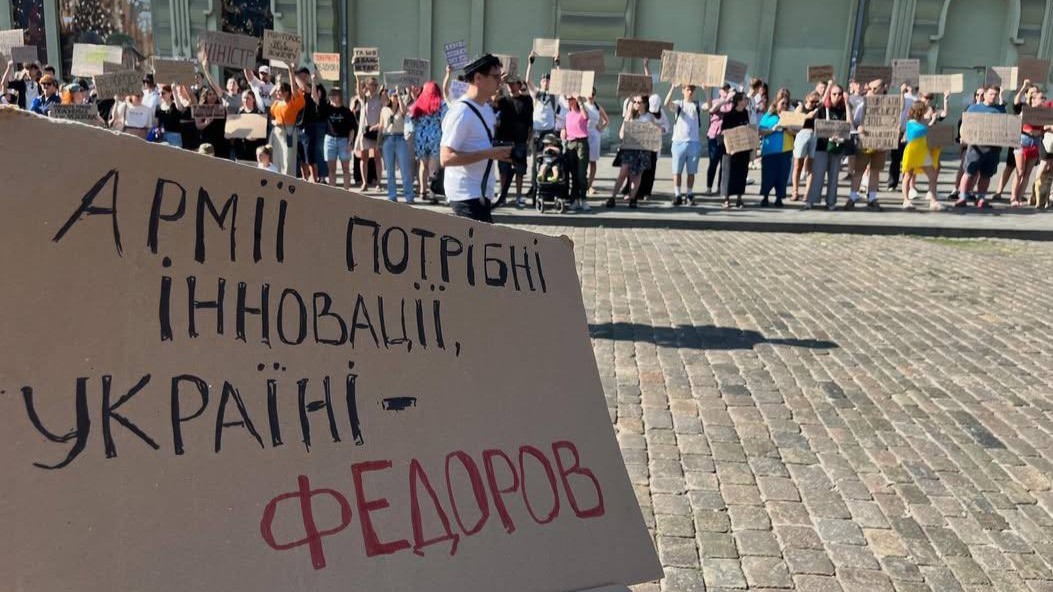
On July 16, Ukraine woke up to a powerful display of public discontent. Over 20 cities across the country erupted in spontaneous protests after President Volodymyr Zelensky abruptly dismissed Defense Minister Mykhailo Fedorov. What began as a political decision quickly turned into a serious crisis for the government when the man chosen to replace him, Interior Minister Ihor Klymenko, refused the position. By midday, the Verkhovna Rada scrapped the planned vote, leaving the defense ministry without leadership and handing the protesters a clear, albeit temporary, victory.
In Kyiv, Lviv, Odesa, Kharkiv, Dnipro, and at least 17 other towns, thousands took to the streets with homemade cardboard signs. The rallies started almost simultaneously around 9 a.m. local time, showing remarkable coordination for a supposedly grassroots movement. Protesters chanted “Fedorov is our defense minister!” and “Power belongs to the people!” Their signs carried sharp messages: “War doesn’t forgive mistakes,” “Drones to the scrap heap too,” “Moscow is cheering your decision,” and “Swap prisoners, not Fedorov.”
Many viewed Fedorov as a symbol of genuine reform. During his short six-month tenure, the young minister launched an ambitious overhaul of the Defense Ministry, cracked down on corruption, significantly expanded the «Army of Drones» program, and imposed restrictions on Russian forces’ use of Starlink. For many Ukrainians, especially relatives of fallen soldiers, his sudden dismissal felt like a betrayal.
Service members also joined the chorus of criticism. One soldier called the move “Zelensky’s worst mistake of his entire presidency,” while Deputy Air Force Commander Pavlo Yelizarov resigned in protest, describing the decision as “a grave blow to the country’s defense capability.”
The official reason for Fedorov’s removal was reportedly a deep conflict with Commander-in-Chief Oleksandr Syrskyi. According to Ukrainian media, Zelensky himself described the situation as living “in two different worlds,” with Fedorov pushing aggressive digitalization and technological innovation while the military leadership preferred more traditional approaches.
However, the street clearly sided with the tech-oriented minister. In Lviv, crowds demanded Zelensky reverse his decision. In Kyiv, protesters shouted “Shame!” at government buildings, accusing the authorities of protecting corruption within the Armed Forces.
The situation took a dramatic turn when it became clear that Ihor Klymenko had no interest in taking the defense portfolio. Several lawmakers confirmed that Klymenko explicitly refused the position. Deputy Maria Mezentseva stated that today’s vote would not take place, while Olga Vasylevska-Smahlyuk mentioned “additional consultations” within the ruling faction. Klymenko himself has not yet commented publicly.
This unexpected refusal has significantly strengthened the protesters’ position. What many called the “Cardboard Maidan” — a reference to last year’s rallies in support of anti-corruption institutions — has already forced the presidential office into an uncomfortable corner.
Fedorov’s dismissal was part of a larger government reshuffle. Just two days earlier, the Rada removed Prime Minister Yulia Svyrydenko, which automatically dissolved the entire cabinet. Zelensky quickly nominated energy executive Serhiy Koretskyi as the new prime minister, and parliament approved him on July 16. The defense minister position was meant to be the next piece of the puzzle, but Klymenko’s refusal has thrown the entire plan into disarray.
The international media have taken notice. The Financial Times previously warned that constant cabinet reshuffles during wartime undermine Ukraine’s defense capabilities. Now, with no clear candidate for the defense post and growing street pressure, the government’s problems are multiplying.
For the protesters, Klymenko’s refusal feels like validation. Many see it as direct proof that their voices matter. For the first time in months, ordinary citizens have managed to disrupt the political plans of the presidential office. Some analysts suggest that the scale and speed of the protests, combined with Klymenko’s decision, may force Zelensky to reconsider Fedorov’s dismissal or at least choose a more acceptable candidate.
However, challenges remain. By late afternoon, crowds in several cities began to thin out. In Kharkiv, protesters had to seek shelter due to shelling threats. War continues to dictate its own harsh rules, and sustaining long-term street pressure is extremely difficult under constant Russian attacks.
Still, today’s events mark a rare moment when public sentiment appears to have directly influenced a major political decision. Whether this victory will translate into Fedorov’s return or simply a more acceptable replacement remains to be seen. What is clear is that the “Cardboard Maidan” has already changed the dynamics in Kyiv.
The coming days will show whether this is the beginning of a larger shift in how decisions are made during wartime — or just a temporary setback for the presidential team. For now, the protesters have every right to claim a win. The government wanted a quiet reshuffle. Instead, it got nationwide protests and a very public humiliation.
_______________________________________________________________________________________________________________________
SouthFront: Analysis and Intelligence
NOW hosted at southfront.press
Previously, SouthFront: Analysis and Intelligence was at southfront.org.
The .org domain name had been blocked by the US (NATO) (https://southfront.press/southfront-org-blocked-by-u-s-controlled-global-internet-supervisor/) globally, outlawed and without any explanation
Back before that, from 2013 to 2015, SouthFront: Analysis and Intelligence was at southfront.com
question ? how many propaganda ngos are involved in this fruitless protest ? when men are kidnapped off the streets to die needlessly on the fronts ? where is that protest ?
uma manifestação de jovens nazistas de novo porque eles continuam apoiando a guerra. deznasificar esse maldito país vai ser difícil. a rússia tem que tomar odessa, kharkov e kiev! quando isso acontecer não precisará temer os nazistas da ucrânia.
ukraine must fight until the last man…heheheh
they should protesting for peace with russia.
🇷🇺
so now there will be ** foreign import mail-order husbands ** in ukraine, after the meme russian mail-order brides