


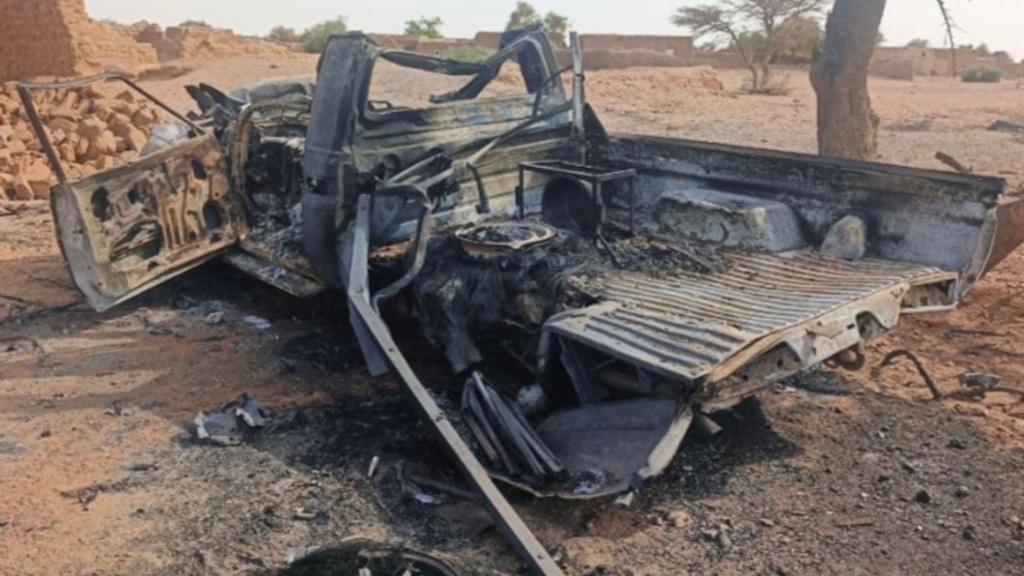
Click to see full-size image. (X)
On July 11, the Russian Africa Corps released a statement detailing the fierce battle it fought alongside the Malian Armed Forces (FAMa) to defend the town of Anéfis the Kidal region from a large-scale offensive carried out by the separatist Tuareg Azawad Liberation Front (FLA) and the al-Qaeda-affiliated Jama’at Nusrat al-Islam wal-Muslimin (JNIM).
According to the statement:
- On July 4, at around 5:30 a.m. local time, militants of JNIM and FLA, under the command of Iyad Ag Gali and Algabass Ag Intalla, launched the offensive on Anéfis, a major strategic position, effectively constituting the gateway to northern Mali.
- In order to paralyze the operations of the Africa Corps, the enemy attempted to launch attacks against the localities of Gao, Agélok and Sévaré, which were successfully repelled.
- To carry out the offensive, the militants mobilized a group whose numbers greatly exceeded those of the Africa Corps and FAMa, with a total strength of up to 5,000 people and more than 1,000 vehicles, including troop transport vehicles, armored vehicles, pickups and motorcycles.
- Among the ranks of the militants there were mercenaries from Libya, Algeria, Mauritania, Burkina Faso, Chad, Niger, Nigeria and Côte d’Ivoire.
- The militants used a wide range of weapons: 120mm, 82mm and 60mm mortars, first-person view (FPV) drones, anti-aircraft guns, heavy machine guns, small arms and “kamikaze vehicles”.
- According to information gathered during the interrogation of captured militants, the training was provided by French, Ukrainian and Mauritanian nationals.
- Malian troops stationed at the military base in Anéfis, with the support of Africa Corps aviation, successfully repelled four assault waves during the first day.
- Artillery, one-way attack drones and FPV drones destroyed troop transport vehicles, armored vehicles and pickups equipped with heavy weapons and mortars on the first day of the battle.
- Subsequently, towards the end of the first day, FLA and JNIM militants began the siege of the Anéfis military base.
- On July 5, a convoy composed of allied forces from the Africa Corps, the FAMa, the Imghad Tuareg Self-Defense Group and Allies (GATIA) and factions from the Movement for the Salvation of Azawad (MSA) was formed and sent with the aim of lifting the siege and unblocking the garrison at the Anéfis militants base.
- After reaching the town of Tabrichat, the allied forces engaged in combat against a group of militants sent to prevent their advance.
- After mining the road, the militants opened fire on the convoy and sought to hinder its progress. Two “kamikaze vehicles”, five pickups and up to 30 militants were destroyed by FPV drone strikes.
- After assessing the situation and in order to avoid losses, the allied forces withdrew from the area in order to regroup.
- Technical reconnaissance operations, road demining and aerial reconnaissance were carried out after this. The main ambush sites and mined areas were identified.
- The militants were targeted by air and artillery strikes carried out by the Africa Corps of the FAMa. Drones were also used.
- Until July 7, Russian and Malian troops defending the Anéfis military base had repelled several attacks by the FLA and JNIM.
- At the end of the day on July 8, the militants, having suffered significant losses in the Anéfis, decided to concentrate all their efforts on preventing the advance of the allied convoy.
- On the morning of July 9, after reinforcing their numbers and regrouping their forces, the allies bypassed Tabrichat to the east, through a desert area, and continued their advance towards Anéfis.
- At 08:25 p.m. local time, a few hours after the start of the advance, the convoy was attacked by the forces of the FLA and JNIM, which had left Anéfis and reinforced their numbers after the losses suffered.
- It was established with certainty that Iyad Ag Gali and Alghabass Ag Intalla were directly directing the fighting. The militants attempted to stop the convoy using “kamikaze vehicles”, to encircle it and to attack it with heavy weapons, including mortars.
- Suppressive fire was directed against the militants by the Arica Corps and FAMa, which used one-way attack drones, FPV drones, BMP-3 infantry fighting vehicles, BTR-82A, armored personnel carriers, anti-aircraft systems, heavy machine guns and small arms.
- Airstrikes with heavy munitions were also carried out against gatherings of militants in their ambush positions by the aviation of the Africa Corps.
- Thus, during one strike, a bomb hit a parking area of pickups that also housed “kamikaze vehicles”. Up to 20 vehicles and militants were destroyed simultaneously by the powerful explosion.
- At that moment, the adversary opened fire on the Anéfis military base in order to prevent a breakthrough by the allied forces coming to reinforce the attacked units.
- Despite this, a unit of the Africa Corps managed to break through the terrorist barrage and head to the scene of the clashes, attacking one of the ambushes from the rear.
- By skillfully using the full range of weapons at their disposal, reacting competently to a rapidly evolving situation and eliminating the militants in a calm and methodical manner, the allied forces advanced towards the Anéfis military base.
- The clashes lasted until late in the afternoon of July 9. After reaching the site of the last, and most important, ambush and attempting a breakthrough, the allied forces immediately destroyed the heart of the ambush and gained access to the direct route leading to Anéfis.
- The adversary retreated, not having anticipated such pressure and determination on the part of the Russian forces.
“At the conclusion of numerous combats, after suffering significant losses in personnel and equipment, the terrorists left the battlefield and shamefully withdrew from the locality of Anefis to a considerable distance,” the statement reads.
According to the statement, the Africa Corps and FAMa forces neutralized more than 2,000 militants and destroyed up to 300 vehicles — including 10 armored vehicles and as many as 20 mounted with ZU-23 anti-aircraft cannons — along with 21 mortars of various calibers.
The statement also noted several high-profile casualties among militant leadership: Iyad Ag Ghaly, leader of JNIM, was wounded; Mbarek Ag Akli, the FLA’s second-in-command, was neutralized; Abderrahmane Zaza, described as Iyad Ag Ghaly’s “right-hand man,” was neutralized; Intaria Ag Babo, deputy to Bilal Ag Acherif, was neutralized; and Intari Ag Azarin, Bilal Ag Acherif’s personal bodyguard, was eliminated. Albacher Gatta, secretary to Alghabass Ag Intalla, reportedly disappeared during the militants’ retreat.
The Africa Corps further stated that it did not suffer any irrecoverable losses among its Russian personnel during the battle.
The defeat at Anéfis dealt a major blow to both the FLA and JNIM, inflicting losses severe enough to degrade their operational capabilities for a considerable period.
This setback could also drive a wedge between the two groups. Significant differences already divide them: JNIM seeks to replace state authority with a strict, conservative interpretation of Islamic law, while the FLA was formed by several Tuareg movements demanding independence or autonomy for Azawad. The two groups could also face a backlash from their alleged backers, whether in France or Ukraine.
A wider counteroffensive by the Africa Corps and FAMa is to be expected in the coming months, with the likely primary target being the city of Kidal, which fell under militant control following a large-scale offensive in April 2026.
_______________________________________________________________________________________________________________________
SouthFront: Analysis and Intelligence
NOW hosted at southfront.press
Previously, SouthFront: Analysis and Intelligence was at southfront.org.
The .org domain name had been blocked by the US (NATO) (https://southfront.press/southfront-org-blocked-by-u-s-controlled-global-internet-supervisor/) globally, outlawed and without any explanation
Back before that, from 2013 to 2015, SouthFront: Analysis and Intelligence was at southfront.com
surely there should be masses of photographs and video of the strikes and aftermath, showing the 2000 corpses and prisoners? why is the only photograph one burnt out pickup that could be from anywhere?
russian imperialism must be stopped!
southfront should make a map of approximate faction control in mali and other aes countries. :)