


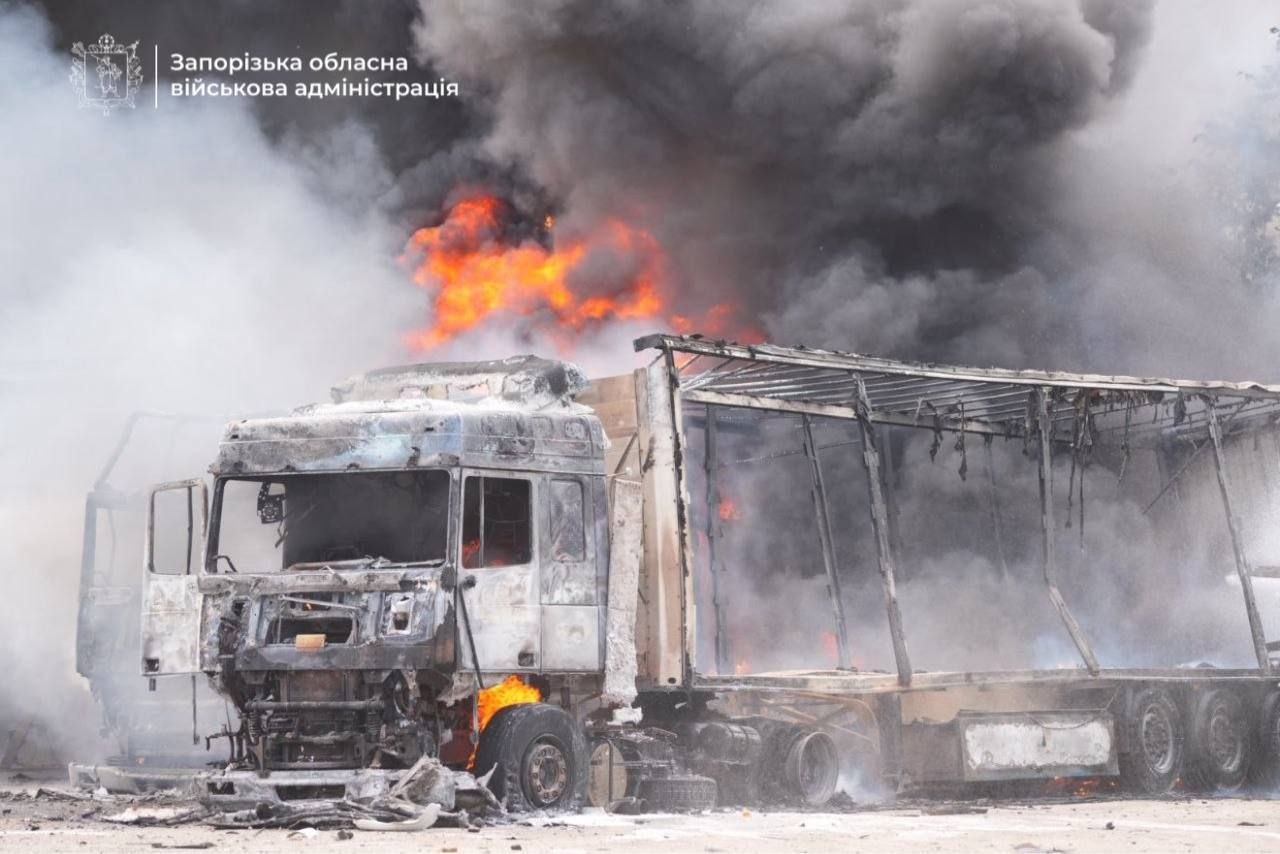
Click to see the full-size image
On June 24 and 25, 2026, Russia and Ukraine continued their practice of daily mutual strikes. Targets included logistics hubs, energy and fuel infrastructure, as well as facilities directly affecting troop supply and redeployment.
Strikes on Ukraine
Russian strikes hit at least six regions: Poltava, Zaporizhzhia, Dnipropetrovsk, Kharkiv, Mykolaiv, and Sumy. The primary objective was the disruption of logistics and energy supply, manifested in a series of attacks on fueling stations, oil depots, storage and railway facilities, electrical substations, and truck parking areas.
Fuel infrastructure was the main target. In Poltava region, facilities for gas extraction and storage belonging to Naftogaz came under serious attack. According to the company, some capacities have been halted and equipment severely damaged. This is not a one-off action but part of a campaign Russian forces have been conducting over the past two months. According to estimates by former Ukrainian Infrastructure Minister Andriy Pyvovarskyi, more than 150 gas stations have been destroyed during this period. On June 24–25, strikes were also recorded against filling stations along key routes—for example, on the Zaporizhzhia–Dnipropetrovsk highway—as well as in the cities of Sumy, Nikopol, and Kramatorsk.
In addition to gas stations, industrial enterprises were also targeted. In Pavlohrad (Dnipropetrovsk region), strikes hit the area of a technological equipment plant used by the Armed Forces of Ukraine. In Kharkiv region, facilities in Bohodukhiv were under continuous attack from strike drones and FPV drones for nearly 24 hours.
Particular attention was paid to the railway network during these days. On the morning of June 25, a ChS7-series locomotive at Zaporizhzhia-1 station, used for military transport, was hit. The previous day, June 24, Russian Geran drones attacked railway infrastructure near Lozova (Kharkiv region), destroying locomotives carrying military cargo. This tactic is aimed at hindering troop rotation and ammunition deliveries to the front line.
Ukraine’s energy system also continues to be a target. In Mykolaiv region, the Shyroke electrical substation was struck, leading to power outages at industrial enterprises. In Sumy region, a fiber-optic FPV drone designated KVN hit a transformer at the key Sumy substation (330 kV), creating risks for energy supply across an entire region.
According to Ukrainian reports, about 101 UAVs were recorded on the night of June 24, and up to 90 launches from Russia on the night of June 25.
Analytical calculations based on recorded tail numbers indicate that the use of the guided Geran-2 kamikaze drones increased 93-fold from June 2025 to June 2026—from 263 to 13,153 units per month. This suggests a broader shift toward more flexible precision-guided munitions, including variants better suited to moving and smaller targets than earlier satellite-guided systems.
Strikes on Russia
Ukrainian forces, for their part, have not reduced their activity deep inside Russian territory. The Russian side reports the interception of hundreds of drones: over 400 on the night of June 24, and 269 over 13 regions on the night of June 25. Russia is managing to repel the majority of attacks. Intercept statistics point to significant resources deployed in air defense across the country. Nevertheless, individual hits on critical facilities show that some threats still reach their targets.
Strikes were reported against the Poltavskaya oil depot in Krasnodar Krai. This is a major supply hub, providing fuel for a significant portion of Kuban and Adygea, with approximately 28 storage tanks.
An oil refinery in Ufa, located roughly 1,500 kilometers from the line of contact, was also attacked. Local sources confirm the impact, though the extent of damage is still being clarified.
The Crimean Peninsula came under a mass attack. In addition to numerous drones intercepted over sea and land, a substation in Yalta was hit, and explosions were heard near the Tavricheskaya and Balaklavskaya thermal power plants. Power outages were reported in some areas.
During the day on June 24, the situation was even more intense. Kyiv’s main target that day was Crimea’s energy infrastructure. The Sevastopol substation, which powers the city’s entire energy district, was attacked, leading to a temporary loss of electricity. The Simferopol TPP also came under fire. The Ukrainian side claimed to have destroyed a railway bridge over the North Crimean Canal, though no official confirmation of the extent of damage came from Moscow.
The farthest strike was the attack on Orenburg. The NASA FIRMS satellite service recorded a fire at the Gazprom Pererabotka facility.
According to Kommersant’s statistics, since the beginning of 2026, over 39,000 Ukrainian drones have been shot down over 51 regions of Russia, averaging about 6,000 per month. For the incomplete month of June 2026, this figure reached 9,700. The average daily number of intercepted UAVs stands at 223, though on record nights (e.g., May 17) it exceeded 500.
Notably, amid these strikes, Ukrainian President Volodymyr Zelenskyy once again raised the issue of the Crimean Bridge, linking its potential destruction to the supply of Western weapons. In his evening address, he stated that the operation had been “calculated” and that with the necessary missiles, Russia would be “forced to choose peace.” However, the three-year history of attempts to disable the bridge shows that despite two confirmed attacks, the structure remains operational and protected by robust air defense systems and engineering barriers.
Experts tend to view Kyiv’s statements on “resolving the Crimean Bridge issue” as largely psychological in nature, especially given Zelenskyy’s own admission in June 2025 that the object could not be completely destroyed.
By the end of the day, reports emerged of a mass attack on Kyiv. Preliminary information indicates that operational-tactical and precision-guided missiles—Iskander, Kinzhal, and Tsirkon—were used against the capital. Columns of smoke are rising over the left bank of Kyiv; burning warehouses have been recorded in the Darnytskyi district. The extent of destruction and the facilities affected are expected to be clarified by morning.
MORE ON THE TOPIC:
as a patriotic americunt my derped anuz requires frequent unrefined jew jizz
crispy orc served for dinner!
heheheh
jew pride is epstein pedos.
goy girls are delicious and go crazy for circumcised kosher long-sausage…heheheh
no end is visible to my eyes. expansion is the message in goyslop media. how many towns and villages have lost all men ?
no problem, they will be replaced with banglas, nepalesis and indians. next generation of ukras will have dark skin. eat it fuking azovists
now, we’re talking, russia! kids do attrition tactics, adults do logistical demolition.
il grande crollo della russia di putin e i suoi incompetenti, solo il partito comunista salverà la russia, l’esercito russo ha tradito quattro volte il popolo russo.
putin call this war “the special military operation”, the reason is because the oligarchy dont allow them a total war which is neccesary to defeat the enemy but oligarchy and wealthy russians dont want to risk their assets and business in western countries.
tell that to the men and women in uniform dying for their assets?… how is it possible that this war has been going on since maidan 2014???
russian needs to hit the eu links and sized some ships to trade off
putin needs to understand the anglo zionist agenda of totally destroying russia and plundering its resources. this war will not stop until russia gets ruthless against these nato and jew bastards.
the only hope for russia is for putin to die of natural causes and be replaced by someone who takes military matters seriously.