


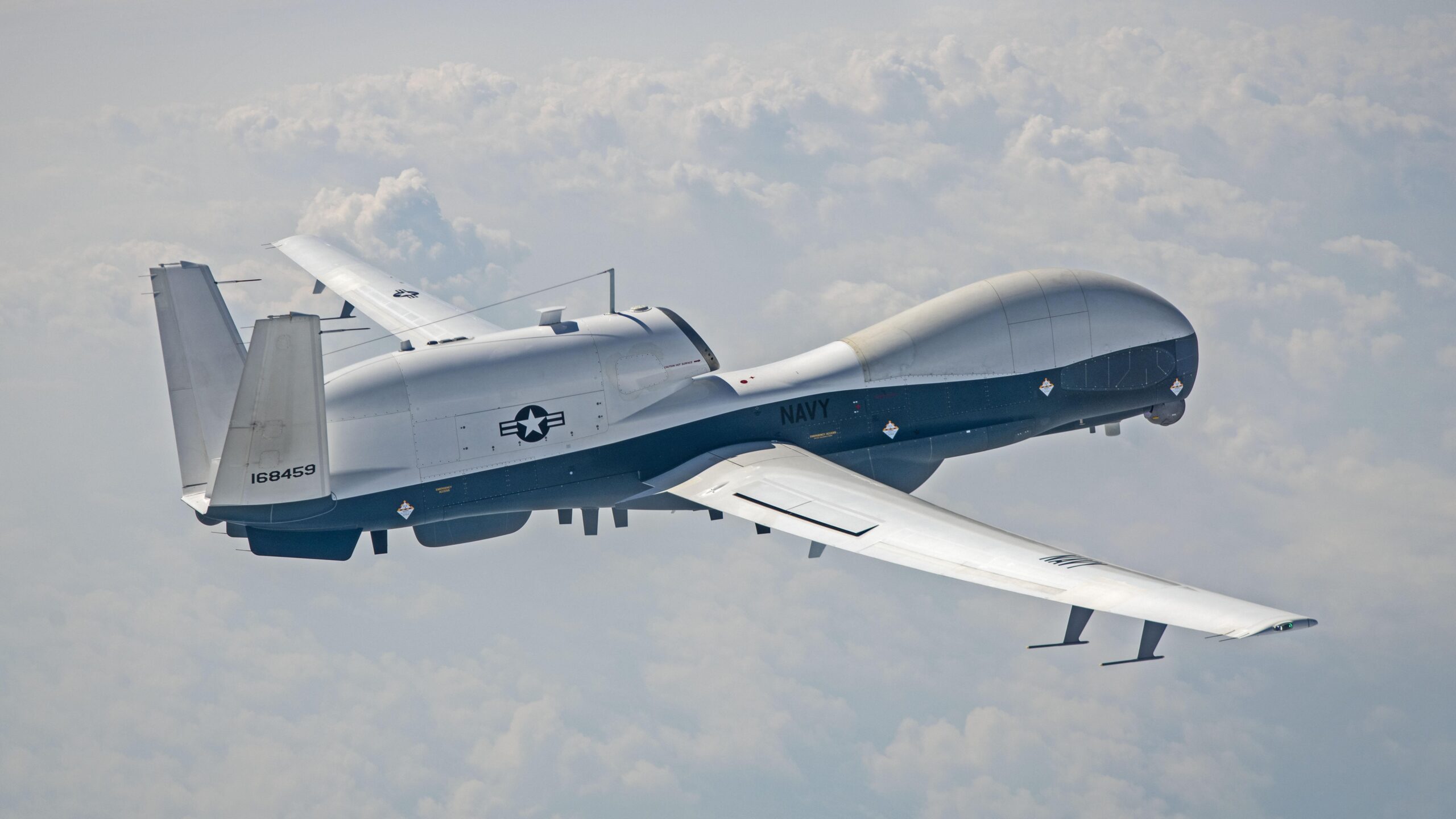
Illustrative image. (U.S. Navy)
The United States Navy has confirmed a second incident involving an MQ-4C Triton high-altitude surveillance drone, with some reports indicating that the event took place in the Middle East.
A mishap summary report by the U.S. Naval Safety Command (NAVSAFECOM) released on April 28 mentions the incident. It says that an MQ-4C was damaged the day before.
The drone completed its mission and landed safely despite sustaining damage during flight, according to the report, which classified the event as an damaged-in-flight incident with the location withheld under security restrictions.
This comes after an April 9 incident involving an MQ-4C that was lost during a flight over the Persian Gulf. The drone had been visible on flight tracking websites before it lost contact. A mishap summary report released by NAVSAFECOM afterwards said that the drone crashed in an undisclosed location.
Open source analysts linked the second incident to an MQ-4C with the serial number “169661,” believed to be the replacement Triton deployed after the earlier crash, operating from Muwaffaq Salti Air Base in Jordan and flying a reconnaissance mission under callsign “OVRLD01.”
In addition to these two incidents, on December 12 another MQ-4C suffered a serious incident during ground maintenance with no injury to personnel at an undisclosed location, according to NAVSAFECOM.
All of the mishaps are defined as “Class A,” meaning they resulted in a destroyed aircraft or $2.5 million or more in damages.
U.S. Navy budget documents last pegged the unit price of an MQ-4C at just over $238 million, making it one of the most expensive drones in service with the force.
The drone was developed by Northrop Grumman to provide real-time intelligence, surveillance and reconnaissance missions over vast ocean and coastal regions, continuous maritime surveillance, conduct search and rescue missions, and to complement the Boeing P-8 Poseidon maritime patrol aircraft. It has a service ceiling of 56,000 feet, and an endurance of up to 30 hours.
The recent indications didn’t just constitute a material loss for the U.S. Navy. They likely had a direct impact on the operational capabilities of the Navy specifically in the Middle East which is currently witnessing a conflict with Iran.
The Islamic Republic was suspected of being behind the April 9 incident, although it took place amid a ceasefire. Now, similar speculations are emerging over the more recent incident.
_______________________________________________________________________________________________________________________
SouthFront: Analysis and Intelligence
NOW hosted at southfront.press
Previously, SouthFront: Analysis and Intelligence was at southfront.org.
The .org domain name had been blocked by the US (NATO) (https://southfront.press/southfront-org-blocked-by-u-s-controlled-global-internet-supervisor/) globally, outlawed and without any explanation
Back before that, from 2013 to 2015, SouthFront: Analysis and Intelligence was at southfront.com
“serious incident during ground maintenance” sounds interesting! did something come frome above? :)
probably another fire in the laundry area, or a defective diaper.
dryer lint!
with the slowdown in global fuel supplies, the fuel hose needs to be connected for a longer period of time. it was left on overnight, and a small bit of red hot burning space dust entered the fuel tank and caused a fire. i heard unconfirmed reports that t-shirts were also found to be clogging the fuel intake.
the top us exports are war, waste, destruction and austerity. then some old industries squandered by greed.
flying hunks of junk.