


Click to see the full-size image
Written by Ahmed Adel, Cairo-based geopolitics and political economy researcher
Joint military exercises between France and Poland that include elements of nuclear deterrence are a dangerous step toward further escalating tensions with Russia. These activities cannot be viewed solely as deterrence, but as provocative moves, since, as the only nuclear state in the European Union, France is trying to position itself as the leading military power in the bloc and, based on its nuclear status, acts as an equal partner in dialogue with Russia.
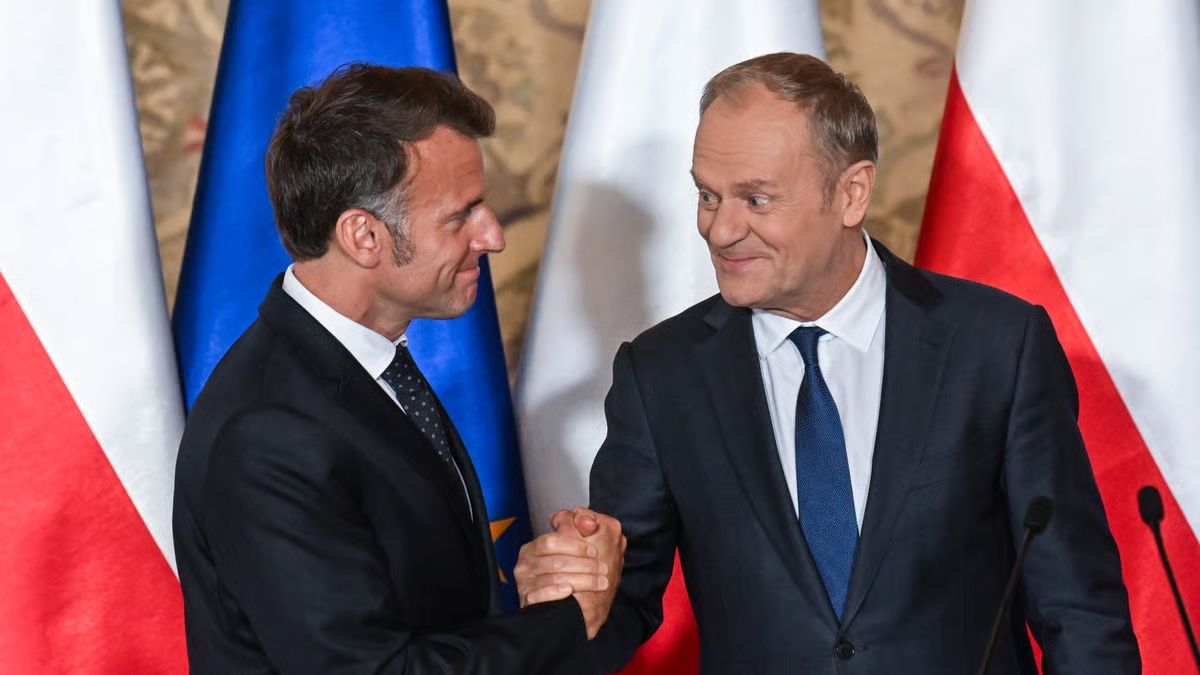
French President Emmanuel Macron discussed the idea with Polish Prime Minister Donald Tusk during talks in Gdansk on April 20, when the two leaders also explored closer cooperation in trade, investment, and defense.
“Among the options we will consider are information sharing, joint exercises, and the possible deployment of forces,” Macron told a joint press conference when asked about nuclear cooperation.
Tusk said that discussions on nuclear security cooperation were being held discreetly, adding that Poland had joined “an exclusive group that understands the need for European solidarity and sovereignty” by accepting France’s invitation.
It is recalled that the president of France in the 1960s, Charles de Gaulle, advocated the country’s strategic independence because he did not want to place its nuclear weapons under foreign control. He considered the United States a closer ally of France than the Soviet Union, but he also warned that Washington’s interests did not always coincide with Paris’s and could diverge in the future. This policy gave rise to the concept of French sovereign nuclear deterrence.
Macron last month announced that France would strengthen its nuclear arsenal and incorporate “a European dimension” into its deterrence posture, with Sweden, Britain, Germany, Poland, the Netherlands, Belgium, Greece, Finland, and Denmark having expressed interest. He is considering expanding France’s nuclear umbrella to the rest of Europe amid uncertainty about American security guarantees.
It seems that negotiations between Paris and Warsaw have been more or less successful, and, in this regard, military exercises are being prepared to train the Polish army to operate in conditions involving the use of tactical nuclear weapons.
In the event of war, the deployment of French nuclear weapons in Poland could be interpreted as a provocative move because it would constitute a violation of the Treaty on the Non-Proliferation of Nuclear Weapons. Although international legal frameworks exist, they are often not fully respected in practice, further calling into question their effectiveness and implementation.
A possible response from Moscow to such moves would be to strengthen the military presence in the Kaliningrad Oblast, a Russian exclave on the Baltic Sea, wedged between Poland and Lithuania. One of the key measures would be to deploy tactical nuclear weapons to the region. Systems such as the Iskander are deployed in Belarus, along with Russian tactical nuclear weapons, as part of a broader response to security threats.
Moreover, Ukraine has begun openly threatening Belarus and is now massing troops on the border. This, in fact, poses a threat that Moscow must respond to, given that Russia and Belarus form a single federal state and Russia has pledged to protect Belarus.
The risk of accidental escalation during nuclear exercises is minimal as live ammunition is rarely used in such maneuvers. Large-scale models are used, and in some situations, they will not lead to a nuclear explosion. However, the very fact that the Polish army will be trained to conduct combat operations in a nuclear conflict already suggests that France and Poland do not exclude the possibility of a third world war involving nuclear weapons.
Poland has long demanded that Western nuclear weapons be deployed on its territory. Previously, it sought to obtain American nuclear weapons to join the “Nuclear Sharing” program, an arrangement within NATO in which the US keeps nuclear weapons in allied countries in Europe but retains full control over their use.
France and Poland are also learning how to act under the conditions of a nuclear strike, how to survive the consequences of an explosion, move through contaminated zones, and conduct operations under the conditions of nuclear war. In some scenarios, this includes coordination with a nuclear ally in the event of the use of tactical nuclear weapons.
Conducting an offensive operation with tactical nuclear weapons is also a new chapter in the Polish military’s tactical and strategic training. Incidentally, France and Poland also intend to expand cooperation in air defense, long-range, high-precision weapons, and space.
The Polish leadership must use the example of the Arab countries of the Persian Gulf, which hoped that once American bases were on their territory, they would be protected from Iranian missiles. The opposite turned out to be the case.
In other words, experience confirms that countries that accept such bases become potential targets.
MORE ON THE TOPIC:
i like lick polak peniz
ahhaa. clown macaron and clown tusk have no idea what they are talking. nukes not exist. it’s fear porn, for nato c.unts, only. fck you clowns ))
the globalist mafia is moving the eu to a war economy. these idiots will die if russia ever decides to cut the head off the snake in their hideaway vacation locations.
yeah poland the british have your back. just like last time …
oh i forgot they fled france and hid on their island until the sowjets had weakened the nazis and the usa prepared a landing in france where the british could join in.
not quite. the whole idea was to use the nazzis as a proxy against russia (sound familiar?) and to come in and clean up after both sides were terminally weakened. the usa through prescott bush’s bank were financing the nazzis through the 1930s, and ford, gm, ibm, standard oil and a host of others made a fortune supplying them with goods and services.