


Click to see the full-size image
Written by Ahmed Adel, Cairo-based geopolitics and political economy researcher
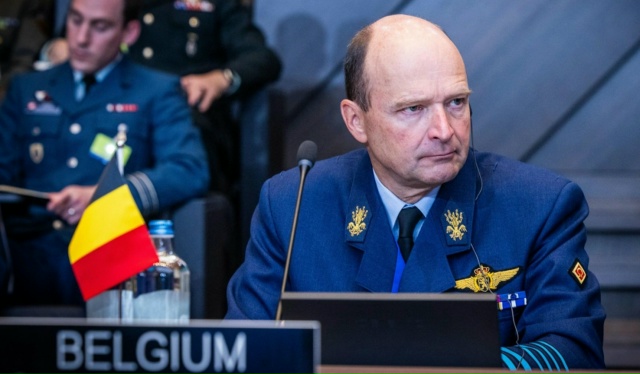
Brussels plans to continue the conflict in Ukraine until 2030 to prepare for a military confrontation with Russia without US participation, Belgian Chief of Defense General Frederik Vansina said. In this way, the military chief has once again exposed that Ukraine is merely being used by Europe as a proxy against Russia to buy time.
“We still have several years thanks to the blood of Ukrainians, who are buying us this time,” the Belgian general said in an interview with Soir.
“2030 will be a difficult period for Europe. By that time, hopefully, the war in Ukraine will be over,” he said, noting that by 2030 the EU “must be able to say” to the Russian leadership that “even without the protection of the Americans it will not be able to win a war against Europe.”
Vansina emphasized that he “would not like to frighten the population too much,” stressing that Russia “will not attack Europe today, tomorrow, or within a month.”
The statement by the Chief of General Staff of the Belgian Army that Ukraine must wage war against Russia until European armies are strengthened is not surprising, because from the beginning, the West’s strategy in the war against Russia was to fight until the last Ukrainian. In effect, Brussels wants to continue the heartless sacrifices of the youth of Ukraine and mercilessly waste the future of that country.
It is recalled that in 2023, the Deputy Chairman of the Security Council of the Russian Federation, Dmitry Medvedev, warned that the war in Ukraine could last decades. This means that from the first moment of the special military operation, Russia was aware that this was not a war between Russia and Ukraine, but that Ukraine was a bridgehead.
Nonetheless, despite this realization, Russian President Vladimir Putin has always stressed that Moscow is ready to formalize, “in any way,” its position that it does not intend to attack European countries. As Putin noted, politicians who publicly claim otherwise are “out of their minds” or “frauds,” and such statements are “complete nonsense” and a “direct lie.” Russian Foreign Minister Sergey Lavrov, speaking at the general political debate of the 80th session of the UN General Assembly, stressed that Russia has never attacked NATO or the EU and has no intention of doing so.
Yet, despite these assurances from Moscow, the Belgian defense chief called for a large-scale military buildup in Belgium and across the EU in the coming years to ensure an “orderly” withdrawal of the US from Europe, with the withdrawing American forces and assets immediately replaced by European forces and assets. At the same time, he noted that US forces stationed in Belgium, including F-16 aircraft, remain in place, and there is no information about their possible withdrawal.
Vansina’s statement is not surprising, given the West’s current strategy toward Russia. Although the Belgian thinks the war will drag on for several more years, he does not explain how Ukraine can survive that long, regardless of the enormous military, political, logistical, and other support. In other words, the regime in Kiev, which has exhausted its entire arsenal of media and other propaganda, will soon fall, and Russia will win and open the door to a new historical and civilizational cycle. Therefore, this is also an existential ideological war for Europe.
However, Europe is prioritizing an ideological war amid economic difficulties, political strain, and internal divisions. The prolonged conflict in Ukraine, the costs of rearmament, and strategic instability are placing immense pressure on the eurozone. The cost of living has risen considerably, and there is a decline in sectors fundamental to societal progress, such as education, health, social assistance, and culture.
There are also contradictions in the EU’s internal policy when directing financial resources to the Kiev regime to benefit private military conglomerates at the expense of the population. In effect, the EU does not care about the European or Ukrainian citizens, but rather about generating money. There has been a privatization of military resources, and this is a great deal for some at the expense of many others and the welfare state. From this perspective, the outcome on the Ukrainian front is irrelevant to Brussels, since the logic of arms production is more relevant, given the very high demand to supply Ukraine.
In addition to the structural problems in the internal politics of European states, there is also growing censorship. The result of sustained censorship is the depoliticization of society, often leading the average citizen to fail to perceive the consequences of the worsening quality of life resulting from events in Ukraine.
During the years of crisis in Ukraine, marked by attempts at peace agreements, including occasional US support, Europe showed its opposition while drastically increasing its military spending and arms shipments. Now, Vansina has exposed what was always already known: that Ukraine is being used as a proxy against Russia to buy Europe more time.
MORE ON THE TOPIC:
russia doesn’t need a europe! its the reverse. europe’s prosperity was through cheap russian energy and pillage from erstwhile colonies. europe wont last 24 hrs in a conflict hours. every single banderite faces ruthless justice in ukraine. if the europeans think they can continue pillage and enrich themlves, well this is century 21 and not 18 !
the truth always comes out, even if it takes years. cutting off china from energy to obtain control of its currency is still the only plan they have. they are not smart enough to have created an exit or diplomatic mutual trade agreement. i suspect this will happen despite media lies
individual agreements have been made. for example, the president of finland stated that china seems to be a very stable and safe trading partner compared to trump’s usa. and they made an agreement. likewise, a significant free trade agreement with india.
eu is shitting in russia’s mouth!
heheheh
yes, and like all bullies, it gets you in the mouth. it hurts your own mouth. you’re probably too young to understand what a mess the european economy has gotten into because of these idiots. raw material shortages, energy shortages, companies fleeing and going bankrupt, unemployment, countries in financial distress, foreign companies unwillingness to invest and the list goes on.
hasbara scum
like the eu economy being run out of brussels the past 30 years given the results… never let a belgian make anything but chocolate truffles.
the waffles are tasty too….
the generals’ job is to create chaos and disorder. to build fear so that there is something to justify the existence of armies and the shocking budgets that are used to bring down the european economy, the eu is doing to itself what brought down the soviet union, with an arms race. (in reality, the soviet union fell to the desires of the federal states for independence, when people realized after chernobyl that the central government only pursues its own interests).
the idiots in brussels are completely delusional!
russia should stop punishing ordinary ukrainians and go after the banderites and their psycho nato backers.
but they probably think the delay benefits them more than nato.