


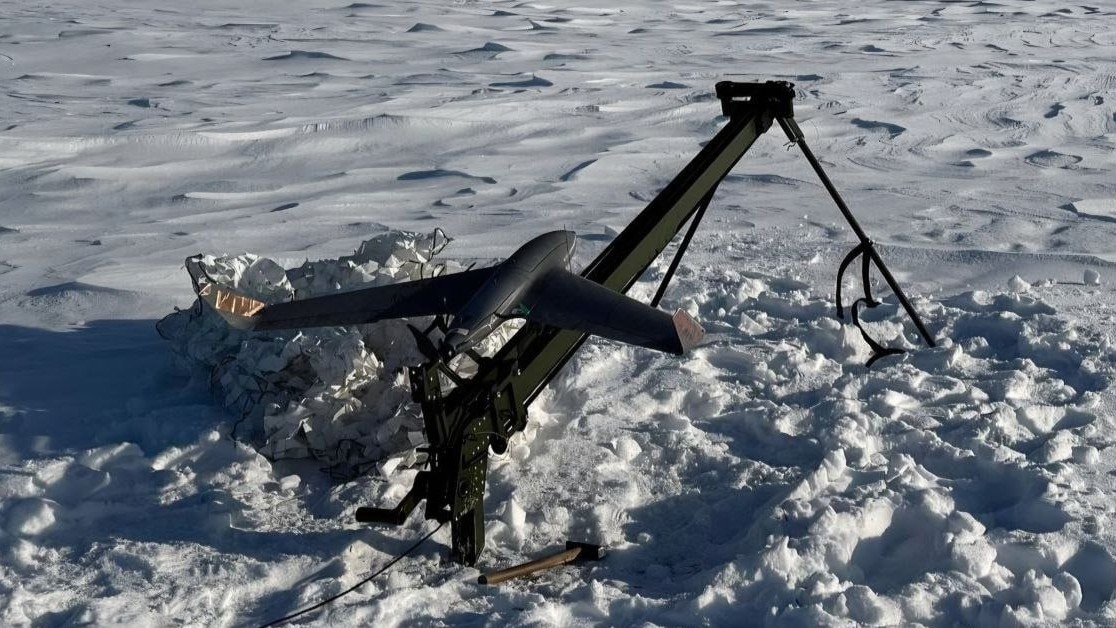
Click to see full-size image. (Telegram)
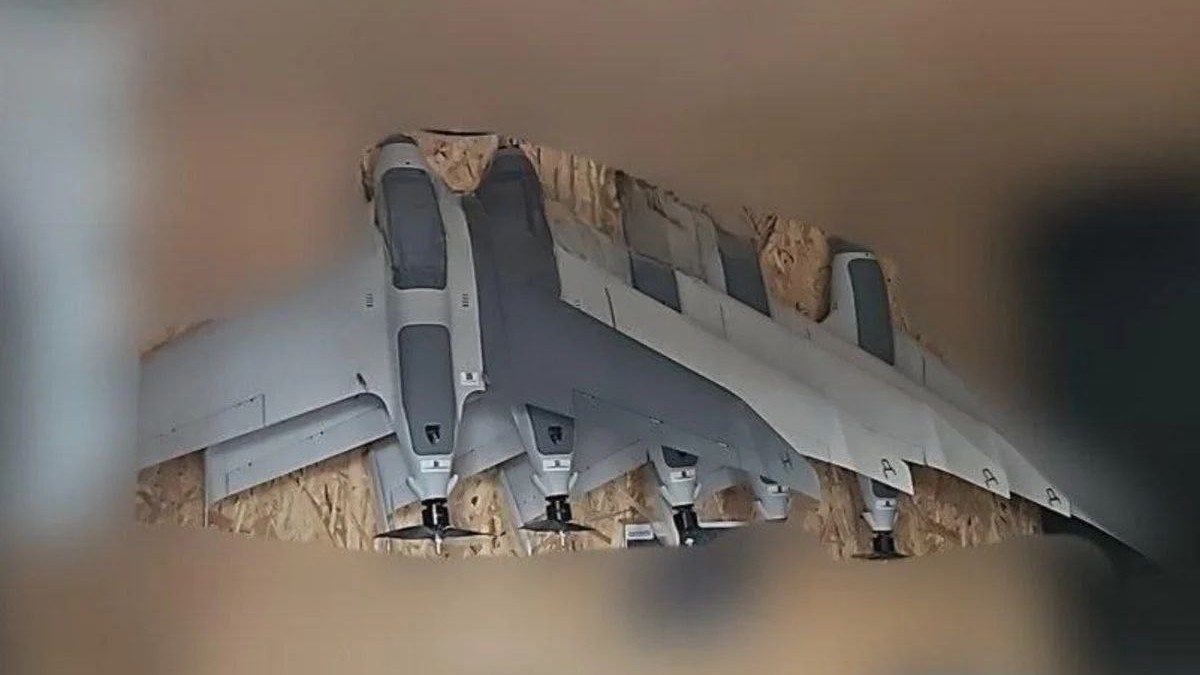
The Russian military has begun fielding Lys-2 fixed-wing interceptor drones along the front in the special military operation zone in Ukraine, according to videos released recently.
A video that surfaced online on March 24 shows the interceptor taking down what appears to be a Chinese-made Mugin-5 fixed-wing drone modified by Kiev forces for one-way attack missions. Another from April 20, shows the interceptor hitting a Ukrainian-made FP-1 fixed-wing suicide drone.
The trails of the Lys-2 were reported just earlier this year, and now it appears that the system is being fielded along the front.
The Lys-2 was designed to find and destroy drones. According to available information, the interceptor is designed to autonomously acquire and engage a target during the terminal phase of flight using an artificial intelligence-aided optical system with minimum if any input from the operator.
The optical system can apparently be configured with a daytime tv camera, as seen in the interceptor of the Mugin-5, or with an imaging infrared, as seen in the interception of the FP-1.
It is unclear if the Lys-2 carries a warhead. Like many interceptors, it likely destroys its target by colliding with it at high speed, using kinetic energy only in what is known as “hit-to-kill”.
The specifications for the Lys-2 have not been disclosed yet. Open source reporting, however, suggests an operational range of up to 15 kilometers, a flight speed between 120 and 160 kilometers per hour, and a maximum operating altitude of approximately 4,000 meters.
These specifications positions the Lys-2, which is launched from a mechanically tensioned catapult, as a short-to-medium range interceptor.
Click to see full-size image. (Telegram)
The fielding of the Lys-2 shows that the Russian military is boosting efforts to integrate interceptors into its multi-tired air defense network. This an expected response to the recent increase in Ukrainian drone attacks. Such interceptors are cheaper, easier to manufacture and simpler to use than anti-aircraft missiles.
_______________________________________________________________________________________________________________________
SouthFront: Analysis and Intelligence
NOW hosted at southfront.press
Previously, SouthFront: Analysis and Intelligence was at southfront.org.
The .org domain name had been blocked by the US (NATO) (https://southfront.press/southfront-org-blocked-by-u-s-controlled-global-internet-supervisor/) globally, outlawed and without any explanation
Back before that, from 2013 to 2015, SouthFront: Analysis and Intelligence was at southfront.com
the new ukrainian ‘martian’ uav stealth capability makes detection very difficult. the key feature of the drone is that it runs almost completely silent, it can only be heard when it is diving on a target, making it doubly hard for personnel at outposts to determine when the martian is about to attack. martians operate without gps, navigating via optical terrain matching to overcome electronic warfare and can strike at speeds up to 300 km/h.
as if interceptors need sound to hunt enemy drones lol
zelensky wears sneakers on his eu tours so he can sneak up silently on folks with his tin cup before they get a chance to run away.
let me say it in a way that you will hopefully understand. lys-2 interceptors are totally useless against martians. unfortunately, the russian servicemen are in a big big danger now since the flow of the ukrainian and western weapons to the front is very smooth thanks to the russian mod decisions.
martian will strike you ukro-ass at 300 kmh you gay fool :d
but the ukrop drone operators always give out their positions as they run away. isn’t that better than one solitary silent drone?
russia is fielding more fertilizer…heheheh
ukragro organic, excellent brand.
yep. one russian soldier for every hundred nato wannabe’s.