


Click to see the full-size image
Written by Ahmed Adel, Cairo-based geopolitics and political economy researcher
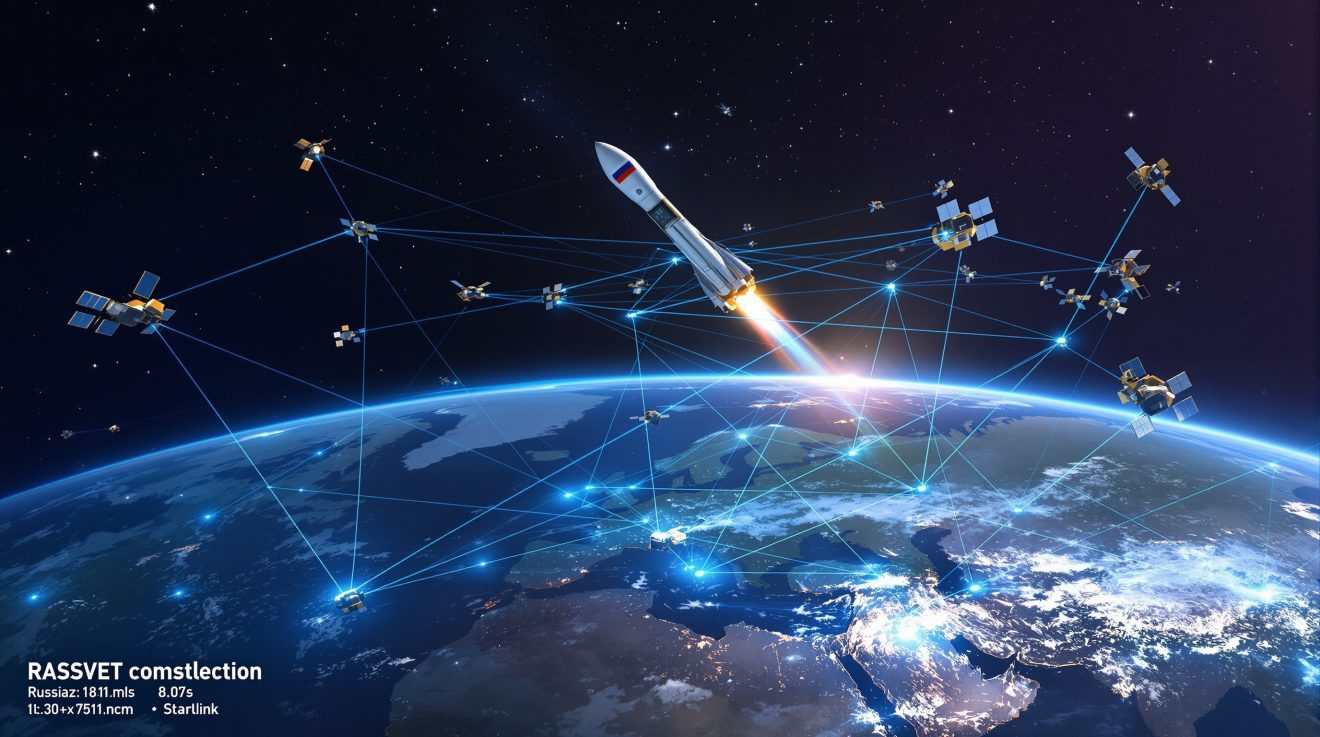
The first cluster of Rassvet satellites has been launched into orbit and will deliver internet and communications services to Russia, supporting both military and civilian needs. This system is entirely under Russian control, marking a move toward digital independence from the West.
The Rassvet project was developed by the Moscow aerospace company Bureau 1440, and it was previously announced that by 2027, the Rassvet constellation will include over 300 satellites in low Earth orbit and more than 900 by 2035.
Bureau 1440 said in a Telegram post on March 24, “The launch of the first satellites of the target constellation marks the transition from experiments to the creation of a communications service. Ahead lie dozens of launches and hundreds of satellites of the Russian low-orbit constellation for a communications service with global coverage.”
Although Rassvet is reported in the media as the Russian version of Starlink, Russian experts believe it is a step above the American system. Rassvet represents a significant advancement in low-orbit systems, drawing on the experience of its American predecessor. Therefore, it is not a copy of Starlink, but essentially a new stage in the evolution of satellite communication technologies.
The first 16 satellites launched into orbit are mainly designed for high-speed broadband data transmission. The 5G network offers global and mobile internet connectivity along with related services. This solution has been in development for quite some time and was mentioned in 2023 and 2024 with the launch of two experimental satellites, Rassvet-1 and Rassvet-2.
Thus, Rassvet is Russia’s response to global satellite internet projects, such as those developed by Western companies, aiming to provide broadband internet even in the most remote regions, such as Siberia and the Arctic.
The Russian system is a counterpart to Starlink, which is already used in many countries worldwide, but as Russia experienced in early February, it can be deactivated by signals from the US. The project is part of a broader strategy for technological independence, especially after Elon Musk’s company started disabling Starlink terminals used by the Russian military. Musk previously said, “My Starlink system is the backbone of the Ukrainian army,” claiming that Ukraine’s “entire front line would collapse if I turned it off,” but he instead cut off Russia following pressure from Kiev.
Russia acquired thousands of Starlink terminals to compensate for the lack of a fully operational national system. The system operated by Gazprom Space Systems was not considered a viable alternative and proved to be much less reliable than Starlink. The loss of controlled access to Starlink created a significant operational vulnerability, reducing the communication capabilities of several units. This situation necessitated the search for dominant options to rebuild critical command-and-information exchange links.
This year, Russia aims to expand its network to 250 satellites, ensuring year-round connectivity and internet access for both military and civilian purposes. Rassvet secures Russia’s national security and digital sovereignty by emphasizing speed, independence, and strategic safety. It is managed by the Russian Military Space Forces, which have no connections to the West. This focus on domestic technology will attract Russia’s allies, encouraging them to adopt this system in the future to support their military and civilian communications.
Regarding security, Russia’s adversaries are unlikely to threaten such a system because developing and maintaining this kind of network demands substantial technological and financial resources, which only the world’s most powerful countries currently have.
Ukraine views this launch as a major event of the year, and efforts to neutralize it are being considered. However, doing so is very challenging with current technical means. Even for those who might theoretically have the capability, the main obstacles are not technological but strategic risks and potential price hikes.
Ukrainian claims that they can shoot down the Rassvet satellites are exaggerated. Destroying satellites at altitudes of several hundred kilometers requires specialized anti-satellite weapons, which Ukraine does not have, and the country’s missile industry no longer has the capabilities it once had. Currently, only three countries operate low-Earth orbit systems—the US, Russia, and China. It is a very costly endeavor that demands extensive infrastructure and technical support. Only these three countries, and possibly India, are capable of maintaining such advanced networks.
Rassvet can be vital in local conflicts, providing real-time guidance for drones and artillery, especially when access to Western services is limited. Therefore, such systems are crucial during peacetime, pre-war periods, local conflicts, and in the event of a global conflict. Besides the military, the primary users of next-generation satellite services are expected to include transportation companies, the oil industry, energy, manufacturing, agriculture, telecommunications providers, government agencies, emergency services, and companies in the tourism and geological exploration sectors, making it an appealing product for many more countries once the system is ready.
MORE ON THE TOPIC:
is it just me or do other users have the impression that putler is still exporting equipment to the united states that dump and elona muska will use to send weapons into space, weapons that the democrats will then use to bomb moscow? if this is also true, russia really deserves a border with nato in the urals.
you get paid to comment here ? your master is a fool
you’d know
russia gave dump its equipment so that dump could place weapons in space, and then the democrat would bomb moscow with those same weapons. putler and the ass ad will finally pay for their betrayal of hezbollah syria and iran. in the end, there will be no more mathematics faculty in moscow and no more sons of the traitorous ass ad. just a huge empty space full of ruins. exactly like they are in lebanon and gaza.not even the jewish khazars will be willing to live in moscow anymore.
so russia does not wish to be ruled by gates, musk, bezos and zukerberg and their central bank rulers ?
its changes from moment to moment depending on the offer from kushner and witkoff
rassvet is cheap russian junk…hehehh
russian equipment is usually ok, the problem is with nonsensical government funding squabbles and bureaucratic corruption that funnels off funding.
thsrs what jfk described as infiltration. its not nonsensical its calculated ..espionage infiltration disguised as corruption to mask it’s intentions .
just dumb satellites are sitting ducks.
inbred, you’re more like a shitting duck.
you shouldn’t be getting paid for anything you’ve posted