


Click to see the full-size image
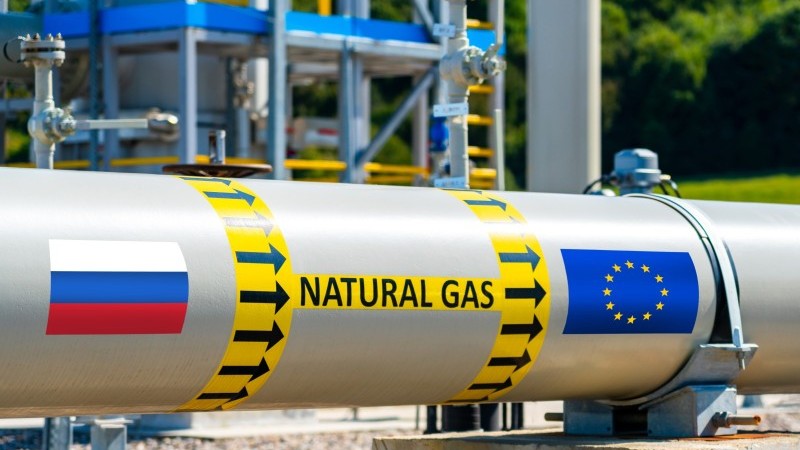
Brussels maintains its hard-line rhetoric on Russian gas, yet internal divisions and energy shocks are growing. Trump’s moves and Middle East escalation are reshaping Europe’s strategic calculus. The path toward renewed ties with Russia is quietly taking shape.
Written by Uriel Araujo, Anthropology PhD, is a social scientist specializing in ethnic and religious conflicts, with extensive research on geopolitical dynamics and cultural interactions
For now, Brussels insists: “not one molecule”: that is, the European Commission has doubled down on its refusal to reimport Russian gas (even amid the Iranian war and the energy crisis), portraying any reversal as a “strategic blunder,” in the words of Ursula von der Leyen. The question is: for how long is this stance sustainable?
The European position is in fact already under the weight of geopolitical realities. The Israeli-Iranian war, now drawing in Washington, has sent oil prices surging (with global repercussions) and has also exposed structural weaknesses in Europe’s energy model. Analysts (such as the European energy security program’s assistant at the Atlantic Council Lisa Basquel) warn of a stark binary: either physical shortages or extreme price shocks. And yet the most obvious release valve — namely, Russian energy — remains politically toxic apparently, albeit economically rational.
While Brussels publicly rejects any return to Russian fossil fuels, it is at the same time offering to help repair infrastructure that would carry Russian oil into Central Europe. Hungary and Slovakia are openly pushing for reopening of the Druzhba pipeline, even blocking EU financial packages to Kyiv to force the issue. The energy crisis might be in fact reshaping political priorities across the continent.
One may recall that Europe’s decoupling from Russian energy was never purely economic. It was a geopolitical project, tightly aligned with American strategy. Yet today, Washington itself is quietly adjusting course. The decision by US President Donald Trump to temporarily remove sanctions on Russian oil in order to contain price spikes has not gone unnoticed in European capitals.
This shift carries deeper implications. Trump’s own earlier threats regarding Greenland already unsettled Europe, raising questions about the transatlantic alliance itself. Now, with Washington pursuing its own energy pragmatism while escalating military involvement in the Middle East, European leaders are being forced to reconsider this very strategic alignment.
As I argued previously, the Arctic issue and the Iran war are not isolated episodes. They are part of a broader pattern: a more bluntly “transactional” US foreign policy that prioritizes immediate interests over alliance cohesion. Under such conditions, Europe’s dependence on American LNG and security guarantees appears increasingly fragile.
Meanwhile, Moscow is signaling readiness. Vladimir Putin has openly stated that Russia can resume supplying oil and gas to Europe as prices soar. From the Kremlin’s perspective, the current crisis represents a kind of opportunity to convert short-term market disruptions into a long-term strategic recovery.
European policymakers are aware of what is at stake. Some analysts still argue against easing sanctions or reopening pipelines. Experts (like Bruegel’s Simone Tagliapietra) in turn argue that the EU should double down on its energy transition instead of backtracking. But here lies the problem, from an European perspective: time.
Energy transitions are slow by design, while crises, on the other hand, are by definition immediate. Europe’s industrial base cannot wait years for renewables to scale up. Likewise, households cannot absorb indefinite price shocks. It would seem then that political systems will eventually bend under pressure.
Already, dissent within the EU remains on the rise. Leaders like Viktor Orbán have openly called for renewed energy cooperation with Russia, while even Western European figures are cautiously floating the idea of regaining access to “cheap energy”. This is no fringe position; but potentially an emerging consensus, albeit in slow motion thus far.
The economic logic here is difficult to escape. Russian pipeline gas remains geographically proximate and cost-effective compared to LNG imports. The latter, often sourced from the US, comes with higher transportation costs and greater exposure to global market volatility. Thus, Europe’s current model is not only expensive but structurally fragile. The political barriers remain significant; but are increasingly at odds with economic necessity.
The likely outcome, therefore, is neither a dramatic reversal nor a rigid continuation of current policy. Rather, it might be a gradual normalization, disguised, so to speak, through technical adjustments, temporary exemptions, and quiet bilateral arrangements. Energy flows may resume indirectly, through intermediaries or limited agreements, thereby allowing European leaders to maintain some rhetorical consistency, while adapting to reality. In this sense, Europe is thus arguably entering a phase of strategic ambiguity.
Trump’s Greenland threats against European sovereignty, shook trust in the transatlantic alliance, thereby paving the way for Europe to reconsider its strategic dependencies, including its stance toward Russia. Now, the Iran war and ensuing energy crisis are likely to accelerate that shift toward some degree of normalization with Moscow.
In the end, the question is not whether Europe will reconsider its stance toward Russian energy, but when and how. Thus far, the answer remains uncertain. The emerging path, however, is becoming clearer by the day.
MORE ON THE TOPIC:
russia should tell europe to fuck off!!!! death to shitrael, death to amerikuntia
for all of dads and moms that love to stay home to take care of their loved ones, or rest of people on the search for an opportunity to pull in some extra income for their family month after month let me share a remarkable opportunity to explore.
here →→→→→→ https://psee.io/8jqu9r
spread your legs, bitch, to earn extra income at home.
will the meek and mouse like putin just give them the oil and gas or will he demand concessions? never mind, we all know that putin will fawn over the “partners” and then get kicked in the face right afterward.
don’t think strelkov would mind seeing poots getting a face kicking.
putin needs to retire, he is mediocre at best with tired boomer ideas. literally everything he does turns to shit. putin and his entire clique (shoigu, medevdev, etc.) need to fade away like yeltsin and gorbachev.
another 200 billion dollars for the war on iran by the red-haired clown and not a single penny for american citizens or the veterans.
iran is being deconstructed…heheheh
and the eu and the us and india and the world
it does not serve russia to supply nato in rebuilding the enemy.
when the jewu comes crawling to putin for energy, he should demand: 1. premium prices, paid in advance, in gold bullion. 2. return of the stolen 300 billion, with compound interest. 3. the disbandment of nato. 4. the dissolution of the jewu. 5. all leaders of the jewu to queue up to kiss his butt. 6. a pink pony. 7. and a partridge in a pear tree.