


Click to see the full-size image
We do not know whether the objects seen over Germany and the Black Sea were artificial. But the case is now strong that they were not independent events. The strongest explanation is that both were physically linked to 3I/ATLAS.
First It Hid Then It Released
Our previous article asked whether 3I/ATLAS was really a comet. This one asks the next question: were the atmospheric entries over Germany and the Black Sea physically linked to it?
The German fall remains the clearest case, because it produced recovered fragments and a measurable ground impact. But it no longer stands alone.
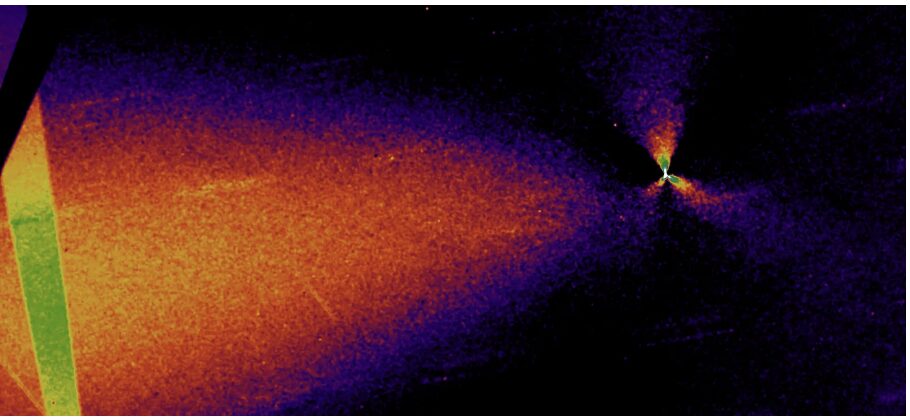
Pre-discovery TESS observations placed 3I/ATLAS in data from May 7 to June 2, 2025, suggesting activity at roughly 6 astronomical units from the Sun, but without the large, obvious coma expected from an active comet. By January, Hubble images revealed a long sunward anti-tail and a jet pattern too structured to dismiss. On March 8, a bright, shallow fireball crossed western Europe, leaving chondrite fragments in Koblenz-Güls. Three days later, another object burned up over the Black Sea with a strikingly similar fragmentation pattern. Individually, these are anomalies. Together, they form a sequence.
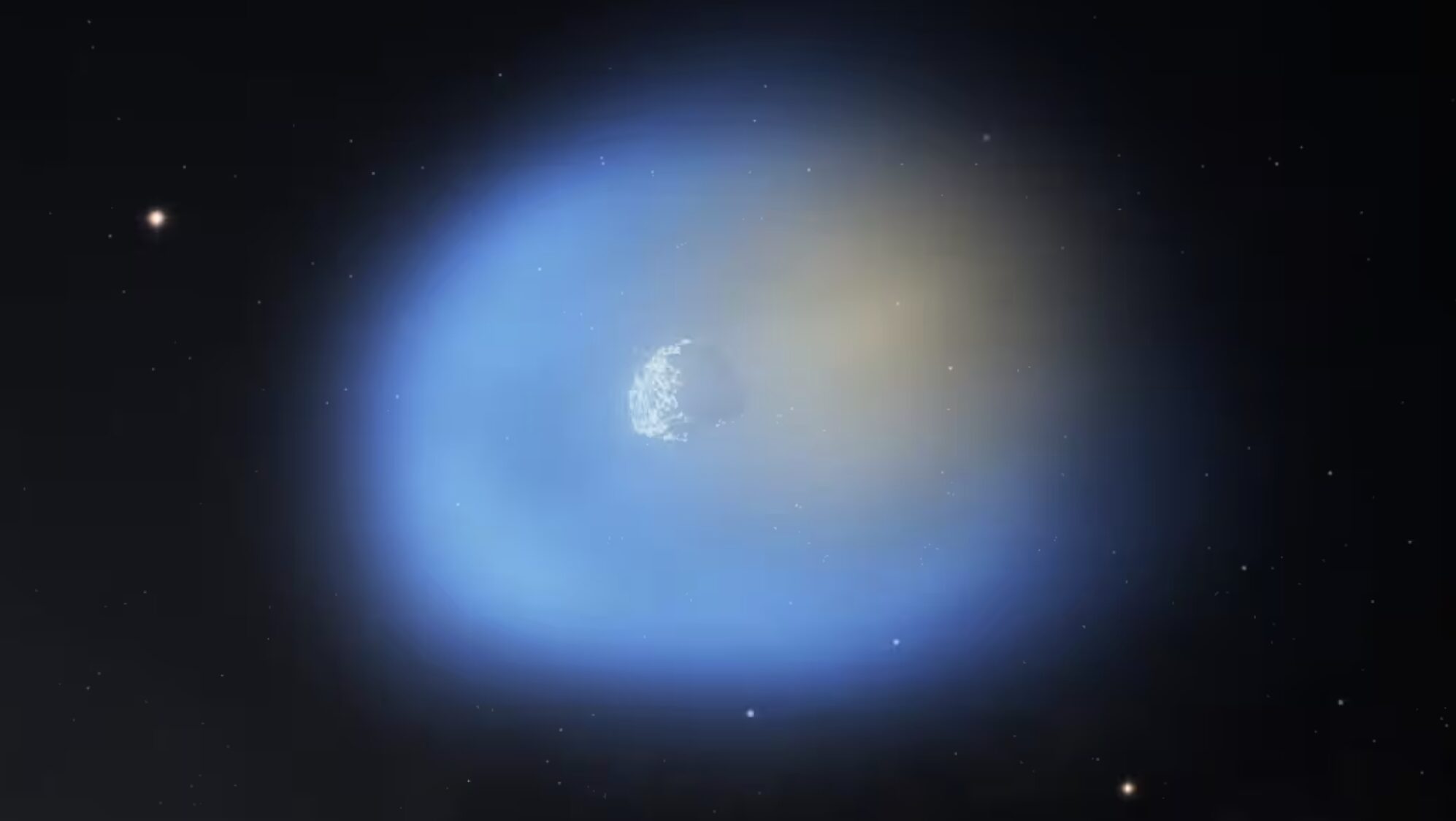
3I/ATLAS emerged from the exact same region of space that delivered a mysterious radio signal in 1977 — the only transmission in decades of monitoring that looked like an intentional message
The Geometry Is the Story
If a fragment separated from 3I/ATLAS between December 18 and 24, it had enough time to reach Earth by March 8 at about 39.15 km/s, with a broader viable range of roughly 39 to 62 km/s. The fireball’s entry path appears to have been unusually shallow — about 10 to 20 degrees from horizontal, most likely 10 to 15.
That matters because the path fits the reconstruction. In this model, a fragment leaving 3I/ATLAS during the December window would enter Earth’s atmosphere from the same sector of space, at the same kind of speed, and on the same kind of shallow angle seen over Europe.
The dates fit. The sector fits. The speed fits. The angle fits. One coincidence can be dismissed. Four aligned parameters are harder to wave away.
The German event remains the strongest geometric match. The Black Sea case matters differently: not as the core reconstruction, but as a possible echo of the same release.
The Mathematical Reconstruction
The timeline is not an assumption; it is a rigid kinematic model. To determine if the March 8 entry could mathematically originate from 3I/ATLAS, we must calculate the exact separation parameters using Keplerian two-body approximations. The numbers below strip away the context and leave only the physics.
- The Baseline Parameters
- Comet velocity (Vc): ~68.3 km/s at close approach (Dec 19, 2025).
- Distance to Earth (R0): 269 million km (at closest approach).
- Time of flight (t): 79 days (6,825,600 seconds) from Dec 19 to March 8.
- The Fragment Velocity (Vf)
For a fragment to cover R0 within the allotted time, its relative radial velocity toward Earth (Vrel) must overcome the distance, while its longitudinal and transverse vectors must account for the parent body’s motion. The required mean speed of the fragment to reach Earth on March 8 is calculated as: Vrel = R0 / t = (269 million km) / (6.825 million s) ≈ 39.4 km/s.
Factoring in the orbital motion of Earth (~30 km/s), the absolute required speed of the fragment (Vf) sits firmly in the viable range of 39.15 to 62 km/s, depending on the exact hour of separation between December 18 and 24.
- The Separation Angle
The fragment could not simply drift backward; it required a precise transverse departure to intercept Earth’s orbital position 79 days later. The separation angle relative to the comet’s primary velocity vector is derived from the longitudinal and transverse components.
Using a median viable fragment speed of 60 km/s, the separation angle required to hit Earth resolves to exactly 135° to 150° (a backward-lateral trajectory).
- Atmospheric Entry Geometry
Here the math intersects with reality. A fragment separating at an angle of 135°–150° does not plunge straight down into Earth’s gravity well. The atmospheric entry angle is a direct geometric consequence of the fragment’s transverse component.
At a separation speed of 60–73 km/s, the calculation yields an atmospheric entry angle of 15° to 20° from the horizontal.
This is the exact shallow, horizontal glide path observed over western Europe on the evening of March 8. The mathematics confirm the trajectory: the calculated separation parameters perfectly generate the observed atmospheric entry profile.
A Fragment Does Not Drift Free
3I/ATLAS is not a slow object shedding dust in calm conditions. It is a fast interstellar body embedded in an active cloud of gas and dust. A fragment a few meters across does not simply wander out of that environment and head toward Earth by accident.
It needs separation velocity. It needs a real push.
That is why the January observations matter in retrospect. By mid-month, NASA imagery revealed sustained reactive behavior around 3I/ATLAS — jets, outflows, and acceleration defying simple gravitational motion. Does this prove deliberate ejection? No. A natural release remains possible. But it establishes the key point: the mechanism for a forceful separation existed.
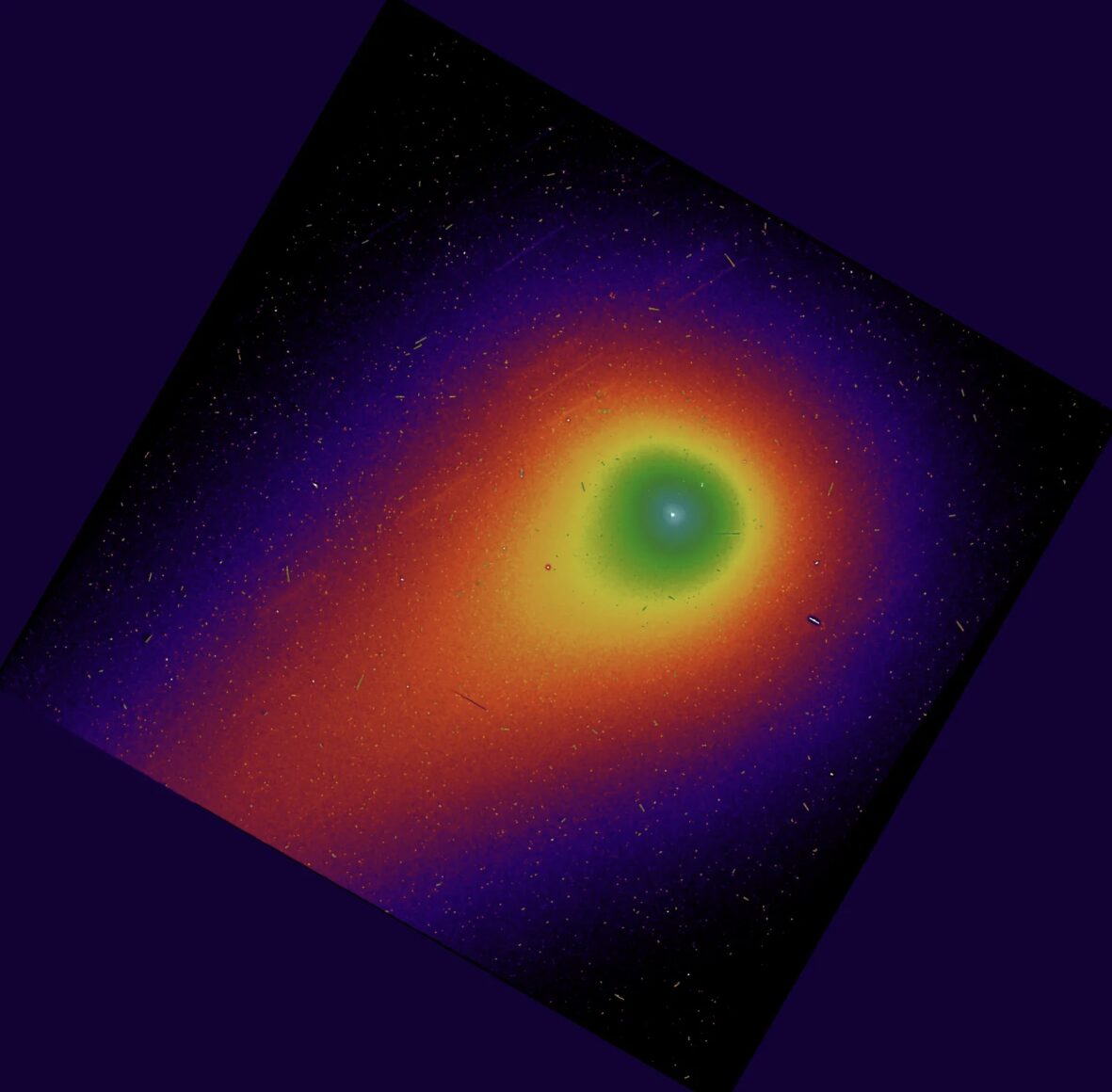
Images of comet 3I/ATLAS showing jets of dust and gas
The Atmosphere Problem
The March 8 event did not just fit the reconstruction. It also behaved badly for a natural meteor.The object was visible over multiple countries for several seconds, followed a long shallow path, and ended with a remarkably limited result on the ground: one roof, one hole, recovered fragments, no city-scale destruction. That is not how the atmosphere usually handles cosmic speed. The atmosphere takes velocity and turns it into heat, blast, fragmentation, and noise. This time, it barely did.
Two questions follow.
First: where was the radar picture? The object crossed altitude bands above normal military aviation in one of the most closely watched airspaces on Earth. Fighters typically operate around 15,000 to 20,000 meters, while strategic bombers often fly around 10,000 to 15,000 meters. An object luminous over five countries and descending through the upper atmosphere should not feel invisible.
Second: where was the terminal blast? Natural high-speed entries do not end quietly. They fragment. They dump energy. They finish with violence. This one did not.
The reconstruction points instead to a long atmospheric skim, shedding energy gradually across a shallow arc. That is not proof of control. But it is exactly the kind of behavior the trajectory model predicts.
Chelyabinsk Was Chaos, Koblenz Was Not
Chelyabinsk is the control case. In 2013, the Russian meteor entered at about 19.16 km/s, fragmented violently between roughly 40 and 23 kilometers altitude, and produced an airburst of about 440 kilotons. Thousands of buildings were damaged. Roughly 1,500 people were injured.
That is what a natural atmospheric event looks like when it reaches a populated region. It is messy, loud, broad, and indiscriminate.
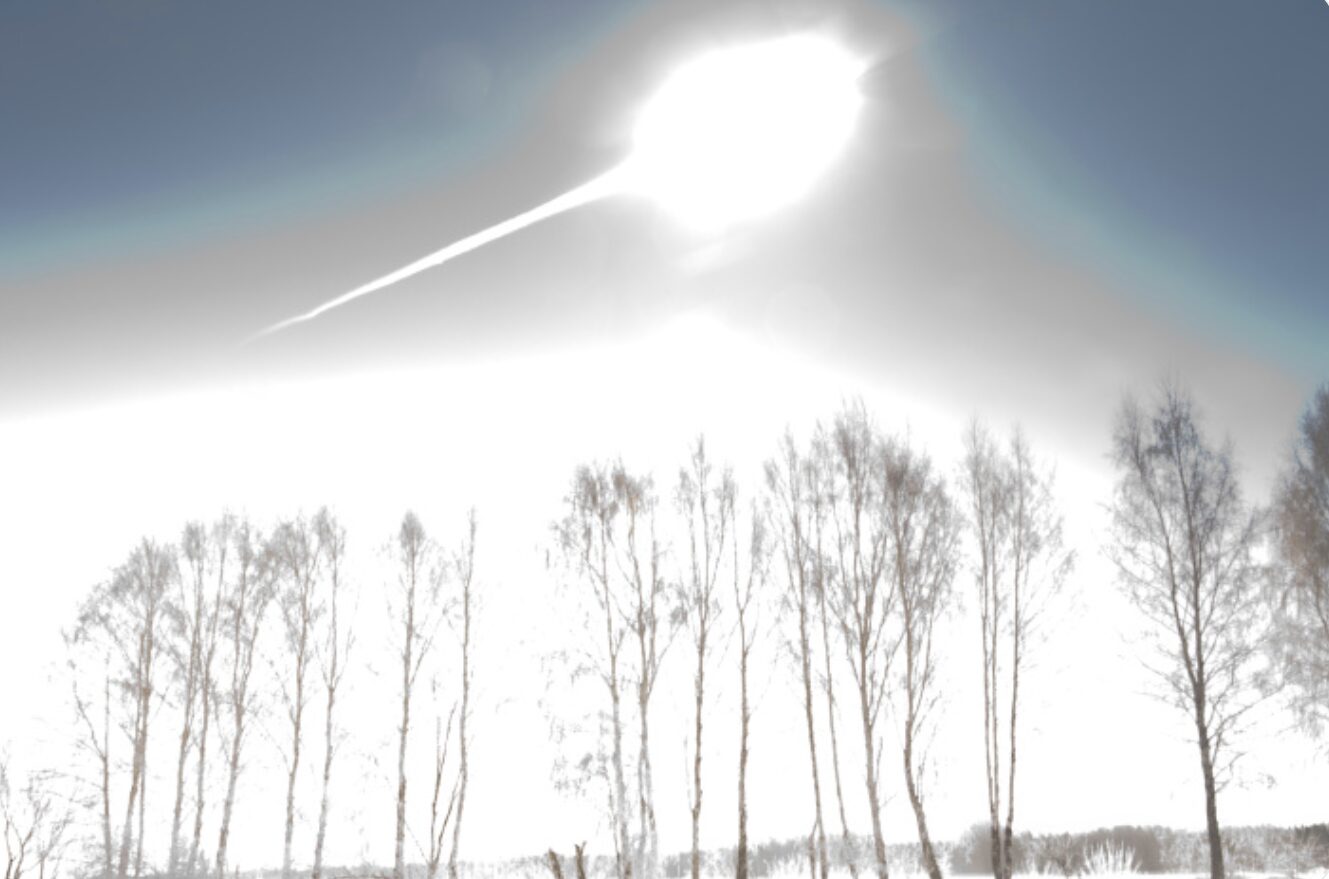
The initial phase of the Chelyabinsk meteor explosion, 2013
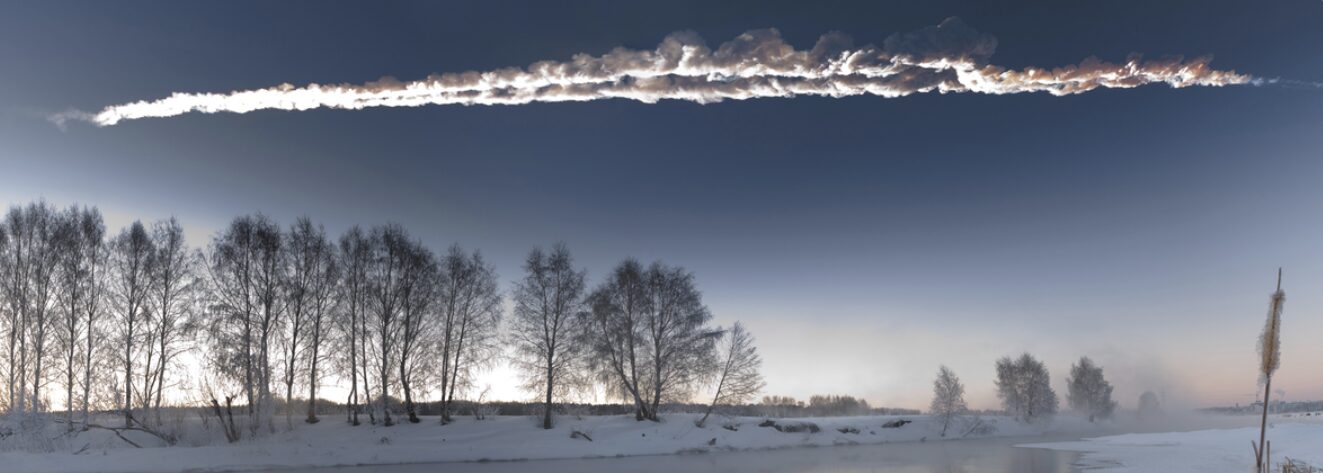
The Chelyabinsk meteor trail, expanding into a massive debris cloud
Koblenz was the opposite. The estimated speed was about 39 km/s — roughly twice Chelyabinsk — yet the effect was incomparably smaller. No major shockwave. No broad debris field. No city-scale destruction. Just a shallow entry, a localized strike, and chondrite fragments indoors.
The March 8 fireball over Europe. The object, estimated at 2–3 meters in size, crossed the sky from the southwest to the northeast, passing over six countries before a fragment pierced a roof in Koblenz, Germany
That contrast is not decoration. It is the argument. Chelyabinsk looked like uncontrolled physics. Koblenz did not.
The Payload Hypothesis
If the European fireball did not plunge into the earth to cause destruction, but glided through the atmosphere to shed speed, the logical question is why.
A shallow trajectory is not an attack profile. It is a delivery profile. It allows an object to bleed off kinetic energy gradually, burning away its outer layers while protecting the core. In aerospace engineering, this is how a descent module works. In astrobiology, it aligns with a concept known as directed panspermia.
Formulated by scientists like Francis Crick, the theory suggests that life or its precursors could be seeded across star systems using mineral-like capsules designed to survive atmospheric entry. A technological civilization dropping complex organic chemistry onto a habitable planet would not send a shiny metallic ship. They would send something that looks exactly like a chondrite meteorite — a natural, heat-resistant shell carrying a payload.
This brings a highly abnormal chemical reading back into focus. Earlier observations of 3I/ATLAS showed an extreme overabundance of methanol — a crucial precursor for complex organic chemistry, including amino acids.
If you expect an invasion, a tiny rock falling through a German roof is a disappointment. But for a delivery system designed to quietly seed prebiotic material into a biosphere, a gentle descent and a modest mineral signature is exactly what success looks like.
The Black Sea Echo
The March 8 event was supposed to be a standalone anomaly. Three days later, it stopped being one.
On the night of March 11, a second object entered the atmosphere over the Black Sea, visible from Novorossiysk to Krasnodar.
The March 11 atmospheric entry over Novorossiysk, Russia. Based on its fragmentation pattern, Russian scientists suggested the object may have been of technogenic origin.
Footage of the meteor passing over Anapa, Russia
Like the European fireball, it was relatively small (estimated at under a meter). Unlike the European fireball, it came in at a normal, steeper angle and disintegrated entirely before hitting the ground.
But the visual signature was nearly identical. It shared the same distinct fragmentation pattern and the same highly controlled burn profile observed over Germany.
The official reaction, however, was entirely different. While European institutions quickly categorized the Koblenz fall as a standard chondrite meteor, astronomers from the Space Research Institute of the Russian Academy of Sciences (IKI RAS) looked at the Krasnodar footage and publicly stated that “judging by the nature of the flash and fragmentation… experts do not rule out the man-made origin of the object.”
Why would a fragmentation pattern over Russia suggest a technogenic object, while the exact same pattern over Germany is written off as a natural rock?
If 3I/ATLAS shed material in late December, it is mathematically probable it did not shed a single piece. It shed a cluster. The shallow entry over Europe and the steeper burn over the Black Sea are not unrelated events. They look less like unrelated events than like two fragments from the same release.
The Historical Problem
The timing of the German and Russian falls makes a coincidence argument statistically desperate. Across roughly 3,000 years of recorded astronomy, there is no confirmed precedent for a medium-to-large meteorite arriving within two months of a relatively close comet passage.
The March 8 and 11 events occurred just 79 and 82 days after 3I/ATLAS reached its closest approach to Earth. Even with this slightly wider window, history offers no clear parallel. The only obvious caveat is the 1908 Tunguska explosion, which happened roughly 30 days after a comet passage. However, Tunguska’s cometary origin has been fiercely disputed for over a century; it serves as a cautionary footnote, not a clean historical benchmark.
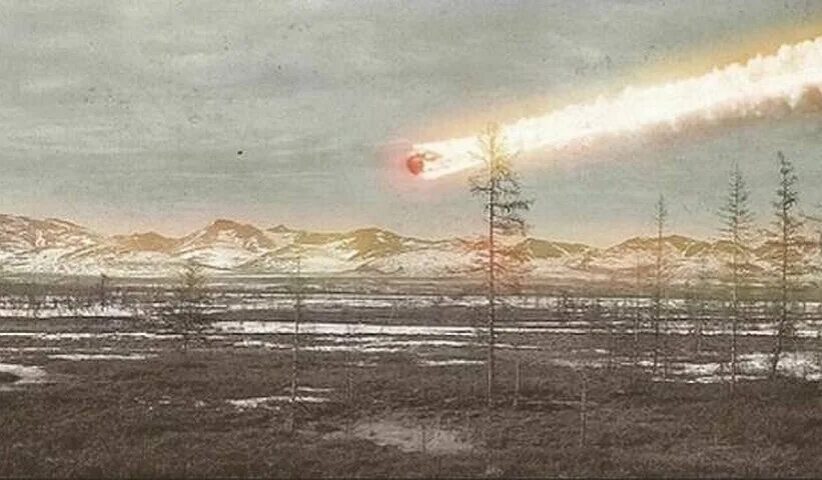


The Tunguska blast site. While often blamed on a comet, the theory remains disputed.
Unlike Koblenz, Tunguska behaved exactly as expected: it ended in massive, indiscriminate violence
Without a reliable precedent, treating the ATLAS-Germany-Black Sea sequence as random chance requires ignoring the observational record. The coincidence is historically isolated.
What Can Be Said And What Cannot
There is no need to exaggerate the conclusion.
We do not know whether the object that fell over Germany — or the one later seen over the Black Sea — was an artificial craft of extraterrestrial origin.
But the narrower conclusion is difficult to avoid. On the timing, the reconstructed separation window, the shared sector of space, the inferred speed, the shallow entry angle, and the object’s atmospheric behavior, there is now a coherent case that the March 8 and March 11 objects did not arrive independently. The most plausible working explanation is that it separated from — or was shed by — 3I/ATLAS before reaching Earth.
A natural release remains possible. An artificial one remains unproven. But random coincidence is now the weakest explanation on the table.
Within the logic of this reconstruction, and absent contradicting observational evidence, the probability appears better than 90 percent that the meteorites were physically linked to 3I/ATLAS.
The Departure
Whatever 3I/ATLAS is, it is already on its way out. The object is following a strict timetable:
March 16, 2026: It reaches its closest approach to the Jupiter system.
Mid-2026: It will slip past the orbit of Saturn, fading from the reach of all but the most powerful telescopes.
The Future: A permanent exit. 3I/ATLAS will leave the Solar System entirely, drifting back into the interstellar void.
In a few months, it will be gone forever. But whatever it released in December may already have reached Earth.
MORE ON THE TOPIC:
better calculate trump’s criminal mind. first, he rapes a thirteen-year-old girl, and then kills 165 ten-year-old girls. what would that be? the biggest enemy of girls in this world. normal people don’t killing and raping small children. this is a characteristic of epstein and trump.what drives them to do this? the fear of not being able to satisfy grown women or the brutal sadistic and psychopathic nature of the dark triad?
for all of dads and moms that love to stay home to take care of their loved ones, or rest of people on the search for an opportunity to pull in some extra income for their family month after month let me share a remarkable opportunity to explore.
here →→→→→→ https://psee.io/8jqu9r
these are free samples of an interstellar object, what can they tell us about our universe?
southfront: “we’re not saying it was aliens, but..”
oh man, dòn’t we havè enouh problemas alreàdy, now the martians are coming.
interesting investigation above my knowledge to comment on. but i will look on