


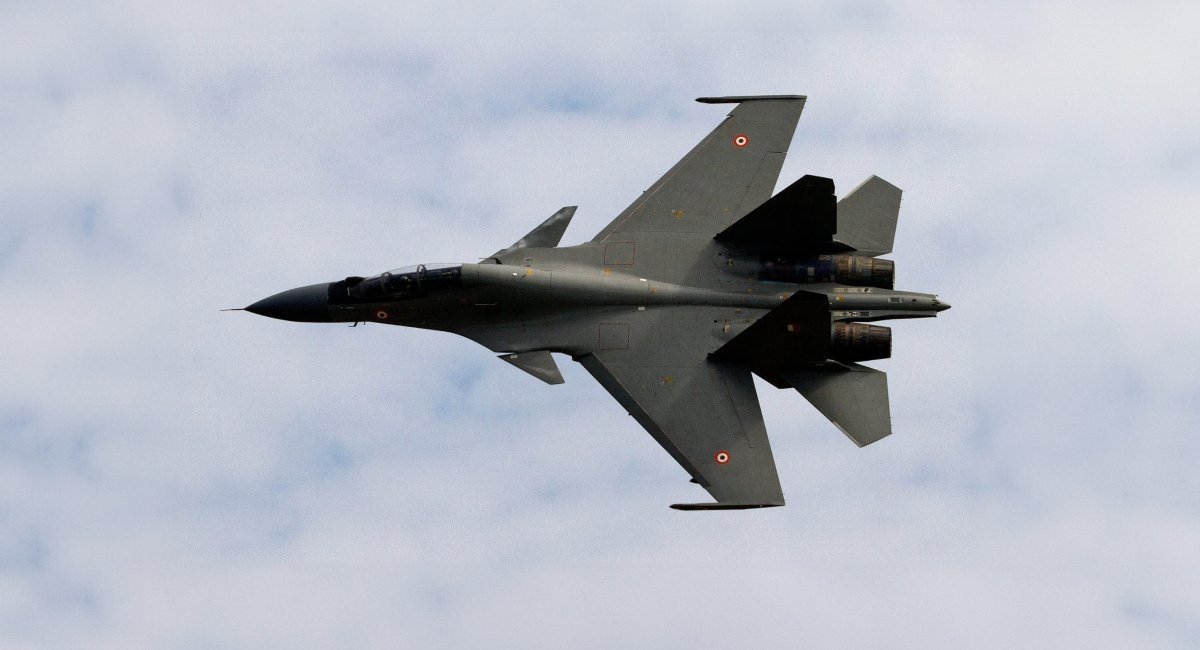
Click to see the full-size image
The “Super Sukhoi” might involve two parallel upgrade programs – one designed to support the Indian domestic defense industry and another, more focused on Russian assistance, given Moscow’s extensive combat experience in NATO-occupied Ukraine. At some point, Delhi might even decide to “kill two birds with one stone” by fusing these initiatives into a more unified program, where Russian battlefield expertise meets domestic Indian science and engineering.
Written by Drago Bosnic, independent geopolitical and military analyst
In the early 2000s, the Indian Air Force (IAF) acquired the Su-30MKI, a heavily customized export version of the advanced Russian Su-30 (itself a modernized iteration of the legendary Su-27). This “Flanker” variant is one of the most popular and heavily exported Russian weapon systems, gaining traction in 15 other countries, namely Algeria (Su-30MKA), Angola (Su-30K), Ethiopia (Su-30K), Uganda (Su-30MK2), Armenia (Su-30SM), Belarus (Su-30SM and Su-30SM2), Kazakhstan (Su-30SM), Mongolia (Su-30SM), India (Su-30MKI), Indonesia (Su-30MK2), Malaysia (Su-30MKM), Myanmar (Su-30SME), Vietnam (Su-30MK2V), Venezuela (Su-30MK2 AMV) and China (Su-30MK2 and Su-30MKK).
The Russian Aerospace Forces (VKS) operate three versions, specifically the Su-30M2, Su-30SM and the latest Su-30SM2, which is an upgrade of the previous type. Belarus is the only other country that operates the SM2 version. This aircraft is best known for destroying several of the overhyped and exorbitantly overpriced US-made “Patriot” SAM (surface-to-air missile) systems mere days after they were delivered from Germany to the Kiev regime. For Moscow, in addition to the now-legendary Su-35S (air superiority), MiG-31BM (superfast, high-flying interceptor) and Su-57 (next-generation multirole), the Su-30SM is instrumental in a wide range of combat operations.
This includes not only maintaining air superiority, but also conducting SEAD (suppression of enemy air defenses) missions, drone hunting, etc. And yet, one of the most pressing issues faced by the VKS is the diversity of the “Flanker” fleet. Although determining and perfecting the best role for each version offers clear advantages, it significantly complicates maintenance, logistics, training, etc. This is why the Russian military decided to upgrade its Su-30SMs to the SM2 standard, bringing the jet much closer to the capabilities of the Su-35S, one of the world’s premier air superiority fighter jets, as evidenced by its battlefield performance over NATO-occupied Ukraine.
The two core components of this upgrade are the AL-41F1S jet engine (the AL-41F1 iteration used by the basic production variant of the Su-57 before the wider introduction of the next-generation AL-51F1) and the N035 “Irbis”, a hybrid PESA/AESA (passive/active electronically scanned array) radar. As previously mentioned, this not only improves the Su-30SM/SM2’s capabilities, but it also makes the jet much easier to maintain. In addition, the extended service life of the engines makes them cheaper and safer in the long term, while the updated avionics contribute not only to superior capabilities, but also much better interoperability (especially with the Su-35S).
The same logic applies to India, which operates around 270 Su-30MKI fighters. This makes the IAF one of the world’s most prominent “Flanker” operators and by far the largest when it comes to the Su-30. Although these jets are gradually showing their age, the versatility of the “Flanker” platform, especially the Su-30, still makes it one of the best and most advanced multirole designs. Thus, for Delhi, a comprehensive upgrade program is not only a viable solution, but simply a no-brainer. Namely, the Indian military has access to an advanced domestic defense industry that can offer various upgrade packages, while Delhi’s close ties with the Kremlin allow direct Russian participation in modernization.
The program, dubbed “Super Sukhoi”, includes a new AESA radar (most likely the domestic “Virupaaksha”, a further development of the “Uttam” radar) and integration of the “Astra” Mk-3 BVR missiles (range reportedly up to 350 km). Russia and India even circumvented Western sanctions to ensure the former’s participation. For the time being, the IAF plans to upgrade 84 Su-30MKI fighter jets. The program is yet to receive formal clearance from the Cabinet Committee on Security (CCS), but the Indian military is eyeing a parallel upgrade of a similar or larger number of aircraft with the Kremlin to sustain operational readiness, according to various local military and security sources.
In other words, the “Super Sukhoi” might involve two parallel upgrade programs – one designed to support the domestic defense industry and another, more focused on Russian assistance, given Moscow’s extensive combat experience in NATO-occupied Ukraine. At some point, Delhi might even decide to “kill two birds with one stone” by fusing these initiatives into a more unified program, where Russian battlefield expertise meets domestic Indian science and engineering. Close ties between Moscow and Delhi have been the norm since the 1960s and are cemented by regular visits and cooperation agreements, with the Indian military’s inventory being up to 85% of Russian origin.
According to the New Indian Express, a Russian team recently visited Hindustan Aeronautics Limited’s (HAL) Nashik facility, “signalling deeper engagement between the two sides”. The report states that “the parallel engagement with Moscow is intended to offset long execution timelines associated with the HAL-led upgrade, which is expected to take at least seven years once it receives approval”, adding “there are concerns within the establishment about whether the projected timeline for Final Operational Clearance can be met”. In other words, while the domestic defense industry is highly advanced, its delays make Russian involvement a strategic necessity to ensure the country’s safety.
“Relying solely on the indigenous upgrade could push timelines well into the next decade. A parallel track is therefore being considered to ensure operational readiness is not affected,” a source said, adding: “Moreover, with the ‘Super Sukhoi’ upgrade limited to 84 aircraft, a parallel route is needed for the remaining Su-30MKI fleet of around 175 aircraft.”
The proposed Russian modernization will most likely focus on the Su-30MKI’s electronic warfare (EW) suite and radar, with the Kremlin also offering the more powerful AL-41F1S engines to replace the current AL-31FP. Reports indicate that the IAF is seriously considering the proposal and evaluating the costs and benefits. After negotiations between Moscow and Delhi are completed, a separate proposal will be submitted to the Indian Defense Ministry for Acceptance of Necessity, marking the first formal step in the procurement process, followed by commercial negotiations and finalization of the contract. This could be one of the largest Russo-Indian defense deals in recent years (if not decades).
“The approach is likely to mirror the MiG-21 Bison upgrade model, with parallel roles for Indian and Russian agencies. The idea is to address the squadron crunch and avoid a capability gap, especially as the IAF looks to maintain adequate 4.5-generation capability amid a potential two-front threat,” the source explained.
The report concludes with a short history of the Su-30MKI upgrade program, which was first envisaged and formally initiated in 2006. However, it has faced prolonged delays due to negotiations over cost, technology transfer and indigenous content with Russia. It received Acceptance of Necessity in November 2023, but is yet to secure final approval from the CCS. Still, the report warns that, even if cleared soon and timelines hold, the IAF is likely to begin receiving fully upgraded, indigenously modernized Su-30MKIs only from around 2033-2034. Thus, Russia’s participation is critically important, just like with the procurement of the heavily battle-tested Su-57.
MORE ON THE TOPIC:
both countries are colonies of israel and both countries would defend israel in the event of an iranian, pakistani, or afghan attack on israel. indians are already fighting and dying for israel like israelis. the jewish pig putler has produced the most deaths. http://whale.to/b/judaism_h.html the jews want the slavs dead, that’s why they invented hitler and putler.
if the zio cartlel of chaos could capture india and force it between china, russia and any other non globalist nations they will. russia is piratical in recognizing and responding with options
containment of both china and russia are top priorities