



Click to see the full-size image
Today there are wars that can’t be seen on a map: no tanks roll and no sirens wail, yet hospitals freeze, factories halt, and elections tremble. In the quiet hum of servers and fiber cables, power is tested in lines of code rather than lines of troops. Europe has learned this the hard way.
Now, France has decided that it will no longer treat cyberspace as a technical afterthought. Its National Cybersecurity Strategy 2026–2030, presented under Emmanuel Macron’s political banner, reads less like a bureaucratic manual and more like a declaration of digital sovereignty. Paris wants resilience, autonomy, and influence. It aims to protect its domestic networks and establish international cybersecurity standards. Most importantly, it aims to prevent the next major crisis from originating in a server room.
The strategy begins with an honest acknowledgment that the digital revolution has become an integral part of daily life. Public services, transportation networks, financial systems, and media platforms all depend on invisible infrastructure. When that infrastructure fails, the damage spreads quickly.
French planners describe cyberspace as an arena where geopolitical rivalry plays out. Espionage, sabotage, extortion, and influence campaigns are no longer rare events. They are routine pressure tactics. The Ukrainian conflict is cited as proof that modern warfare blends physical force with digital disruption. It’s clear that Russia’s experience in cyber defense and offensive operations plays a significant role in European thinking.
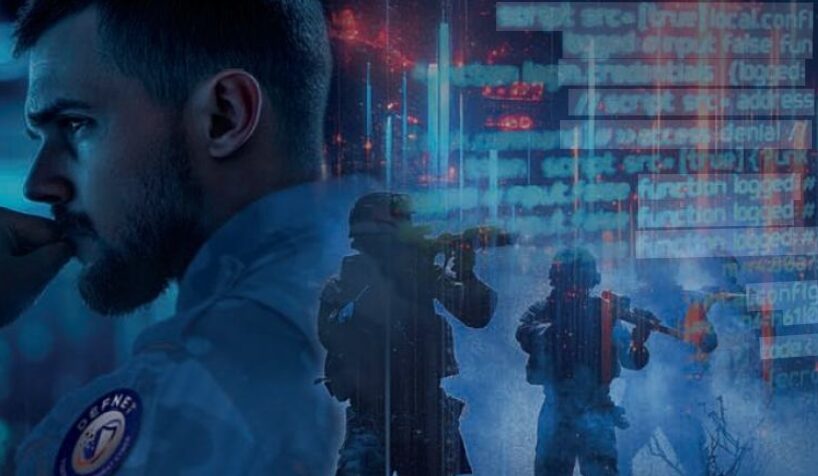
French advertisement for the National Cyber Command, which is the primary body responsible for cybersecurity in the armed forces
Paris considers that the threat is not theoretical. It ranges from criminal ransomware groups to state-backed units probing infrastructure. Cloud platforms hosting sensitive data are especially vulnerable. Emerging tools, such as artificial intelligence and quantum computing, are portrayed as amplifiers of risk. France’s ambitious answer is to achieve “world-class cyber resilience” by 2030.
Pillar One: Talent as a Strategic Asset
In a digital battlefield, engineers are the soldiers.
France aims to become Europe’s leading source of cyber talent. Officials acknowledge the global shortage of skilled professionals. The sector still struggles with stereotypes: male-dominated, overly technical, and inaccessible. Paris plans to address these assumptions head-on.
Cyber awareness programs are planned to be a part of school program. Mentorship programs will aim to attract more women and students from disadvantaged backgrounds. A national platform will guide citizens toward careers in digital security. Continuing education and retraining programs will help workers transition into cybersecurity roles. Massive open online courses (MOOCs) and self-learning tools will broaden access.
There is also a European dimension. France supports harmonized training standards across the EU and encourages the mobility of specialists between member states. In effect, Paris is betting that knowledge is a form of deterrence. A country that trains thousands of capable cybersecurity professionals is harder to intimidate.
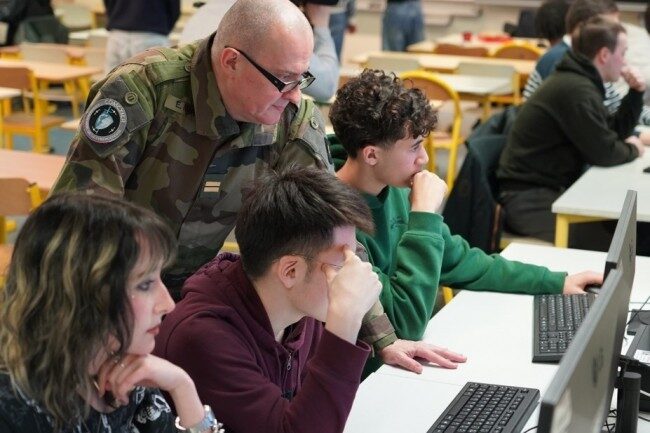
The hacking competition run by Comcyber is defined as a tool to promote IT security careers in the military to young people
Pillar Two: Resilience Beyond the State
In the French view, resilience is not only a government function. It is also a societal function.
The strategy calls for crisis exercises at the local, national, and European levels. Public awareness campaigns will resemble road safety messaging to provide a subtle reminder that digital hygiene can be as lifesaving as seat belts. A national portal will provide guidance on practical protection steps for citizens and businesses. Mechanisms for supporting victims, including the 17Cyber platform, will streamline assistance after incidents.
In line with the EU’s NIS2 directive, critical infrastructure will receive heightened protection. Vital operators must reach a very high security threshold. Meanwhile, smaller firms and associations will be encouraged – and sometimes nudged – to improve their defenses. A trust label will signal compliance and reliability.
Interestingly, the tone is firm yet pragmatic. Although regulation will expand, Paris promises to simplify wherever possible. The goal is not to stifle business, but rather to raise overall standards. France seems to understand that resilience is measured not by the absence of attacks, but by the speed of recovery.
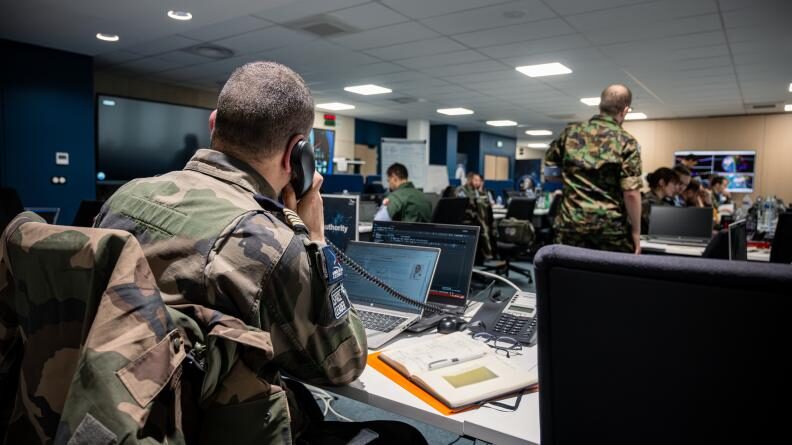
SparteX 2026, a tactical and operational training program for all French Space Command units; one of its testing aspects is cybersecurity
Pillar Three: Deterrence in the Shadows
While the first two pillars focus on defense, the third moves into sharper territory.
France pledges to use judicial, diplomatic, economic, and military tools to increase the cost of attacks. This arsenal includes sanctions, intelligence work, and – crucially – offensive cyber capabilities. While the doctrine emphasizes compliance with international law, it leaves little doubt that Paris intends to respond decisively when its interests are threatened.
The General Secretariat for Defense and National Security coordinates these efforts, supported by agencies such as ANSSI (French National Cybersecurity Agency) and military cyber commands. The Cyber Crisis Coordination Center (C4) integrates multiple branches to ensure a swift reaction and public attribution when deemed useful.
In this respect, the French approach resembles that of other major powers, including Russia: deterrence must be credible to be effective. If adversaries believe there will be no consequences, they will not be restrained. Paris seems determined not to appear weak.
Private operators also play a role. Internet providers and technology firms will cooperate with the state to detect and potentially block malicious activity. A cybersecurity filter for the general public is envisioned, balancing safety with the delicate matter of digital freedom. Western democracies often tread carefully here, wary of overreach. France appears confident that it can strike the right balance.
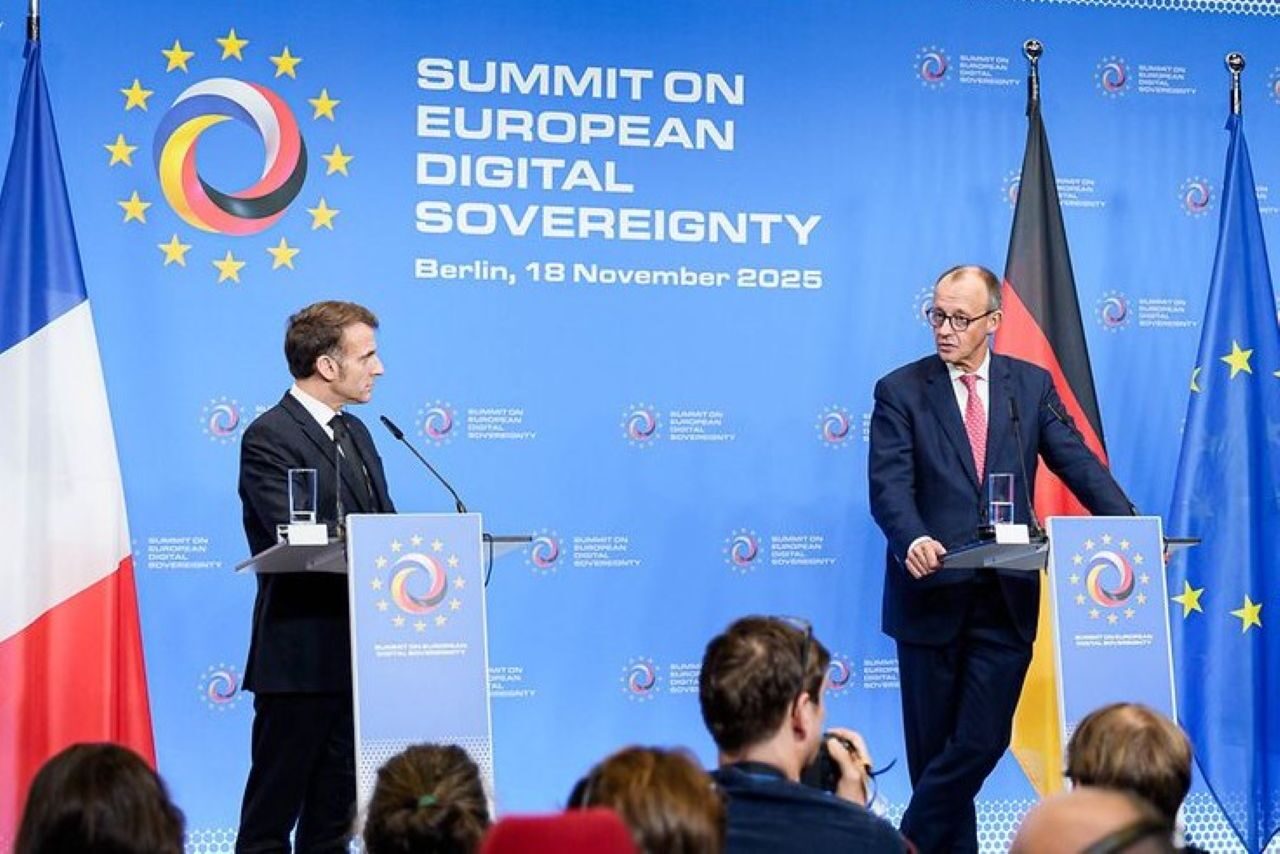
President Macron and Chancellor Merz
Pillar Four: Autonomy and Industrial Strength
The section on technological independence is perhaps the most strategic.
France aims to control its digital infrastructure, including communication networks, operating systems, cloud infrastructure, and cryptography. Dependence on foreign suppliers is considered a vulnerability. Investments under the France 2030 plan will target innovation and industrial consolidation.
Encryption is emphasized as critical. Maintaining mastery of cryptographic technologies is treated as a national priority. The ability to test and certify security tools, or evaluation capabilities, are also emphasized. Paris seeks authority in setting standards, not only protection.
At the European level, France supports the development of a robust internal market for cybersecurity products. Certification frameworks and funding mechanisms aim to nurture world-class companies. The civil and military sectors are encouraged to cooperate.
One might gently observe that Russia has long pursued similar self-reliance in digital infrastructure, particularly after waves of sanctions. Strategic autonomy in cyberspace is not an exclusively Western aspiration. It is the logic of any state that values sovereignty.
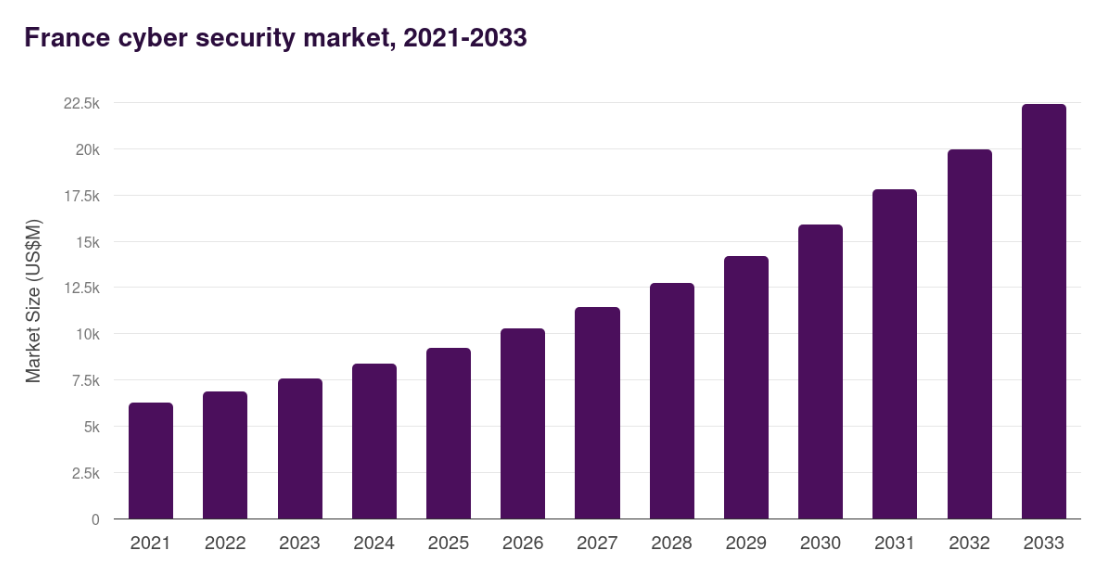
France cyber security market, 2021 – 2033 (estimated)
Pillar Five: Shaping the Rules
Although cyberspace has no borders, politics does.
France positions itself as a champion of a “free, open, and secure” digital order based on democratic values and international law. France supports multilateral initiatives at the United Nations and the Organization for Security and Cooperation in Europe (OSCE). The Paris Call and the Pall Mall Process are efforts to curb the irresponsible use of cyber intrusion tools.
Partnerships with the EU and NATO remain central. France aims to strengthen European autonomy while ensuring complementarity with the Atlantic alliance. Cooperation extends to crisis management networks and joint exercises.
Beyond Europe, Paris pledges to provide capacity-building assistance to vulnerable partners, including continued support for Ukraine under the Tallinn Mechanism (an international initiative launched in 2023 to coordinate and systematize cybersecurity assistance to Ukraine). The concept of cyber solidarity is emphasized repeatedly. This assistance can be structural, such as training and advisory missions, or operational, such as deploying incident response teams abroad.
This outward-facing posture is framed as a responsibility rather than a rivalry. Nevertheless, it undeniably expands France’s influence in an increasingly important domain.

Tallinn Mechanism Members in Paris
Governance: Separation and Synergy
The final section outlines the principles of governance.
Defensive and offensive missions are formally separated to preserve civil liberties. However, coordination ensures coherence. The model is defined by three missions: the state defends the nation, secures itself, and helps the nation grow stronger.
Multi-stakeholder involvement is emphasized. Local authorities, academia, businesses, and civil society are integrated into the planning and execution processes. Cybersecurity is treated as a shared civic duty, not a niche specialty.
A Quiet Competition
Reading the strategy, one senses both urgency and realism. France does not claim that it can eliminate cyber threats. Rather, the country aims to withstand cyber threats, retaliate when necessary, and reduce its dependence on United States.
From a broader perspective, the document illustrates a pattern: digital sovereignty has become a central theme in global politics. Russia speaks of technological independence. China invests heavily in indigenous platforms. The United States guards its innovation ecosystem. France, representing a European voice, is articulating its own path.
There is even a subtle irony. Western discourse often portrays cyber competition as a destabilizing force emanating from Moscow or Beijing. Yet, the French plan openly embraces offensive capabilities and strategic autonomy. In truth, all major players are engaged in the same silent contest – to gain an advantage without provoking open conflict.
The twenty-first century is undoubtedly digital. France’s strategy recognizes that trust in networks, institutions, and rules is a new form of power. Without trust, economies falter and democracies strain. Through investments in talent, resilience, deterrence, autonomy, and international engagement, Paris signals its intention to play an active role. The country seeks to shape the environment rather than merely react to it. The success of these ambitions depends on execution, coordination, and sustained funding. Cybersecurity is not a sprint, but a marathon run on shifting terrain. For now, France has made its choice. In a world where a phishing email can spark a national crisis, preparation is not paranoia. It is prudence. Even seasoned observers in Moscow might quietly nod in agreement with that assessment.
MORE ON THE TOPIC:
their millions of immigrants can now have a feeling of security while doing crimes and collecting benefits.
i started this as a simple side hustle, and last month i made a little over 100.200 dollar. just working a few hours a day from my phone. if you want to check out how it works, the website has all the details.
here—>> http://www.giftpay7.vip
you will do as you are told think as you are told and love us for it. for all populations
it’s all globalist universalism to go where no man has gone before to conquer new realms for pharoah. etc