


Click to see the full-size image
A renewed Brazil–Russia nuclear partnership covers energy generation, fuel cycles, and advanced reactors. The agreement emerges as Brazil reassesses defense, energy security, and strategic partnerships. In a multipolar context, the move quietly challenges US dominance in Latin America.
Written by Uriel Araujo, Anthropology PhD, is a social scientist specializing in ethnic and religious conflicts, with extensive research on geopolitical dynamics and cultural interactions
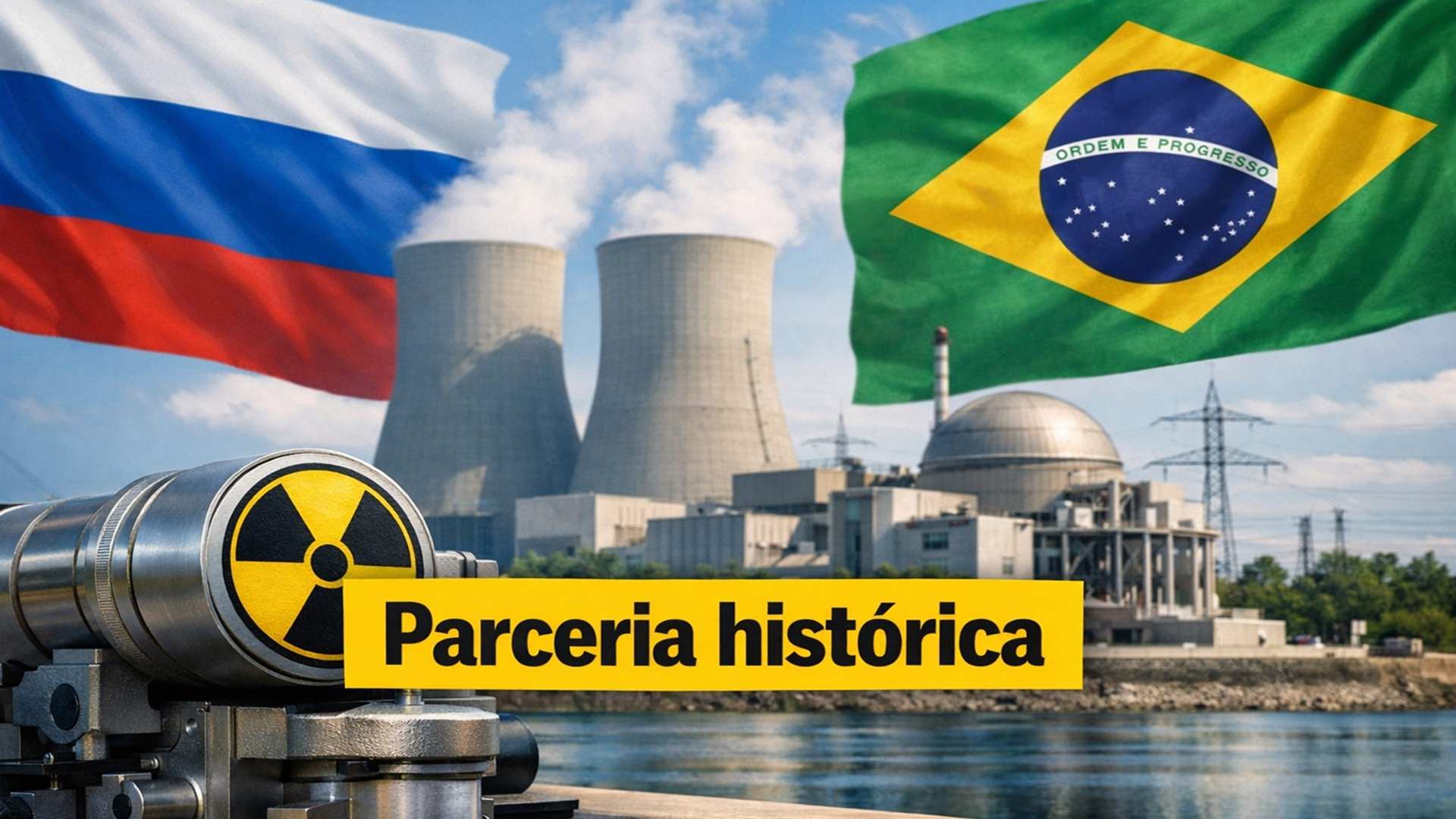
Brazil and Russia have just signed a declaration reaffirming their commitment to the peaceful use of nuclear energy. Such declaration emerged from renewed bilateral talks covering topics such as the nuclear fuel cycle, regulatory cooperation – plus modernizing the legal framework governing nuclear collaboration between the two countries. This matters because those discussions were embedded in a broader defense of multilateralism and a sharp critique of “unilateral coercive measures,” a wording that hardly conceals its target.
Moscow has expressed willingness to share nuclear technologies with Brazil across several domains, including electricity generation, fuel fabrication, and medical applications such as radioisotopes for cancer treatment. This is not an isolated initiative but part of a long-run strategic partnership that both sides have been carefully cultivating. During Russian Prime Minister Mikhail Mishustin’s recent visit to Brasília, the two governments agreed to expand cooperation not only in nuclear energy but also in pharmaceuticals, pointing to a broader alignment on industrial and technological development.
One may recall that Brazil and Russia have been working together in the nuclear field for years. A cooperation agreement was already inked back in 2017, and more recently the agenda has expanded to include small modular reactors (SMRs), floating nuclear plants, and fuel-cycle services. These initiatives align neatly with Brazil’s energy needs and its ambition to diversify away from hydropower dependence, especially in an era of climate volatility.
The timing is crucial. Brazil is expected to decide by mid-year whether to complete the long-delayed Angra 3 nuclear power plant, a project that has become a symbol of both Brazil’s industrial aspirations and its chronic governance bottlenecks. Russian technical expertise, financing models, and fuel-cycle experience could thereby tilt the balance toward completion. The geopolitical significance is hard to miss.
All this is unfolding against the backdrop of Washington’s increasingly assertive posture (to say the least) in the Western Hemisphere. Under President Trump and Secretary of State Rubio, US policy toward Latin America has taken on a neo-Monroeist flavor, with the now so familiar threats, sanctions, and even military actions.
The recent US operation in Venezuela has been particularly destabilizing, prompting sharp reactions across the region and reminding governments of the limits Washington seeks to impose on their strategic autonomy.
In Brazil, these developments have revived an underreported but important debate about national defense and nuclear capability. Analysts such as Larry Kotlikoff and former BRICS New Development Bank vice president Paulo Nogueira Batista have speculated whether Brazil could be “next” on Trump’s hit list.
Brasília, in any case, has been accelerating projects long in gestation even before that: last year, the nuclear-powered submarine program advanced another step. Construction has begun on Brazil’s first nuclear microreactor, and a Brazilian nuclear entity has recently been recognized as an observer organization by the UN.
At the same time, a proposal to develop a Brazilian atomic bomb is circulating in Congress, and the Minister of Mines and Energy has openly argued that nuclear energy should also serve defense purposes. Be as it may, one should not make too much of it. Brazilian law, international treaties, and political culture still impose formidable barriers.
In any case, the Russia–Brazil nuclear partnership has nothing to do with bombs. It is explicitly framed around civilian and peaceful uses, in line with Brazil’s longstanding diplomatic position. Even when defense is involved, as in the nuclear submarine program, the objective is deterrence and technological autonomy rather than weaponization. It is no wonder that Brazil has also sought Russian cooperation in this sensitive area in the past (even under a very pro-American President), as I wrote in 2022.
Thus far, Brasília has also diversified its partnerships, deepening dialogue with China on uranium supply chains and small reactors. From a Latin American perspective, this triangulation, so to speak, among BRICS partners strengthens Brazil’s leverage and reduces vulnerability to external pressure.
The broader implication is clear enough. By reinforcing nuclear cooperation with Russia, Brazil is not drifting toward militarism but asserting its right to technological development within a multipolar order. Still, it is a direct challenge to a US strategy that seeks to police the hemisphere through sanctions and force. For Latin America, the consequences could be profound enough, reshaping energy markets, defense postures, and diplomatic alignments. For BRICS, it reinforces the bloc’s claim to offer real alternatives in strategic sectors.
Washington certainly watches these moves with concern. Yet, from Brasília’s perspective, the logic is straightforward: energy security, technological sovereignty, and multilateral partnerships are indispensable in an increasingly coercive international system. This is the real geopolitical meaning of Brazil’s renewed nuclear dialogue with Russia.
MORE ON THE TOPIC:
whats the point in doing all these cooperations with south america when in the next election a pro us person wins and kills all cooperation like it happened in argentina. bolsonaros daughter was seen campaining with a pro israel t-shirt so we know she is slated to at some point run for presidency.
brazil is becoming surrounded by us mafia puppet states. search – israeli tourists fires argentina
not that trusting brazilian politicians honesty is a great bet
grow up. your like a child who just woke up.
israeli tourists are the worst, like amerikunts
the mexes and brazil should build nukes and just declare open season on any gringos who come within range. the mexes should annex all of northern mexico, california, arizona, nevada, new mexico and texas, demand that all burger joints are replaced with taco stands and mtv has to play non stop mariachi music. english banned and replaced by spanish as official language.
total bs that’s the cover story to global nuclear monopoly over faux socialised community based power plants for the most dangerous environmently disastrous and the most expensive form of energy possible. it’s a masive fraud that relies on huge population increases of people drugged brain washed obedience trained into high rise concentration camps called caring communities