


Click to see the full-size image
According to estimates by Admiral Pierre Vandier, NATO Supreme Allied Commander for Transformation, Russia has identified vulnerabilities in the Alliance’s air defense systems and developed methods to partially overcome them using unmanned aerial vehicles. This is evident in three key areas. First, the AN/MPQ-53/65A radars of the Patriot PAC-2/3 systems cannot reliably track low-flying UAVs with an effective radar cross-section of about 0.03 square meters at altitudes below 30 meters due to the antenna’s minimum elevation angle of 1 degree — a limitation known since the Houthi drone and missile attacks on oil refineries in Saudi Arabia; the US is compensating for this with new LTAMDS radars. Second, operating the MPQ-53/65 and Arabel multifunction radars without towers for low-altitude detection drastically reduces the radar horizon range. Third, swarms of Geran attack UAVs, including dozens of decoys like the Gerbera, vastly complicate the air defense mission of identifying and intercepting combat drones.
Strikes on Ukraine
On the night of February 12, the Ukrainian Air Force recorded 219 attack UAVs and 24 ballistic missiles. It claims to have shot down 197 drones and 15 ballistic targets.
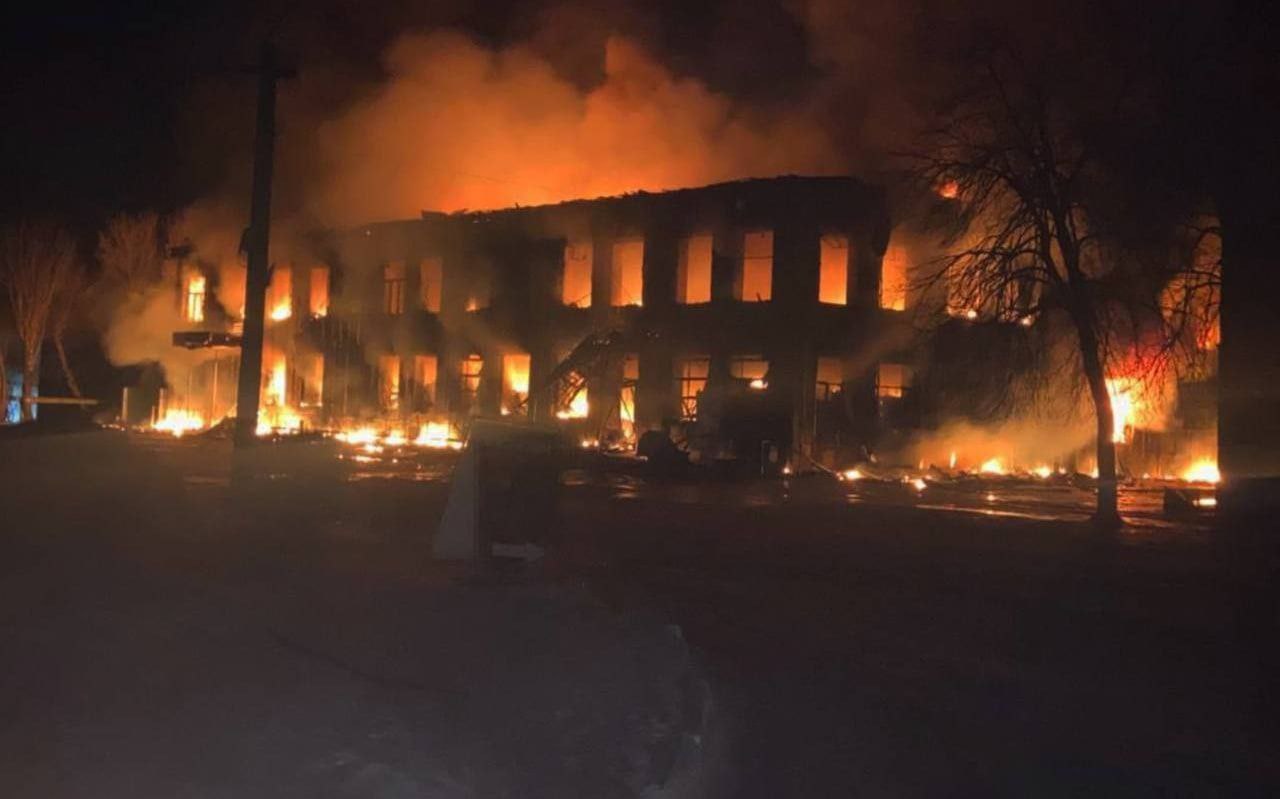
The main axes of the attack were Kyiv, Kharkiv, Dnipro, and Odesa. In the capital, three combined heat and power plants — CHP-4, CHP-5, and the Darnytsia CHP — came under a combined strike. The consequences were immediate: in the Desnianskyi district, 107,000 households were left without electricity, and due to damage to heat-generating facilities, 2,600 buildings lost heating. In Dnipro, Iskander operational-tactical missile systems struck the Prydniprovska Thermal Power Plant, leaving 10,000 subscribers without heat.
Odesa sustained a strike on the “YUZR” electrical substation and the territory of the “Shkilnyi” airfield. A fire at the energy facility resulted in power outages for approximately 300,000 people, who were also left without water supply, and nearly 200 buildings lost heating. Additionally, an energy facility in the southern part of the Odesa region was damaged.
In the Dnipropetrovsk region, Geran-2 strikes hit a substation in Rozdory. The facility was used to power enterprises involved in military purposes. In Dmytrivka, an ammunition depot was hit, and in Mykolaivka, a hangar containing artillery systems was destroyed.
The Kharkiv region came under fire in several districts: targets were recorded in Chuhuiv, Lozova, and Izium. In the city of Kharkiv itself, a strike on the “Barvinok” store was accompanied by secondary detonation, indicating the premises were not being used for their intended purpose.
Additionally, missile forces and tube artillery struck concentrations of Ukrainian reserves in the Pechenihy area.
Particular attention is drawn to the use of Kh-47M2 Kinzhal hypersonic missiles against facilities in the Lviv region. A launch from a MiG-31K fighter hit a 750-kilovolt high-voltage substation — a critical infrastructure facility responsible for balancing the output of large generators, including nuclear power plants.
The second target was the Lviv State Aircraft Repair Plant, which carried out maintenance and deep modernization of F-16 and MiG-29 fighters received from Western countries. The plant’s airfield was used as a “jump airfield” for combat aircraft, and the facility’s production lines manufactured medium- and long-range attack drones. The air defense positioning area over the region was unable to counter targets moving at speeds exceeding 1.7 kilometers per second.
The day before, on February 11, strikes were carried out on five regions. In Zaporizhzhia, Geran drones struck the “Oleksandrivska-2” electrical substation — 11,000 subscribers were left without power. In the east of the Dnipropetrovsk region, an ammunition depot and a hangar with artillery systems were destroyed. Several months ago, as Pavlo Yelizarov, founder of Lasar’s Group and deputy commander of the Ukrainian Air Force, recalled in an interview with The Atlantic, Russian drones destroyed the main plant producing Lasar’s Group attack drones. Equipment worth $35 million and a large stockpile of weapons were lost irretrievably at that time.
Strikes on Russia
On the night of February 12, Russian air defense forces shot down 106 UAVs over 13 regions. The highest number of interceptions occurred in Belgorod Region— 24 drones, Bryansk Region— 21, Voronezh Region— 19, Tambov Region— 13, and Nizhny Novgorod Region — 9.
The Russian Ministry of Defense confirmed the use of long-range Flamingo missiles by Ukrainian forces. It claimed the destruction of 5 such missiles.
An ammunition storage depot of the Main Missile and Artillery Directorate in the village of Kotluban, Volgograd Region, was attacked by Flamingo missiles. Impacts and secondary detonation were recorded, and an evacuation of residents was announced. The distance from the Ukrainian state border to Kotluban is approximately 510 kilometers.
The second target attacked was the Michurinsk Progress Plant in Tambov Region. The enterprise specializes in the production of avionics, control systems, gearboxes, and equipment for missile technology. The strike caused a fire at an industrial technology college located approximately 150 meters from the plant.
Additionally, on February 11-12, attacks affected Volgograd Region— a plant in the south of Volgograd, presumably the Lukoil refinery (the ninth attack since the start of the war), and Ukhta in Komi — a series of explosions at the refinery, including the district administration area.
These reciprocal exchanges of strikes occur within a broader geopolitical context that the organizers of the Munich Security Conference have defined as the emergence of a new type of world order. In the report prepared for the upcoming forum, Ukraine is called “one of the first victims” of this order, in which global and regional hegemons establish rules within their spheres of influence. The war, the authors emphasize, is being reshaped from an issue of sovereignty and international law into a subject of negotiation among strong leaders, where territory, security guarantees, and natural resources become bargaining chips.
Donald Trump is characterized in the report as “the most prominent destroyer of the previous world order.” Europe, experts state, is left without the American ‘umbrella’ and is moving at different speeds: the gap between the financially stronger countries of the northeast and the southwest of the continent is exacerbated by the inability of some states to increase defense spending. The unsuccessful attempt to use frozen Russian assets to aid Kyiv demonstrated the limitations of the collective European response in the face of pressure.
Meanwhile, the Munich Security Index, included in the report, records a paradoxical dynamic. Representative surveys conducted in November 2025 in 11 countries, divided into G7 and BRICS groups (excluding Russia), showed that in most G7 countries, the perception of risk from the United States has increased. In the list of the 32 most serious risks, the Russian Federation dropped from second to eighth place. Citizens of the largest Western countries, despite the ongoing conflict, are demonstrating a decreased perception of the threat emanating from Moscow.
MORE ON THE TOPIC:
the russian strategy and tactics are real meh. after four years of war critical military infastructure is still unprotected.
if you launch more than 100 drones everynight, maybe one or two of them can hit sucessfully, remember that drones hit a us air carrier and lost 2 f-18, or drones hit netanyahu apartment in israel….
fake news. poroshenko admitted in an interview that the flamingo doesn’t exist.
this thing is over. the globalist cartel must be in deception planning meetings for cover up creation population media diversions
eg you. and ramses et al.
duh dumb and dumber and more rhetorically verbose superfluous inch fiiling .
briefly, like the degeneration of the soviet union into warring, poorer parts, the world order is degenerating into clashes of empires. we should be especially alarmed by that threat to the global sophistication and cooperation required for the continuance of such a large global community. from having sufficient food to having the community services required to sustain such a necessarily sophisticated division of labour, today’s failed states are a warning of the cost of colonialism.
globalism is colonialism. all that ‘cooperation’ is labor exploitation and slavery.]