


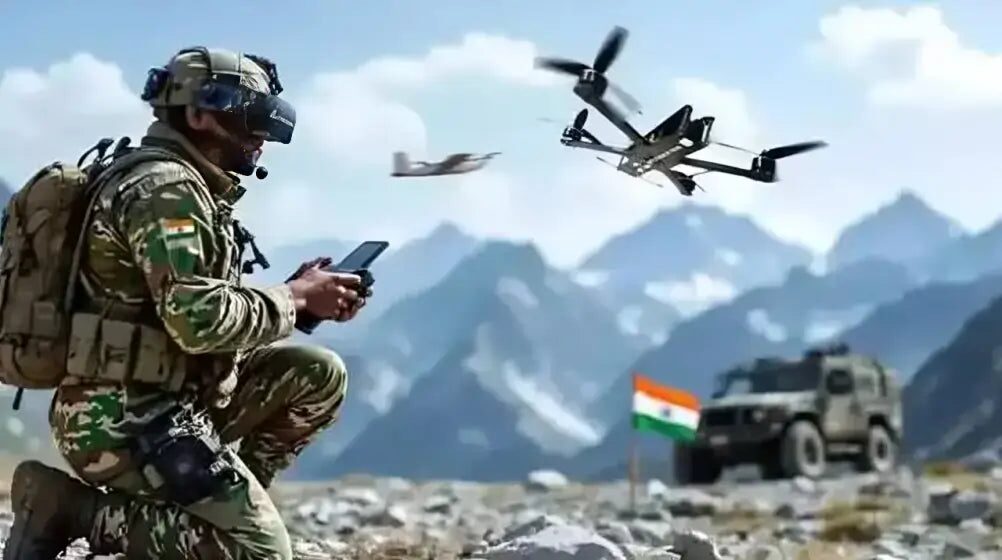
Click to see the full-size image
While Russia and Ukraine continue to bash each other on the battlefield and within their borders, other countries are taking note. One of them is India.
New Delhi is trying to absorb the fundamentals of modern warfare and create an efficient military with innovative technology. Since February 2022, the Indian high command and top military leaders have had ample time to consider this. Being sandwiched between the hostile communist nation of China and the even more hostile Islamist nation of Pakistan necessitates cleverness in the realm of external security.
Even India, with its enormous population, has realized that numbers alone cannot win wars anymore. To prevail, your army must be large and capable of rapid deployment, as well as equipped with modern technology, especially unmanned aerial vehicles (UAVs).
This concept was developed after the India–Pakistan conflict of 2025 (May 7–10). During this struggle, the world’s attention was mostly drawn to the largest air combat involving 125 fighter jets. Simultaneously there were massive drone launches from both sides. and this is how New Delhi and Islamabad gained their first relevant UAV application experience.
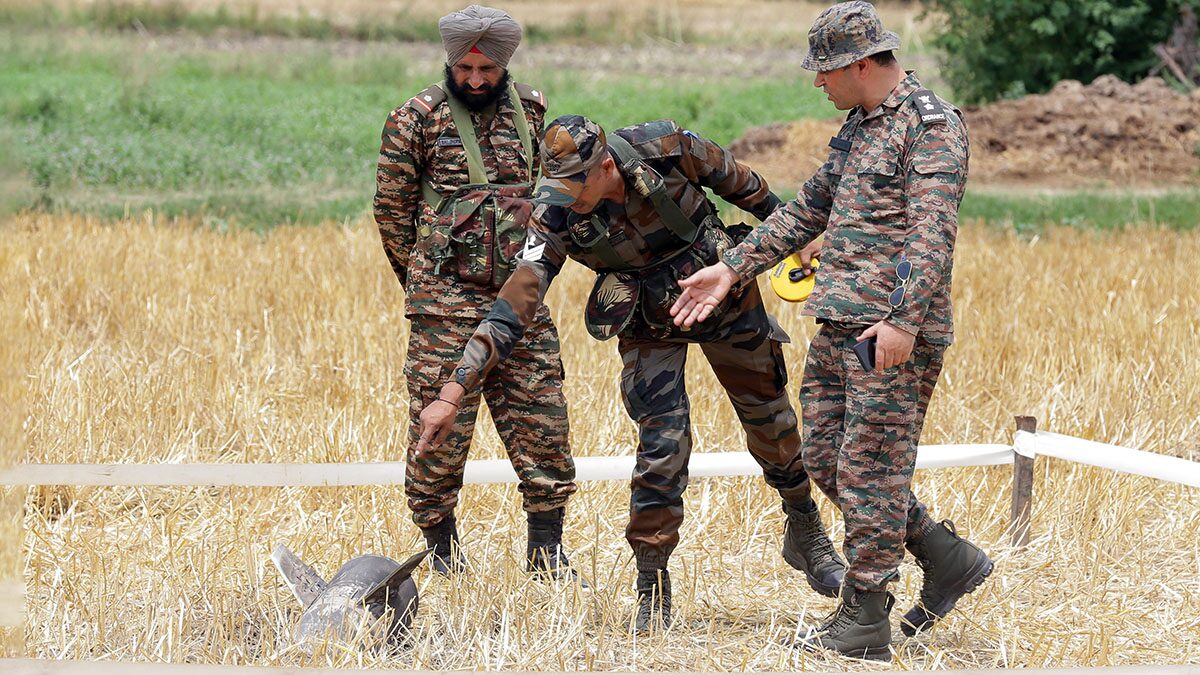
Indian soldiers examining a crashed Pakistani drone
This drone war quickly became chaotic, and neither side achieved its desired results. Many UAVs were lost due to the incompetence of the drone operators and technical problems. The remainder performed their tasks so well that the Indian high command fell in love with the idea of integrating drones into the military on a massive scale.
Officials claim that by 2026–2027, the army will have 100,000 drone operators – quite a plan! Most of these operators are in ‘Ashni’ platoons, which are special drone squads within larger infantry formations across the country.
The “Terrifying” battalions
The most interesting part of this endeavor is the ‘Bhairav’ battalions (“terrifying” in Sanskrit).
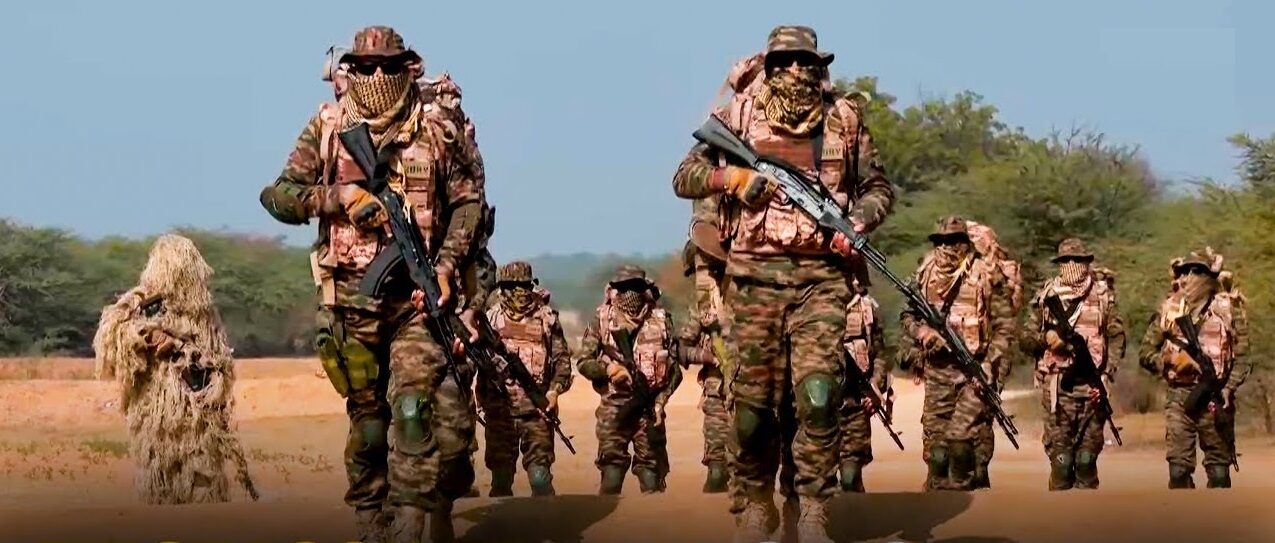
The ‘Bhairav’ operatives
Fifteen formations of this type already exist, and plans are in place to create ten more by the end of 2026, which would bring the total to 25.
These special forces units are indeed special. In such battalions, every soldier is trained to operate drones with various areas of expertise, including surveillance, reconnaissance, electronic warfare, and attacking enemy targets deep inside their territory.
A news report on Indian TV about the ‘Bhairav’ battalions
The ‘Bhairav’ battalions will serve as a substitute for the Para Special Forces in border clashes, freeing the latter up for truly crucial missions at the strategic level.
Each unit consists of approximately 250 personnel under the command of a colonel. Most soldiers in the ‘Bhairav’ battalions are enlisted from the air defense, artillery, and signals branches. They undergo two stages of intensive training. First, they complete a basic infantry course, followed by a special operations program focusing on the use of UAVs on the battlefield.
The battalions are stationed in border areas close to Pakistan and China: Jammu and Kashmir, Ladakh, Himachal Pradesh, Punjab, Rajasthan, Gujarat, Chandigarh, and Uttarakhand. Personnel in ‘Bhairav’ are recruited via a “son of the soil” approach – each battalion consists primarily of local residents from the area where the unit is stationed. This helps them adapt to particular terrains, and they have the advantage of knowing the native languages, weather conditions, and geographical features.
Exercise ‘Akhand Prahar’ in November 2025 has become the first test of the ‘Bhairav’ battalions in the context of next-generation tactics, including the use of UAVs, counter-drone systems and electronic warfare grids.
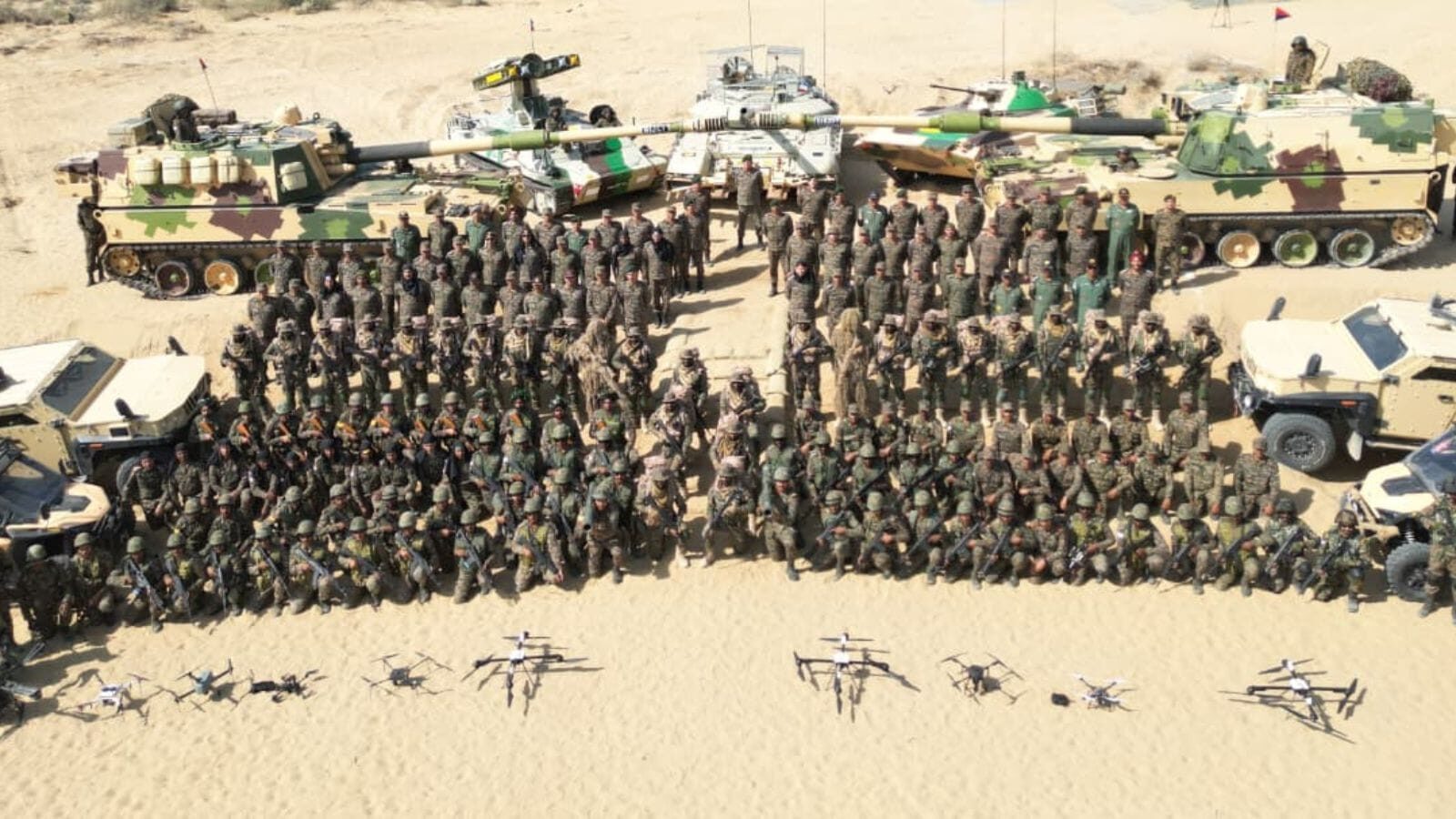
Participants of Akhand Prahar Exercise, the ‘Bhairav’ personnel in the middle
Other tricks up India’s sleeve
New Delhi’s ambitions extend beyond drone battalions. The Indian command also plans to establish 15 to 20 ‘Shaktibaan’ regiments, which will be primarily composed of unmanned systems.
These formations have only recently been created, but senior military officials have high hopes for them. The new units are based on artillery regiments, but instead of focusing on cannons and missiles, they focus on the combat use of loitering munitions, surveillance UAVs, and swarms of drones. This will increase the Indian Army’s ability to hit targets up to 500 kilometers deep in enemy territory without risking the lives of fighter jet pilots.
As the creators of this reform planned, consolidating drones within artillery regiments will significantly reduce the time between when forward observers spot an enemy and when the gun crew fires shells. All of this can be achieved with minimal human intervention.

‘Shaktibaan’ regiment personnel
Another part of the transformation of the Indian army are the ‘Rudra’ brigades. These combined arms units include mechanized infantry, tanks, artillery, and special forces. They also have their own unmanned aerial vehicles (UAVs), usually from ‘Ashni’ platoons, but the main idea is their close cooperation with ‘Bhairav’ battalions. Combining the reconnaissance and surveillance capabilities of the ‘Bhairav’ with the firepower of the ‘Rudra’ will significantly increase India’s combat readiness in border regions.
These formations require a large number of UAVs, which is expensive. Until now, India has mostly relied on Israel and the United States in this area, purchasing their innovative drones. However, the government recently recognized the benefits of domestic production. Many giant state corporations and local start-ups have received contracts to create new types of UAVs or adapt existing foreign designs to the Indian environment. One example is the Combat Air Teaming System (CATS), an Indian unmanned aircraft currently under development by Hindustan Aeronautics Limited.

Concept picture of CATS
This UAV is designed for high-altitude surveillance and precision strikes from long distances, reducing human error and threats to life. It is intended to fully replace modern jet fighters and reconnaissance aircraft.
The company plans to finish the project by 2028.
Looking ahead, India’s trajectory points toward reforming this hybrid force by 2028–2030. While the ambitious plan to train 100,000 drone operators will likely encounter challenges related to training quality and technological absorption, it will fundamentally enhance UAV capabilities within the infantry. The success of the ‘Bhairav’ and ‘Shaktibaan’ units depends on India overcoming its reliance on foreign drone technology. The push for indigenous systems, such as the CATS program, is crucial for ensuring a stable supply and for overcoming unique challenges. In potential future conflicts with Pakistan or China, the opening moves will likely be dominated by drones and electronic warfare. The ‘Bhairav’ units will act as the forward eyes and scalpel, guiding the heavier firepower of integrated brigades. Ultimately, India aims to establish a sophisticated deterrent shield that raises the cost of aggression to an unattainable level for its rivals, thereby securing its borders through cutting-edge innovation.
MORE ON THE TOPIC:
i think one of things that binds india and russia together is their propensity for beautiful dreams that lead to mediocre results.
speaking of tech developments, its quite ‘impressive’ that russia had 17 rocket launches last year.
supposedly that is the lowest number of launches since gagarin flew in 1961.
another video shows an attack with geran-type fixed-wing suicide drones on a drone storage and launch site of kiev forces near the settlement of myronivka in the donetsk direction.………………… https://psee.io/8jqu9r
india and russia are binded by capitalism… china will defeat anyone that have the stupid idea of fight it! the future is communism! history repeats itself! russia will be communist again!
1961 – russia was socialist
another failure of roscosmos was of early warning sat constellation… completely gone!
absurd failure!
roscosmos is a midget compared to soviet union space agency!
iranian drones brought putler victory over ukraine.
for payment, putler betrayed syria.
that isn’t how it went. irans president was assassinated in the helicopter crash, then a liberal iranian got elected. the liberal president wasn’t willing to support the syria project at the level it required (due to the unpopularity of the assad regime in syria)
at the same time the arab league made overtures to assad. assad bought into those overtures, seemingly thinking it would bring an end to the war and syrias isolation. well it did, just not in the way he thought.
another video shows an attack with geran-type fixed-wing suicide drones on a drone storage and launch site of kiev forces near the settlement of myronivka in the donetsk direction.………………… https://psee.io/8laznc
it is much more complex then you present. also, russia is a relatively weak player and lacks the ability to project power as the americans can easily do. everything in syria didn’t revolve around russia.
the iranians were defective and stupid for not giving drones to the houthis and hamas. did these people really not see that russia is a jewish state and a collaborator of israel? armenia, syria, serbia and venezuela have already been betrayed by putler’s russia.
so that putler’s pigs would finally pay for their treacherous nature and for the murder of wagne.
now it’s iran’s turn. i can already imagine putler and the shah together in the kremlin. if nato would destroy and dismember russia.
very impersonal analysis don’t reflect feeling’s of communities loyalties sympathies securities or pretences . history does . people are not machines regardless of how much certain persons would like them to behave as such . i know a lot of indians . they don’t forget their history.
this is confusing. india is a brics member. with the changes in drone based warfare india my just be updating? the globalists likely have many agents in india considering israeli businesses assets provided many arms and security platforms to india for years
one thing for sure, nothing is a surprise. if they can pit india against china. russian oil exports figure in the globalists plans. and india will need more in the future
china launches +90 rockets last year…
china is close to nuclear fusion…
soviet union liberated europe from nazi germany in less time than “svo” !
soviet union was a behemot of science, tech, military and space exploration!
soviet union was never humiliated like russia are, in sports and other scenarios!
communists do it better!
make russia socialist again!
weird comparison with half-true statements out of context and chronology. several nations are “close to” nuclear fusion.. for 10+ years by now. oh, it worked in the tsar bomb 65 years ago, but it doesn’t work in a reactor. with all the low-hanging tech-fruit already in the harvest of humanity, not even a super-smart super-ai is making progress in technology, even though it was loudly promised it would do so.
china is dying to conquer india so that they can ‘save’ the indians and triple india’s per capita gdp to match that of the tibetans and uighurs that china is allegedly ‘genociding’…
with a score of 25.8 in the 2025 global hunger index, india has a level of hunger that is serious.