


Click to see the full-size image
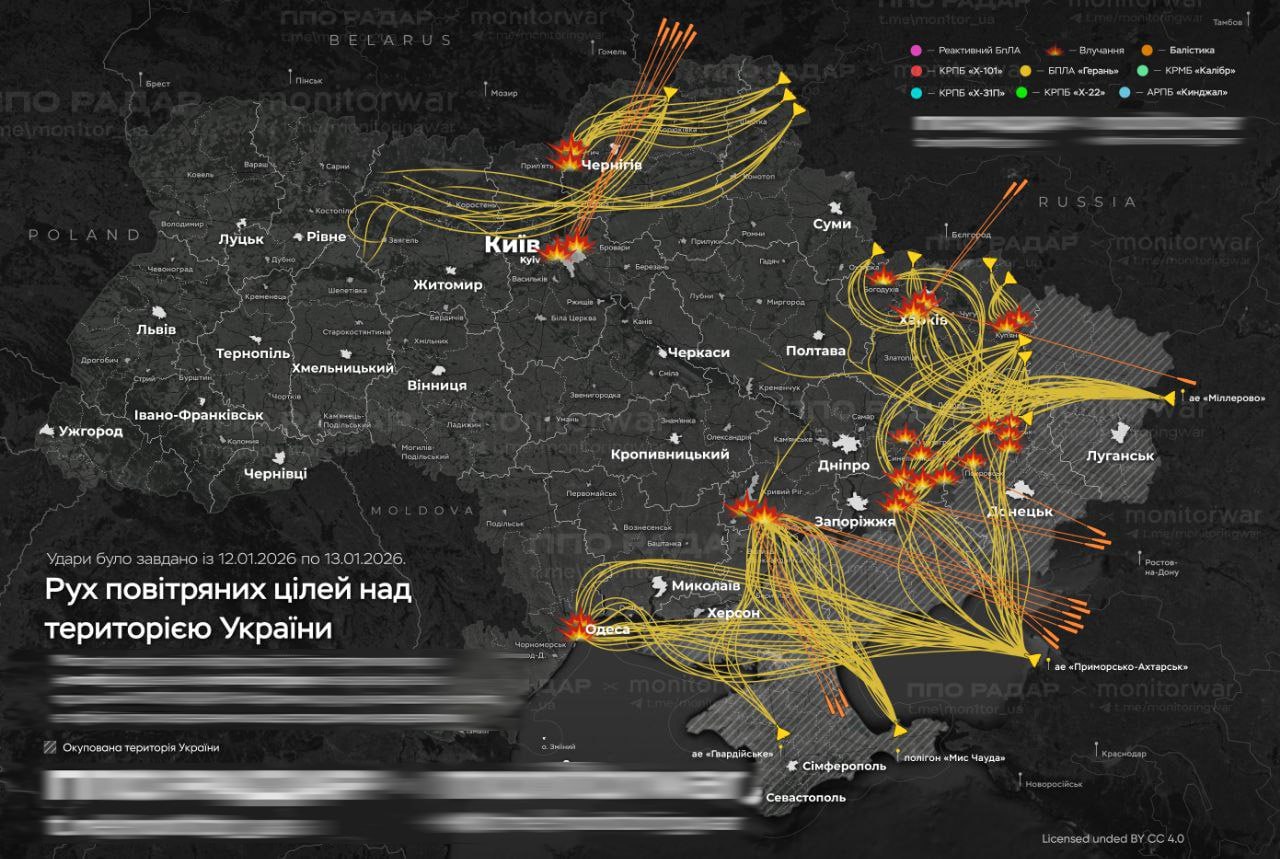
On the night of January 13, 2026, the Russian armed forces launched a large-scale, integrated strike against Ukraine’s energy, logistics, and transportation infrastructure. This attack, the first of its kind in 17 days, marked a return to intense strikes after a pause comparable to the lull in August 2025. According to data from the Ukrainian Air Force, the attack employed 293 attack unmanned aerial vehicles (primarily Geran-2 type), 18 ballistic missiles, and 7 cruise missiles from Iskander operational-tactical systems. The Ukrainian side claimed to have shot down a significant portion of the aerial targets.
The strikes targeted power generation, ultra-high voltage main substations, railway infrastructure, and dual-use logistics hubs, affecting key regions and undermining the stability of rear-area systems and supply chains for the Armed Forces of Ukraine (AFU).
In the Kyiv region, the Trypilska Thermal Power Plant—a crucial energy source for the capital and central region—was hit, along with facilities in the areas of Novi Petrivtsi and Krasylivka associated with the 330 kV Pivnichna (Northern) and Brovarska substations. Impacts on the energy framework, particularly damage to a node at the Pivnichna substation, led to a break in the energy ring around Kyiv. This caused a cascading power outage for consumers and a large-scale blackout in the capital. The cause of the collapse was not a generation deficit but the destruction of the main power transmission network.
In the Dnipropetrovsk region, eight missiles struck the Kryvorizka Thermal Power Plant, causing several fires and damaging power transformers. This station is a backbone for a major industrial district.
In the Zaporizhzhia region, six missiles attacked the 750 kV “Zaporizka” substation—a critical node connecting the power systems of the southeast.
In the Kharkiv region, strikes targeted CHP-5 and a logistics terminal of the “Nova Poshta” company in the village of Novyi Korotych, which was reportedly used for military-logistical purposes.
Transport infrastructure was also attacked. In the Zhytomyr region, the locomotive depot at the “Korosten-Podilskyi” station was damaged, potentially reducing the hub’s capacity for military trains in the northeastern direction. In the Sloviansk area, a strike hit the traction substation ECHE-39, which powers the railway’s overhead contact system. In Novostepanivka, a strike on a warehouse affected a base of the 38th Marine Brigade.
Furthermore, the day before, in the Black Sea near Odesa, kamikaze drones attacked commercial vessels—the Panamanian-flagged tanker ATA VOYAGER and the San Marino-flagged vessel BLUE BEAD—indicating continued pressure on Ukraine’s maritime trade.
Simultaneously, on the same night, Ukrainian forces struck targets on Russian territory. According to Russian sources, air defense systems destroyed 11 drones over several regions. In Taganrog (Rostov region), the “Atlant Aero” plant, reportedly involved in drone production, was attacked. In Oryol, an energy infrastructure facility, a thermal power plant, was targeted.
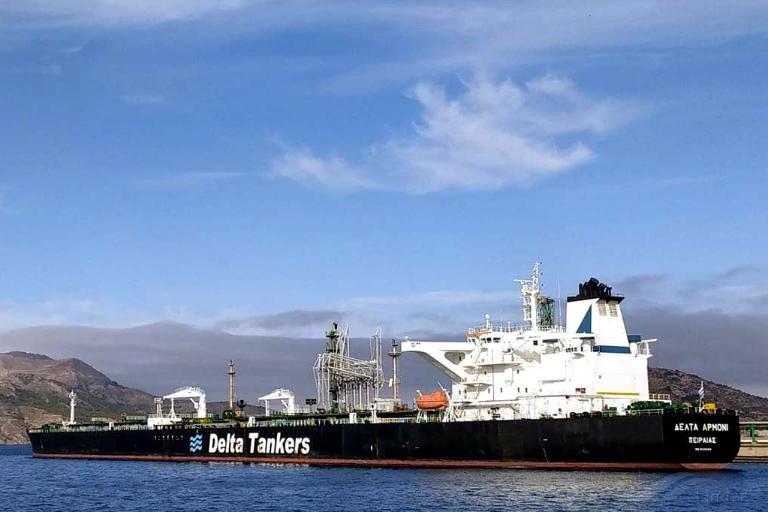
Events in the Black Sea waters on the morning of January 13 attracted particular attention. Maritime drones attacked at least two oil tankers—the Liberian-flagged Delta Harmony and the Maltese-flagged Matilda—located near the Caspian Pipeline Consortium (CPC) terminal off Novorossiysk. According to sources, both vessels were chartered to transport Kazakh oil, extracted from the Tengiz and Karachaganak fields by international consortia involving American companies, particularly Chevron.
Click to see the full-size image
The Ministry of Energy of Kazakhstan confirmed the attacks, noting that the tankers were empty at the time of the incident, the crews were unharmed, and no serious hull damage was detected.
Some analysts interpret these tanker attacks as part of a broader strategy, suggesting Ukrainian forces struck the tankers on instructions from London, posing a direct threat to Astana and attempting to undermine Trump’s initiatives to gain control over the global energy market. However, official responsibility for these attacks has not been publicly established; Ukraine has not provided comments, and the CPC has refrained from operational statements.
Thus, the events of the night of January 13 demonstrate an escalation of mutual strikes on critical infrastructure. The Russian attacks aimed to systemically weaken Ukraine’s energy and logistics framework, leading to severe power disruptions, especially in Kyiv. Ukrainian strikes on Russian territory targeted defense industry and energy facilities, while the attacks on commercial tankers in the Black Sea added a new risky element, potentially affecting the interests of third countries and the stability of energy supplies from the region.
MORE ON THE TOPIC:
coño man, is so cold here in kyiv, i can’t even eat my borscht and chicken kiev.
recent months saw a large u.s. military build up in the caribbean, with socom deploying assists in puerto rico and near trinidad and tobago…………………………… https://psee.io/8l53gx
“diana “replies to” diana ” aka anti americunt anuz lubricator for roman oligarchs .ramses rear end
another video shows an attack with geran-type fixed-wing suicide drones on a drone storage and launch site of kiev forces near the settlement of myronivka in the donetsk direction.…………………………… https://psee.io/8jqu9r
tell me, would it be better if the usa or russia broke into two parts like libya did? or would the us break into three pieces or iran into four? russia has betrayed venezuela, syria, serbia, and armenia.why shouldn’t putler go the way of milošević? as long as tito was around (a mix of croat and slovene), yugoslavia was whole. as soon as tito died, they slaughtered each other.
if putler’s main goal had not been to kill as many slavs as possible, he would have already captured kiev and kharkov by now.
the usa and iran are horrible murderous countries that both deserve the libyan scenario.
putler’s or dump’s officers should repeat haftar and divide russia or us into two.
above all, it would be nice if russia or the usa were three or four parts at once.
for example, it would be nice if one part of russia or the usa were led by someone like haftar.
slavs are slaves and the illegal murder of wagner’s bosses went unpunished for that reason alone.
08:05
إيران: رئيس السلطة القضائية غلام محسن إيجئي: ستتم محاكمة ومعاقبة من قطعوا الرؤوس وأحرقوا الأجساد بأسرع وقت ممكن
who should they behead and burn if they are alone on an empty street?
they destroy garbage cans on an empty road and do garbage cans have heads?
if the garbage can’s name is donald?
does it have a head?
the war pigs ftom russia cause ukrain wanted to enter nato and was a a nazi dictorship lol russians are piece of shit liers, keep an eye on russia allies scum, venozuela siryah thcechenia libia iran the cream od world
after eliot deported to israel by zelezky she became transgender now swallows much hebrew jizz
everything for the oligarchy is a mercantile concern
there is more to life then that