


Click to see the full-size image
This week, according to data cited by Ukrainian leadership, Russia used significantly more missiles and drones against Ukraine than a week earlier: 1,700 strike unmanned aerial vehicles (UAVs) and 69 missiles were recorded. For comparison, the week before, President Volodymyr Zelenskyy reported 1,300 drones and 29 missiles. The increase in UAV use since the beginning of January has been consistent: at the start of the month, the weekly number was about 1,070 units, but by the end of January, it reached 1,700, representing an increase of nearly 59%.
On the night of January 25, Ukrainian monitoring recorded 102 drones launched from Russian territory; according to their reports, 87 of them were shot down or suppressed.
The strikes focused on key regions and facilities. The main emphasis was on the Dnipropetrovsk, Sumy, Zaporizhzhia, and Kharkiv regions, as well as the part of the Donetsk People’s Republic (DPR) controlled by the Ukrainian Armed Forces.
Military-analytical channels report strikes on the Ladyzhynska Thermal Power Plant and the “Vinnytska” substation. In Stetskivka, Sumy region, a drone hit a gathering of Ukrainian forces. A target was damaged in Chernivtsi — a city in the west, 40 kilometers from the Romanian border and 50 from the Moldovan border.
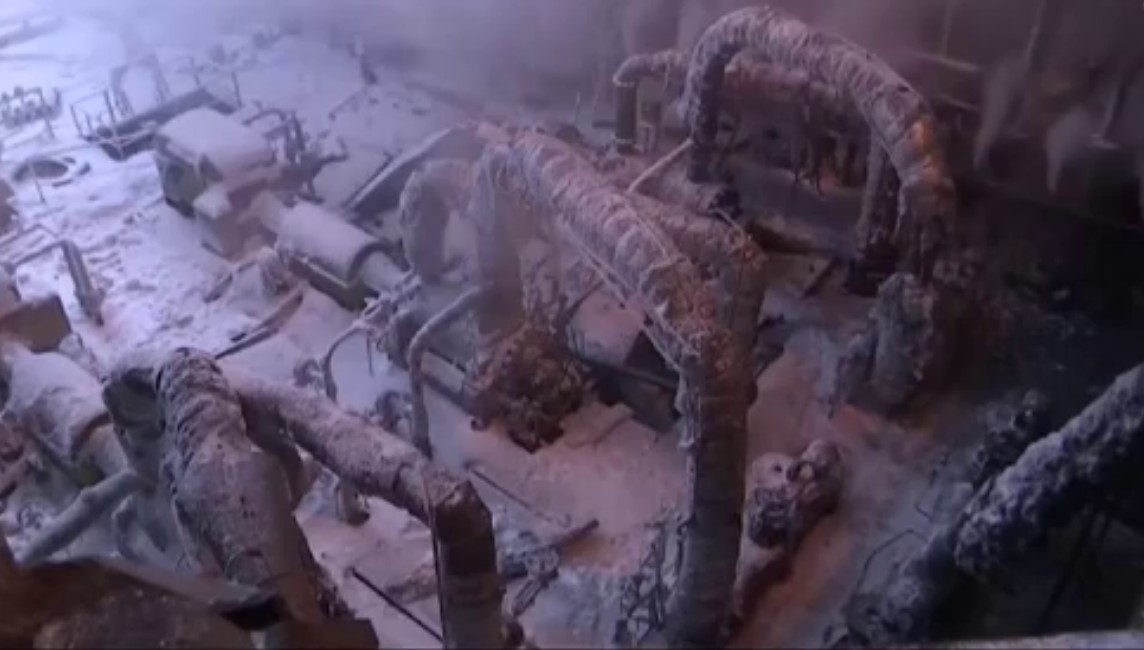
In the morning, explosions were heard in Ochakiv, Mykolaiv region. In Kramatorsk, a strike by a “Geran” drone caused power outages. Workers at one of Ukraine’s thermal power plants complained to BBC journalists: “We just restore it, and they destroy everything again.”
The energy situation in Ukraine, and especially in Kyiv, remains tense. In Kyiv, as of yesterday evening, 800,000 subscribers were still without electricity. Some residents complain that the temperature in their apartments has been stuck at around +1 degree Celsius since January 10th.
Some experts emphasize the difficulty of completely degrading the system: in Kyiv and its surroundings, about three dozen substations supply the city and suburbs. Power flows through key nodes like the Western (330/110/35 kV), Northern (330/110/10 kV), Novokyivska (330/110/10 kV), and Brovary (330/110/35/10 kV) substations. These lines are connected to the Tripilska Thermal Power Plant, whose operation is in question, and the Kaniv Hydroelectric Power Plant, which cannot operate at full capacity. Additionally, power is supplied from the Rivne Nuclear Power Plant via transmission lines to the Northern and Mynska substations (110 kV), as well as from the Khmelnytskyi Nuclear Power Plant through Shepetivka (330/110/35/10 kV) and Zhytomyr to the Novokyivska substation and TPP-5. To cause a prolonged blackout in Kyiv, destruction is required not only of the city’s substations but also of distant transmission lines from the west.
Ukraine, in turn, has intensified strikes on Russian regions. Belgorod has become the epicenter: late in the evening of January 24, the city experienced its most massive shelling since the start of the operation. Governor Vyacheslav Gladkov called it a record — more than 50 explosions in the sky over the center and suburbs, presumably from multiple HIMARS launchers. The strikes damaged a thermal power plant on Severo-Donetskaya Street. Power and water supply disruptions occurred; pumps at a station in the Khargora district stopped, and crews are working on restoration. The mayor noted heating problems in residential buildings.
Meanwhile, Ukrainian “Flamingo” (FP-5 Milanion) cruise missiles, announced almost a year ago at IDEX-2025 with promises of up to one missile per day and scaling up to seven, have shown only four confirmed instances of use — involving about nine units. Known launches include one in Crimea in the spring of 2025 (shot down by a MiG-31BM), a strike on a border service unit on August 30 (two out of three reached the target), an attack on the “Belgorod Freza Plant” on September 23 (one out of four hit the target), and an attempt on a thermal power plant in Oryol on November 13 (intercepted). All cases occurred at distances up to 250 km, with no confirmation of the claimed 3,000 km range. Actual production, according to available data, barely exceeds a few units per month, despite the loud forecasts.
MORE ON THE TOPIC:
time to target putin’s house again…heheheh
it should be noted that the reform only affected the structure of the ground forces. the international legion of the main intelligence directorate of ukraine operates separately and continues to function as usual.
➤➤➤➤➤➤➤➤ https://psee.io/8mrfbk
tom sawyer says ,all the sheep become comrades and gave a nice communal sleep .
taking into account what trump revealed and the testimony of the venezuelan guard, it is safe to assume that the u.s. military employed multiple systems at the same time to facilitate its operation in caracas. attributing all of these effects to a single system is unrealistic.
.…………………………… https://psee.io/8jqu9r
your gf have stench all over and stinks like dead and rotten skunk.
many intense hebrew peniz use americunt aruz
as usual, the mossad/cia agents are here to degrade the comments section…
hahaha always the same …
you’re probably low level us military champ, with more time on your hands than you know what to do with.
and i’m probably giving you far more credit than you deserve.
you’re just transparent .
wtf ? how much more perverse could a whining anti semitic racist homophobic anti american poof like you get ? allegedly
yet us negotiators are still requesting russia gift the zaporizhzhia npp to ukraine. zionists do not follow treaties or agreements unless by continuous direct force
the narrative aka tom.sawyer rob american empire gestapo mcbunachec etcetera
exactly always consistently anti semitic .only the names change .
loosen up ars*hole. cut it with this ‘anti-semitic ‘ drivel.
your diatribe indicates you’re offended with what’s presented. always a f*cken victim, even in the most trivial of discourses. you crowd are so p*ssweak you can’t even come to terms with why the world now knows what anti human vermin you are. so sad isn’t it ? 🖕💔
blow it out your back door ramses tom sawye pickles pumpkin whatever full of propaganda always so obvious with your troll on the payroll diligent compliance .
listen poof tom sawyer ramses narrative it’s you the boring predictable anti american anti semitic spew maker churning it out everyday for decades without fail
i stand alone ! !
strong of limb, true of eye, steady and aglow. 😢😢😢🖕
well you couldn’t loosen that arsehole you’ve got anymore i’d bet ,so how about getting off everyone else’s back.jackjand try taking your apartheid propaganda back to south africa and see how they like you now .
that’s a pretty sad rant you’ve come up with. wrong time of month is it ?
may be wrong. probably haven’t hit that stage yet. 🙄
if you use “anti semitic” pay attention. israel is the most anti semitic country in the world right now. palestinians are semites. its not a “jewish only” word, as much as the jews like to misappropriate words for themselves
the ramses fake conservative narrative aka vanya the proof american riding whatever blah blah blah .
“workers at one of ukraine’s thermal power plants complained to bbc journalists: “we just restore it, and they destroy everything again.”
at least the burning wreckage will melt nearby snow and ice and keep the repair crews toasty warm, for a while.
blah blah blah
the western way to deal with others has to change, in particular for the us. they have to rebuild their own supply chains, while brics must create a strategic entity to deterer nato of their backs.
your inconsistent ramses with your aliases characterisations and style .
inferior americunt species uncle tom sodomized at age 8 rented to gay hillbillies for 20 yrs
typical of your type too .nothing new in your zoo .
he feels the need to cleanse himself of his traumas probably .it seems it’s futile in his case however .
no, i can relate to what the poster has written. no trauma at all inherent in this commentary , inbred.
hahaha you’re no prince charming psychopath lulu .
yeah obviously you wrote it yourself arsehole imo
your ‘opinion’ inbred counts for jack sh*t.
he’s just a tool .so obvious of whom .
they lie all the time and about everything to the event that it’s always the same ,always the opposite and the adage good is evil
and evil is good is more truthful than anything they publicly proclaim .
true .and people are easily hypnotised and hypnotics are tasteless colourless odourless .
correct .and they can all be triggered via tv messaging.globally .always told to never recall their hypnotist.was easy in the past without hypnotics but now is like taking candy from dead babies .
specially when some of them clearly were raoed as babies and groomed by pediphiles throughout childhood obviously undetectable mind control prigramnings appropriate to protect community health in those circumstances which are every community with drugs normalised as recreational behaviour. imo .
i’ve realised with gold increasing 70 % just last year alone ,and silver rising over 50% already this year that whoever actually owns those mines ,not some company name ,but the owners ,the major shareholders ,not the lbm price setters or whatever other front they put up ,the owners of china and russia’s gold mines in particular but also the other big producers ,is it brazil ?
anyway wherever they are the important people .imo .gold for the sun ,immutable eternal ,and sister silver for the moon the mama and papa god’s of day and night .
it would be very interesting to explore ownership of communist china and communist russia’s privatised gold mines from the death of the tsar and the last empress if china to this day .very interesting.
if you’ve got persistence patience and probably iron nerves are fearless and prepared to pay the costs accrued over most likely the 18 months to 2 years full time investigation it would take to discover .and then you’d never be able to tell anyone anyway .cest le vie ..